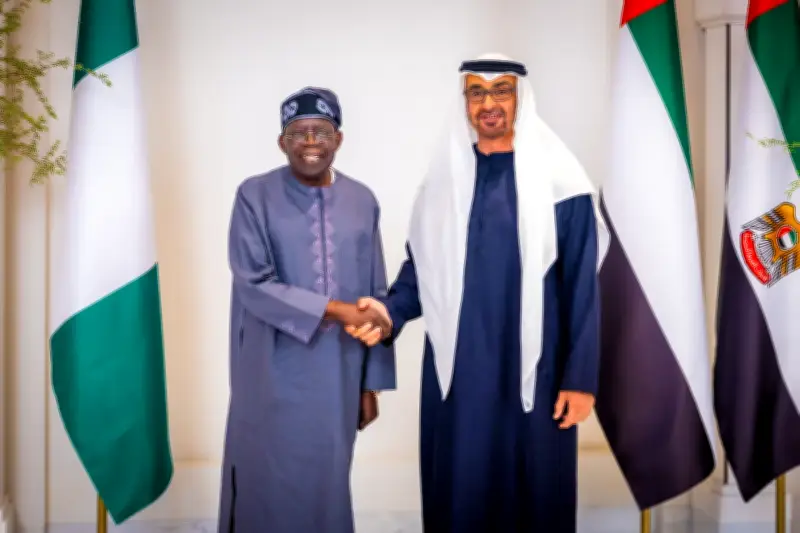
A viral social media post comparing Nigeria's debt to the United Arab Emirates' (UAE) net worth has been found to contain significant inaccuracies, according to a fact-check by Premium Times. The post, shared on X by user @felixherbt on 25 June 2026, claimed that despite discovering oil two years earlier, Nigeria is $500 billion in debt while the UAE is worth $700 billion.
Post Attracts Widespread Attention
The post quickly gained traction, amassing over 370,000 views, 23,000 likes, and more than 7,000 reposts as of 2 July 2026. It sparked a heated debate, with many users attributing Nigeria's economic struggles to poor leadership. User @chopsdaddi wrote, "The UAE has only oil and tourism. They don't even tax their citizens. Nigeria has oil, agriculture, tax revenue, mineral deposits, and a large workforce. But a bunch of fools at the top who do not know how to harness potential." Another user, @NigVoteWatchers, commented, "The difference is leadership! UAE is blessed, while Nigeria is cursed with leadership." The claim also circulated on Facebook.
Verification of Oil Discovery Dates
Premium Times broke the claim into three parts for verification. The first part, regarding the timing of oil discoveries, was found to be accurate. According to Nigeria's Federal Ministry of Petroleum Resources, Shell-BP made the first commercial oil discovery at Oloibiri, Bayelsa State, in 1956. Records from the Abu Dhabi National Oil Company (ADNOC) confirm that Abu Dhabi's first commercial oil discovery occurred in 1958 at the Murban Bab oil field, two years after Nigeria's discovery.
Nigeria's Debt Figure Inflated
The claim that Nigeria's public debt stands at $500 billion is false. According to data from Nigeria's Debt Management Office (DMO) published on 13 April 2026, the country's total public debt as of 31 December 2025 was $110.97 billion (N159.28 trillion). This figure includes domestic and external debts of the federal government, 36 states, and the Federal Capital Territory. The claim inflates Nigeria's debt by more than three times the official figure.
UAE's Net Worth Understated
The post also understates the UAE's net wealth. The claimant suggested the UAE is worth $700 billion, but Gulf News reported in December 2025 that the UAE's total net wealth had reached $3.12 trillion, comprising $1.15 trillion in financial assets and $2.18 trillion in real assets, according to Boston Consulting Group (BCG) data. The $700 billion figure may have been sourced from the 2026 BCG Global Wealth Report, but that data refers to separate sub-metrics—private wealth of UAE residents and assets under management at the Dubai International Financial Centre—not the country's total net worth.
Flawed Comparison of Economic Indicators
Beyond the inaccurate figures, the post compares two different economic measures: Nigeria's public debt against the UAE's net wealth. Paul Alaje, Chief Economist at SPM Professionals, told Premium Times that such a comparison is economically misleading. He noted that isolating Nigeria's debt without considering debt servicing, government revenue, and foreign reserves does not present an accurate picture. He pointed out that the United States and China carry far higher debt than Nigeria yet maintain significantly better quality of life, indicating that debt stock alone is not determinative.
Alaje also highlighted structural differences: "While they are investing in capital, Nigeria sometimes invests in consumption." He noted that the UAE borrows to fund "measurable infrastructure and development while Nigeria has borrowed to pay salaries."
Muda Yusuf, former Director-General of the Lagos Chamber of Commerce and Industry and CEO of the Centre for the Promotion of Private Enterprise (CPPE), added that economic outcomes cannot be explained by the timing of oil discoveries alone. Differences in governance, investment climate, policy consistency, and oil-sector management are key factors. "That is where we missed it when we compared Nigeria with the UAE," he said.
Conclusion
While the dates of commercial oil discovery for Nigeria and the UAE are correct, the figures for both countries' net worth and debt profiles are misleading. The claim that Nigeria has $500 billion in debt is false; the actual figure is $110.97 billion. The UAE's net wealth is $3.12 trillion, not $700 billion. The comparison itself is flawed, as it mixes different economic indicators and ignores broader context.