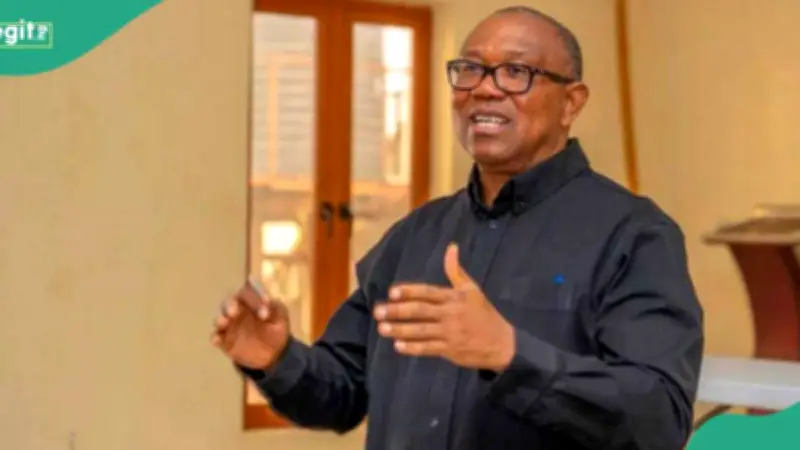
Peter Obi, the presidential candidate of the Nigeria Democratic Congress (NDC) for the 2027 general elections, used Nigeria's 66th Independence Day on Thursday, October 1, 2026, to paint a bleak picture of the country's social and economic conditions. Obi cited a string of statistics on poverty, hunger, education, employment and public health.
Obi's Independence Day Claims
The former Anambra state governor said more than 140 million Nigerians are currently living in poverty and severe hardship. He added that Nigeria has over 18 million out-of-school children, that more than 40 million Nigerians will face extreme hunger by the end of 2026, and that youth unemployment and underemployment affect over 35 million people. He also said Nigeria's drug abuse rate stands at 14 per cent against a global average of six per cent, and that life expectancy in the country is 54 years compared with a global average of 74 years.
As reported by Daily Trust, a review of available evidence shows that several of his claims are broadly supported, but others are overstated or rely on figures that are not directly comparable.
What the Data Shows on Poverty
The National Bureau of Statistics (NBS) placed 133 million Nigerians, 63 per cent of the population, in multidimensional poverty based on a survey conducted between November 2021 and February 2022. No newer official national survey has pushed that figure above 140 million.
More recent monetary poverty estimates come closer to Obi's figure. The World Bank's April 2026 Nigeria Development Update put roughly 140 million Nigerians below the national poverty line in 2025, while PwC's 2026 West Africa Economic Outlook projected about 141 million people living in poverty in 2026. Both projections relied on data from the 2018/19 and 2022/23 Nigeria Living Standards Surveys. Crucially, monetary poverty and multidimensional poverty measure different things and cannot be used interchangeably.
Hunger, Education, Employment and Health Figures
On food insecurity, the United Nations Office for the Coordination of Humanitarian Affairs, the UN Population Fund and the World Food Programme all project that nearly 35 million Nigerians will face acute food insecurity during the 2026 lean season, including about 5.8 million people in Borno, Adamawa and Yobe states. Obi's figure of over 40 million therefore appears higher than current UN projections.
UNICEF's 2024 assessment found 10.2 million primary-school-age children and 8.1 million junior-secondary-school-age children out of school, giving a combined total of about 18.3 million. This is consistent with Obi's claim, though the figures cover specific age groups rather than all children outside school.
On drug use, the National Drug Law Enforcement Agency cited a 2018 NBS survey that found 14.4 per cent of Nigerians aged 15 to 64 used at least one psychoactive substance in the previous year, supporting Obi's 14 per cent figure, though the data is now eight years old.
The World Bank lists Nigeria's life expectancy at birth at 54 years in 2023, but the World Health Organisation puts the figure at 63.4 years for 2021, with global life expectancy at 71.4 years rather than 74. Obi's broader point on low life expectancy holds, but the precise comparison he offered is not uniformly supported across datasets.
Verdict on Obi's Claims
The overall verdict on Obi's Independence Day claims is partly true with qualifications. The broad picture of widespread poverty and hardship in Nigeria is well-documented, but several of his specific figures either draw on data that is not current or combine measurements that capture different aspects of deprivation.
Earlier, Legit.ng reported that Obi made the pledge in his Independence Day address delivered in Abuja. Obi promised to make governance measurable and accountable, with Nigerians seeing tangible impact within his first year in office. The NDC candidate also criticised the APC-led government over deepening poverty, insecurity, and out-of-school children across Nigeria.