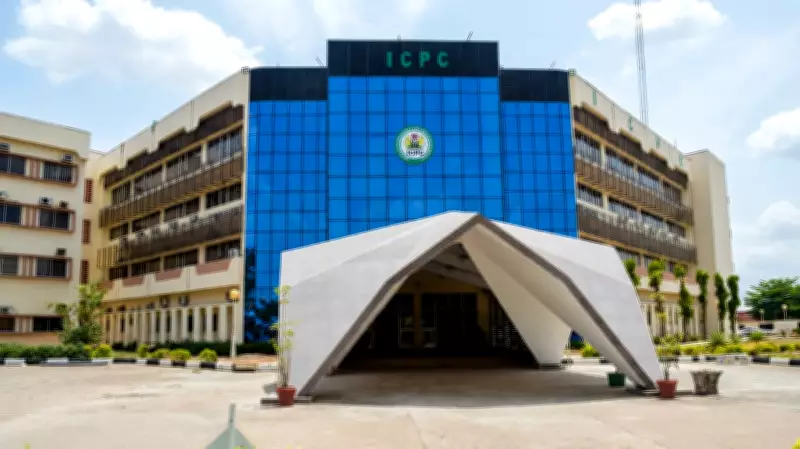
The Independent Corrupt Practices and Other Related Offences Commission (ICPC) has defended its access control procedures at its Abuja headquarters, describing allegations of inhumane treatment and denial of access to detained former Kaduna State Governor, Nasir Ahmad el-Rufai, as “false and misleading.”
ICPC Clarifies Distorted Narratives
The Commission’s Deputy Director and Head of Media and Public Communications, J. Okor Odey, stated on Monday that the ICPC was compelled to clarify what it called distorted narratives circulating in the media regarding the treatment of persons in its custody.
The controversy followed the circulation of a Hausa-language video interview since Friday night, in which a woman identified as one of el-Rufai’s wives alleged that ICPC operatives denied her entry into the Commission’s headquarters around 7:00 p.m. to deliver food to her husband. She also alleged that the Commission violated a court order granting family access to the detained former governor and denied him access to food.
ICPC Rejects Allegations
However, the ICPC rejected the allegations, insisting that its access control policy, which permits visitor access between 9:00 a.m. and 6:30 p.m., is a longstanding institutional protocol applicable to all detainees and visitors.
According to Odey, families of suspects and defendants in ICPC custody are routinely informed of the protocol and had complied with it prior to the incident in question. He disclosed that on the day of the incident, one of el-Rufai’s wives and a housemaid were granted access on at least three separate occasions between 10:30 a.m. and 5:30 p.m. to deliver food to the former governor.
“The records are clearly documented in the visitor register and available for independent verification,” he said.
Visiting Hours and Security Measures
The ICPC spokesperson further stated that the woman in the viral video admitted arriving at the premises around 7:00 p.m., which was thirty minutes beyond the approved visiting period. He added that the same woman also acknowledged in the interview that she had earlier delivered both breakfast and lunch to her husband, thereby contradicting claims that the former governor was denied food.
Odey stressed that the Commission permits authorised visitors, including family members, lawyers and medical personnel, to visit persons in custody, but maintained that no visitor is allowed entry after 6:30 p.m. under its standing security regulations. He noted that given el-Rufai’s status as a high-profile and politically exposed figure who had served as a federal agency director-general, minister and governor, the Commission was obligated to enforce heightened security measures for his safety and that of others within its custody.
Medical Access and Standard Procedures
On allegations that medical personnel were denied access to the detained former governor, the ICPC clarified that officials merely requested proper identification and confirmation from the detainee before granting supervised access, describing the process as standard operational procedure.
The Commission also revealed that el-Rufai had recently been granted permission to visit both his dentist and eye doctor on separate occasions under official escort, in addition to having access to the Commission’s in-house medical facilities.
The anti-corruption agency expressed concern that the disputed visit was conducted in the company of media personnel and outside the approved visiting hours, alleging that attempts were being made to dramatise the situation in order to circumvent lawful institutional procedures.
“The ICPC will not compromise its security protocols under any circumstances,” Odey stated. He reaffirmed the Commission’s commitment under the leadership of ICPC Chairman, Musa Adamu Aliyu, to the rule of law, protection of human dignity and equal application of institutional rules irrespective of status or political affiliation.