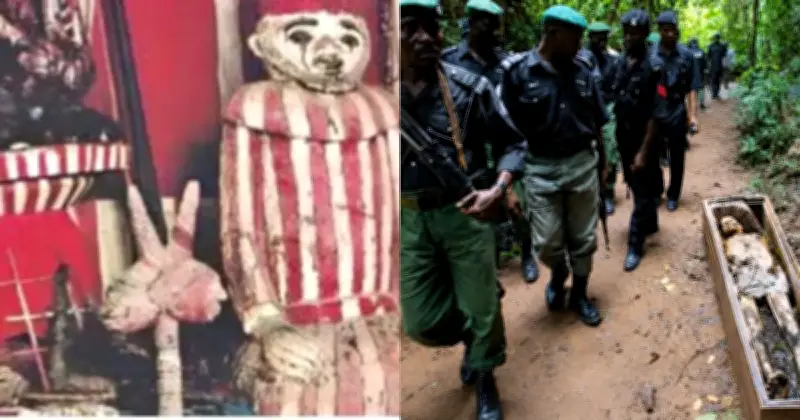
On August 4, 2004, a police raid on a forest shrine in Okija, Anambra State, uncovered a disturbing scene that plunged Nigeria into one of its most controversial scandals. Among the discoveries were dozens of corpses, human skulls and a register containing the names of people who had visited the shrine. The discovery raised disturbing questions about what happened in the forest and the people who sought the shrine’s intervention in their personal, business and political affairs.
The Discovery That Shocked Nigeria
Acting on a tip-off, Nigerian police officers stormed a complex of shrines in the wooded area of Umuhu Okija, where they made shocking discoveries. Human remains lay within the shrine complex. Some were in coffins, while others were scattered along paths through the area. Police investigations eventually led to the arrest of 31 suspects, who were connected to the discovery of 83 corpses, including 63 headless bodies, and 20 human skulls. The sight of the remains prompted speculation about ritual killings and allegations that the shrine had been involved in practices intended to secure supernatural power. However, the discovery of corpses and skulls did not establish that people had been murdered at the shrine.
The shrine’s operators claimed that relatives brought the bodies there after the individuals died elsewhere. According to beliefs associated with the shrine, anyone who died after breaking an oath was considered to have suffered the deity’s punishment, so their relatives brought the corpse to the shrine.
Inside the Forest Shrine
Located in Umuhu Okija, in Ihiala Local Government Area of Anambra State, the shrine was known as a place where people took disputes over land, business transactions and personal disagreements for spiritual adjudication. Visitors believed the shrine could determine who was telling the truth and punish anyone who swore a false oath. The shrine also reportedly served as a place where people could formalise agreements and settle disputes outside the conventional court system. Its patrons were not limited to politicians. Traders, businessmen, and other community members also sought its intervention.
According to Bridget Obi, a former Anambra State commissioner who inspected the site after the raid, the shrine had a history that preceded the scandal. In a 2019 interview with PUNCH, Obi recalled the story of how a woman brought the shrine to Okija when she married a man from the community. According to the account, someone stole the woman’s cassava which prompted her to go to her community and return with the deity to Okija. The shrine subsequently gained a reputation for its supposed effectiveness. However, Obi rejected the argument that the activities uncovered during the raid represented traditional Igbo religion. “I believe they (priests) went the extra mile to use that place for ‘419’ (to defraud), extort money and deceive people,” she said.
The Names That Led Back to Powerful Nigerians
The Okija shrine scandal took a political dimension when allegations emerged that influential Nigerians had visited the shrine to swear oaths of loyalty. Among the figures whose names became associated with the controversy was Chris Ngige, who served as Anambra State governor from 2003 to 2006. In an interview with Vanguard published on August 9, 2025, Ngige recounted how he was taken to the shrine by force a few days before the 2003 governorship election. He said he was taken there at midnight without knowing their destination and was told that he had to swear an oath of loyalty. Ngige, however, said he did not personally take the oath. According to his account, he carried a Bible and holy water to the shrine, where another person volunteered to swear on his behalf.
Ngige’s political relationship with Chris Uba, who supported his emergence as the Peoples Democratic Party’s candidate, later deteriorated. Their dispute became one of the defining political crises in Anambra State, particularly over questions of political control and the influence Uba expected to exercise over the governor. On July 10, 2003, months after the governorship election, Ngige was abducted in a separate incident involving police officers and political associates. He was pressured to resign, and news of his purported resignation sparked a major political crisis before he regained control of the situation.
Chris Ngige’s account of being taken to the shrine against his will added another dimension to the story. His recollection raised questions about the pressure that powerful political figures could exert on those seeking their support and the expectations that could accompany such alliances. More than a disturbing discovery in a forest, the Okija scandal became a story about the hidden arrangements that can shape public life. It exposed the tension between the authority Nigerians entrust to elected officials and the private loyalties that may influence how political power is exercised.