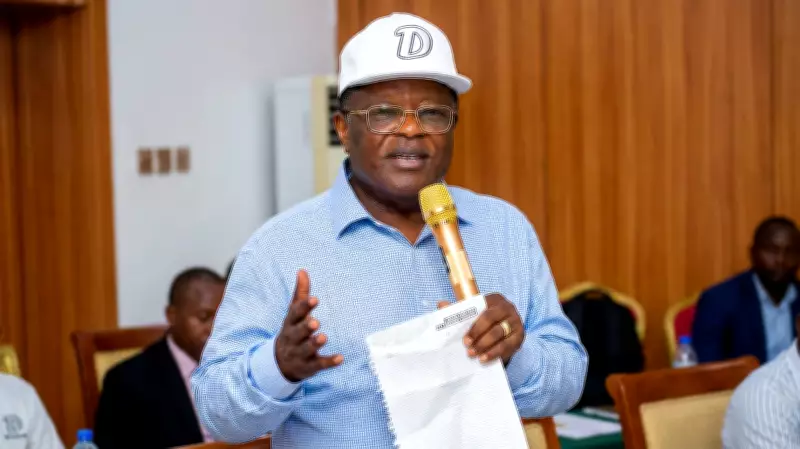
The Minister of Works, David Umahi, has stated that President Bola Tinubu is borrowing to fix Nigeria's roads, emphasizing that infrastructure is essential for security, commerce, and economic growth. This comes as data reveals Nigeria's external debt reached $51.86 billion by December 2025.
Umahi Defends Borrowing for Infrastructure
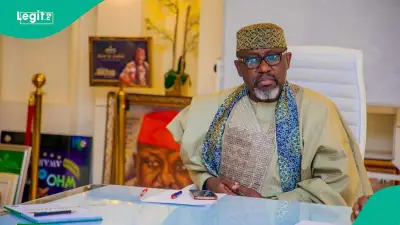
Speaking in Abuja during a visit by the Inspector General of Police, Olatunji Disu, to the Ministry of Works, Umahi addressed criticisms about the administration's borrowing. He said: “When people say, ‘Why is he borrowing?’ The President is borrowing so that our roads can be good. Infrastructure, roads, everything. Without roads, it’s difficult for the security agencies. Without roads, it’s difficult for commerce to thrive. Without roads, schools will be hindered.”
Since assuming office in May 2023, the Tinubu administration has accumulated an estimated N57 trillion to N65.9 trillion in new public debt, according to economic analysts and data tracking organizations such as the Alliance for Economic Research and Ethics (AERE).
Inherited Projects and New Initiatives
The minister explained that more than 80 percent of the ongoing projects, valued at about N34 trillion, were inherited from previous administrations, some dating back to 2000, 2015, and 2017. The President decided to retain them because they are critical to the country's economic revolution.
Umahi said the administration adopted reinforced concrete pavement to ensure durability, noting that completed roads would not require attention for 50 to 100 years. He highlighted four legacy projects: the Lagos-Calabar Coastal Highway, Sokoto-Badagry Highway, the Calabar-Ebonyi-Benue-Kogi-Nasarawa-Abuja corridor, and the Akwanga-Jos-Bauchi-Gombe-Biu-Maiduguri route.
Citing progress, Umahi said the 47.47-kilometer section one of the Lagos-Calabar Coastal Highway has been completed and is attracting investors interested in tolling and recouping funds for the government. He added that the President approved solar lighting for the entire 375-kilometer Abuja-Kaduna-Zaria-Kano road, with the first 118 kilometers already completed for N252 billion. The second section of 164 kilometers is expected to be finished by November.
Nigeria's Rising External Debt
According to figures from the Debt Management Office (DMO), Nigeria's total external debt rose significantly in 2025. By December 2025, Nigeria's total external debt stood at $51.86 billion, showing a 13.27 percent increase compared to the $45.78 billion recorded in December 2024.
The figures also showed growth within a short period. Between September and December 2025, external debt increased by seven percent, rising from $48.46 billion to $51.86 billion. This increase suggests that Nigeria continued taking new loans while also experiencing changes in debt values.
Major Creditors
The data revealed that Nigeria's external debt is heavily concentrated among a small group of international lenders and investors. The country's biggest creditors include:
- Eurobond investors – international investors who buy Nigerian government bonds issued in foreign currencies
- International Development Association (IDA) – a lending arm of the World Bank that provides financial support to developing countries
- African Development Bank (AfDB) – a major regional lender supporting development across Africa
- International Bank for Reconstruction and Development (IBRD) – another World Bank institution that provides development financing
Together, these major lenders dominate Nigeria's foreign borrowing profile.