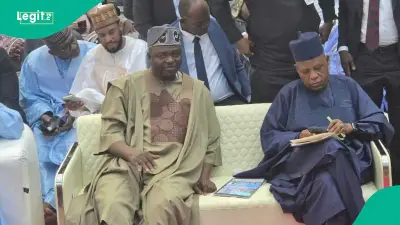
PDP Faces Significant Setback as Former Legal Chief Crosses to Ruling Party
The Peoples Democratic Party (PDP) has encountered a substantial political setback in Akwa Ibom State with the defection of its immediate past National Legal Adviser, Barrister Emmanuel Enoidem, to the All Progressives Congress (APC). This development marks a fresh blow to the opposition party in the crucial South-South region, where political alignments are increasingly shifting.
High-Profile Reconciliation Facilitates Political Realignment
Enoidem announced his decision to join the APC following a reconciliation process facilitated by Akwa Ibom State Governor Umo Eno with his former political leader, Senate President Godswill Akpabio. The move represents a significant mending of political fences, as Enoidem had previously contested against Akpabio in the last senatorial election for the Akwa Ibom North West Senatorial District.
Governor Eno led a high-powered delegation of political leaders to formally notify Akpabio of Enoidem's decision, describing the development as part of ongoing efforts to strengthen political cooperation within the state. The delegation's visit to Akpabio's residence in Uyo underscored the ceremonial importance of this political realignment.
Key Political Figures Hail Move Toward Unity
Senate President Godswill Akpabio welcomed the defection, emphasizing that efforts aimed at preventing conflict and fostering harmony were worthwhile and beneficial to Akwa Ibom State. In a statement by his Special Assistant on Media and Communication, Anietie Ekong, Akpabio commended Governor Eno for what he described as growing political unity in the state.
"Peace and cooperation among political actors will accelerate development in Akwa Ibom," Akpabio stated during the meeting. He further stressed that political engagement should extend beyond mere electoral contests, highlighting the importance of unity and peace for the state's progress.
Governor Eno echoed these sentiments, noting that stakeholders in Akwa Ibom had resolved to support President Bola Ahmed Tinubu and work collectively to promote stability and development. This declaration signals a broader political consolidation behind the ruling party at both state and federal levels.
Enoidem's Political Journey and Reconciliation
Emmanuel Enoidem brings considerable political experience to the APC, having served for eight years as commissioner during Akpabio's tenure as Governor of Akwa Ibom before rising to become National Legal Adviser of the PDP. His defection follows a period of political estrangement from his former mentor, which Governor Eno successfully mediated.
During the visit to Akpabio's residence, Enoidem expressed appreciation to Governor Eno for intervening to restore political ties between him and the Senate President. He described Governor Eno as a unifying figure and affirmed that despite past political differences, Akpabio remained his leader.
"I am ready to work with him and contribute to the development of our state," Enoidem declared, signaling his commitment to the new political alignment.
Formal Reception and Broader Political Implications
Enoidem is scheduled to be formally received into the APC at a rally in Utu Etim Ekpo, Etim Ekpo Local Government Area, on Friday, January 23. This event will cement his transition and demonstrate the APC's growing strength in Akwa Ibom State.
The defection occurs against a backdrop of similar political movements across Nigeria, including the recent joining of former Plateau State House of Representatives member Dachung Bagos to the APC. These developments suggest a trend of opposition figures aligning with the ruling party ahead of the 2027 elections.
Political analysts view Enoidem's move as particularly significant given his former role as PDP National Legal Adviser, a position that involved deep knowledge of the party's legal framework and strategic operations. His departure represents not just a loss of personnel but potentially valuable institutional knowledge for the opposition.
As Akwa Ibom politics continues to evolve, this defection underscores the fluid nature of political allegiances in Nigeria's democratic landscape and the ongoing efforts to consolidate power ahead of future electoral contests.