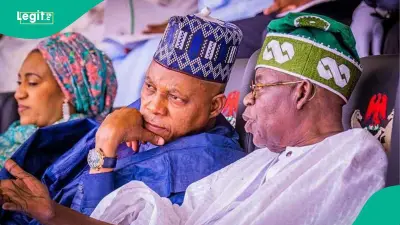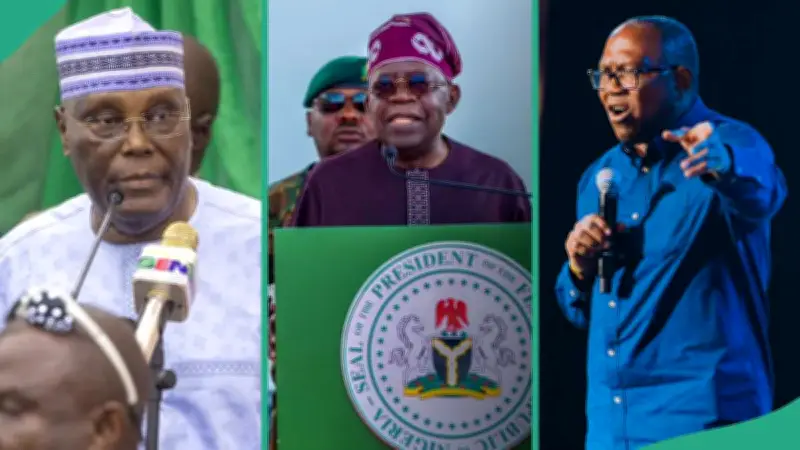
The Independent National Electoral Commission (INEC) has formally released the personal particulars of all candidates contesting the 2027 presidential and National Assembly elections. The documents were displayed at INEC offices in local government headquarters nationwide, granting public access to each candidate's full name, gender, residential address, educational qualifications, and professional experience. This publication is a direct requirement of Section 29(3) of the Electoral Act 2026, which obliges the commission to make such details available within 21 days of receiving nomination papers. Additionally, the information of vice-presidential candidates was included in the same disclosure.
The list features the leading presidential contenders: President Bola Tinubu of the All Progressives Congress (APC), Peter Obi of the Nigeria Democratic Congress (NDC), Atiku Abubakar of the African Democratic Congress (ADC), and Omoyele Sowore of the African Action Congress (AAC). Their submissions reveal significant differences in how each candidate documents their academic history, a matter that has become a recurring theme in Nigerian electioneering.
Tinubu Repeats Omission of Early Schooling
Tinubu's submission once again omits any mention of his primary or secondary school education. The APC candidate lists only a Bachelor of Science degree, which he says he obtained in 1979, and attaches his certificate from Chicago State University (CSU). This mirrors his filing ahead of the 2023 presidential election, during which his CSU credentials became a subject of intense public scrutiny. Critics then alleged that the individual who attended the university was not the same person as the current Nigerian president, a claim that added to the controversy surrounding his qualification.
Interestingly, INEC's nomination form typically asks candidates to provide all academic qualifications from the earliest level upward. While Tinubu has not provided his basic-school details, the electoral act does not explicitly require disqualification for such an omission. This means his submission is formally compliant, but it is likely to renew debates about transparency in the 2027 campaign.
Obi Provides Comprehensive Academic Trail
In direct contrast, Peter Obi presented an unbroken academic record. The former Anambra State governor indicated that he completed primary school at Augustine's Primary School, Anambra, in 1973. He then finished his secondary education at Christ the King College in 1978. For tertiary education, Obi listed the University of Nigeria, Nsukka (UNN), stating that he graduated in 1984. He attached certificates for all three levels of education, making his submission the most thorough among the four main contenders.
Obi has consistently made transparency a central pillar of his political messaging. By providing a complete paper trail from primary school to university, he may be seeking to distinguish himself from rivals who have left gaps in their biographies. This full disclosure could resonate with voters who prioritize accountability in leadership.
Atiku and Sowore Leave Gaps in Submissions
Atiku Abubakar's file shows that he earned his First School Leaving Certificate in 1954 and his West African School Certificate in 1961. However, he did not name the schools he attended for either qualification, and he also failed to attach copies of those certificates. He did, however, include a Master of Arts degree in International Relations, which he obtained from Anglia Ruskin University in England in 2020. The absence of school names and supporting documents for his early education may make it difficult for voters to verify those claims independently.
Omoyele Sowore, the AAC candidate, stated that he received his First School Leaving Certificate in 1980 and his West African Examinations Council (WAEC) certificate in 1987. As with Atiku, his submission does not name his primary or secondary institutions. Notably, Sowore's file contains no mention of any first degree, but he attached evidence of a master's degree from Columbia University, earned in 2003. The lack of an undergraduate qualification is unusual, given his later enrollment in a graduate program at an Ivy League university.
What This Means for Voter Scrutiny
With the 2027 election scheduled to unfold in a deeply polarized atmosphere, the release of these documents provides an opportunity for voters to compare the candidates' educational histories side by side. The gaps in Tinubu's, Atiku's, and Sowore's submissions stand out against Obi's comprehensive record. While the law does not demand uniform disclosure, the differences are likely to shape public discussion about the integrity of the aspirants.
As the election cycle progresses, these particulars will be examined by journalists, political analysts, and ordinary voters who may use them to assess the credibility of those seeking to lead Nigeria. The INEC publication is a statutory step, but its broader impact lies in allowing the electorate to make more informed decisions at the ballot box.