
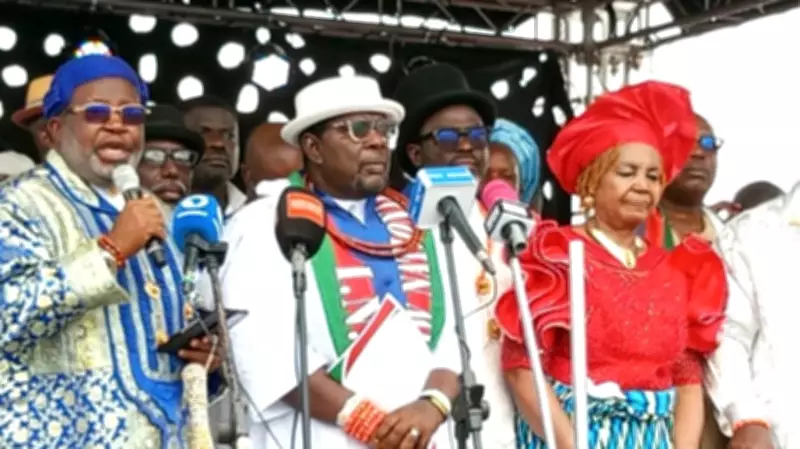
The inauguration of a new leadership for the Ijaw National Congress (INC) in Warri has rekindled debates on restructuring, resource control, and the political future of the Niger Delta. Ijaw leaders renewed longstanding demands for additional states, expanded local government areas, and stronger internal unity during the event held on Thursday.
The ceremony marked the formal transition of leadership from outgoing President Benjamin Okaba to newly elected President Macdonald Igbadiwei. It drew traditional rulers, political leaders, professionals, youth groups, and delegates from Delta, Bayelsa, Rivers, Edo, Ondo, and Akwa Ibom States, underscoring the broad geographical spread of the Ijaw nation.
What began as a ceremonial inauguration quickly expanded into a wider political and cultural platform, with speakers revisiting long-standing grievances over marginalisation, environmental degradation, and economic exclusion in the oil-producing region. Despite the Niger Delta's central role in Nigeria's oil output and foreign exchange earnings, many contributors noted that Ijaw communities continue to grapple with poverty, unemployment, weak infrastructure, and ecological damage linked to decades of exploration activities.
New Leadership Vows Inclusivity
In his inaugural address, Igbadiwei described his emergence as both symbolic and historic, noting its significance as a return of INC leadership to the Western Zone. He emphasised that leadership must be rooted in service, sacrifice, and accountability, pledging to run an inclusive administration that unites all factions within the Ijaw nation.
A central issue at the congress was renewed agitation for the creation of Toru-Ebe State and Oil River State. Proponents argued that new states would address structural imbalance, improve political representation, and strengthen inclusion for Ijaw communities, particularly in Edo and Ondo States. Delegates also intensified calls for the expansion of local government areas in Bayelsa State, proposing an increase from eight to at least twenty-four. They argued that the current structure limits grassroots development, weakens political participation, and restricts access to federal resources needed for community advancement.
Economic Justice and Environmental Concerns
Economic justice dominated discussions, with participants insisting that the issue of resource control remains unresolved. Outgoing President Okaba reiterated that the Ijaw nation must intensify advocacy for greater ownership and control of resources derived from its territory. He argued that decades of oil extraction without corresponding development have deepened inequality in the region. He further declared that the idea of an "Ijaw Republic" reflects growing frustration over structural neglect, even as leaders stressed that their demands remain within constitutional and restructuring frameworks.
Environmental concerns also featured prominently, with speakers highlighting the continued degradation of farmlands, waterways, and fishing livelihoods due to oil pollution. They called for stronger environmental accountability and fair compensation for affected communities. The congress also addressed specific grievances in oil-bearing communities such as Ibeno in Akwa Ibom State, where leaders alleged that host communities have been denied recognition and equitable benefits from oil operations. They pledged to pursue lawful and constitutional means to secure justice and inclusion.
Cultural Identity and Unity
Cultural identity formed another key pillar of the gathering. Traditional rulers and cultural troupes appeared in colourful regalia, reinforcing calls for the preservation of the Ijaw language, customs, and heritage. Speakers warned that cultural erosion poses a long-term threat to identity, particularly among younger generations increasingly influenced by external cultures.
Across the event, unity emerged as a recurring theme. Leaders repeatedly cautioned against internal divisions, political rivalries, and personal ambitions that could weaken the collective struggle of the Ijaw nation. Okaba urged reconciliation among aggrieved stakeholders, while Igbadiwei promised an open-door policy that would accommodate all interests, including former rivals in the electoral process. "We are going to reach out to all who contested with us. The INC belongs to every Ijaw person," he said, stressing that inclusiveness would define his leadership approach.
Traditional rulers and elders reinforced this message, warning that disunity could undermine ongoing advocacy for restructuring, resource control, and political recognition. They urged stakeholders to prioritise collective interests over sectional or individual considerations.
Transparent Elections and Future Priorities
The election that produced the new leadership was widely praised for its transparency and peaceful conduct, despite earlier tensions and litigations. Delegates described the transition as evidence of growing democratic maturity within the INC and a sign of institutional stability. In his valedictory remarks, Okaba cautioned against attempts to impose leadership through "backdoor arrangements," insisting that the will of the people must be respected. He urged the incoming leadership to strengthen internal cohesion and preserve institutional credibility.
Igbadiwei outlined several priorities for his administration, including intensified advocacy for state creation, expansion of local governance structures, and renewed engagement with national institutions on issues of justice and equity. He also highlighted pressing challenges such as youth unemployment, environmental degradation, and cultural marginalisation. He reaffirmed the INC's commitment to enforcing Supreme Court judgments relating to ward delineation in the Warri Federal Constituency, insisting that legal rulings must be implemented to ensure fairness and stability in contested areas. He also announced plans to deepen international engagement, including partnerships with United Nations-related bodies and global institutions, to draw attention to Niger Delta issues and strengthen advocacy for development support.
Recognition of Peace Efforts
A notable highlight of the event was the widespread recognition of Government Ekpemupolo, who was commended by speakers for his role in promoting peace and stability in the region. He was described as a unifying figure whose influence has helped reduce tensions and strengthen coordination among Ijaw stakeholders. Some delegates credited him with contributing to relative stability in previously volatile parts of the Niger Delta, noting that his interventions have supported broader peace-building efforts and development initiatives across coastal communities.
Symbolism of Warri Venue
The choice of Warri as the venue added further political and symbolic weight to the gathering. As one of the Niger Delta's major oil and commercial hubs, Warri has long been central to debates on resource control, environmental justice, and ethnic representation. By hosting the inauguration there, the INC reinforced its commitment to grassroots engagement and highlighted the centrality of oil-producing communities to its advocacy. Leaders also described the location as a symbolic meeting point for Ijaw communities across Delta, Bayelsa, Rivers, Edo, Ondo, and other states. Warri's strategic significance also reflected the evolving political consciousness of the Niger Delta, where issues of inclusion, development, and representation continue to shape regional discourse. Culturally, the venue underscored pan-Ijaw solidarity, projecting unity across clan and state boundaries at a time when internal cohesion is seen as essential to sustaining political demands.
Igbadiwei thereby called for reconciliation, unity, and collective progress, urging stakeholders to rise above divisions and focus on building a stronger Ijaw nation. He emphasised that his administration would be judged by its ability to promote inclusion, defend rights, and improve the welfare of the people.
From demands for new states and expanded local governments to calls for environmental justice, cultural preservation, and stronger political unity, the congress reaffirmed that the Ijaw question remains central to Nigeria's broader debate on equity, federalism, and national restructuring. The inauguration ultimately served not only as a leadership transition but also as a renewed declaration of political identity and collective aspiration by the Ijaw nation within Nigeria's evolving federal landscape.




