
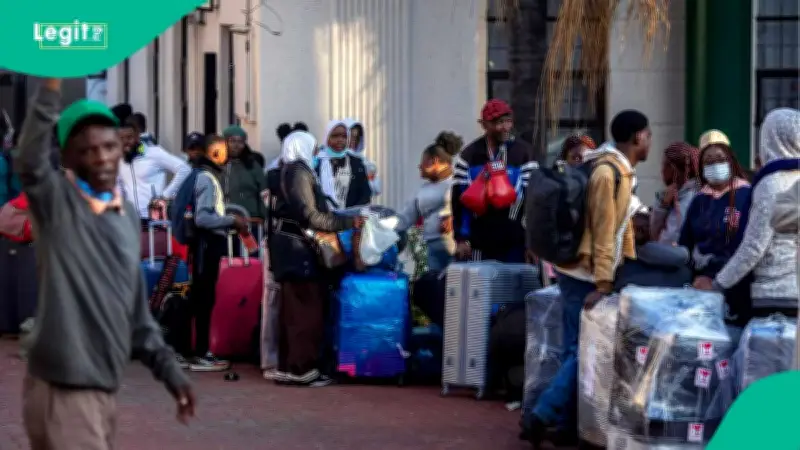
Nigeria is bringing back citizens from South Africa after xenophobia tensions, but what happens after they arrive is now the real concern. Lekan Olayiwola, a public-facing peace and conflict researcher, speaks on the greater struggle that begins once evacuation ends.
Beyond Repatriation Logistics
With more than 1,000 Nigerians opting for voluntary return from South Africa and evacuation arrangements underway, attention has understandably focused on safe return. Yet the more consequential question begins after touchdown. What happens when traders, transport operators, students and small-business owners who built livelihoods abroad must restart in an economy already struggling to absorb its own labour force?
The issue is beyond repatriation logistics. Return migration is not merely a transport exercise but an economic, social and institutional test of how effectively Nigeria can reintegrate citizens whose livelihoods, incomes and identities were shaped elsewhere. What is being left behind, what awaits returnees at home, and whether existing reintegration mechanisms are adequate now require urgent attention.
A Familiar Cycle
From previous waves of migrant returns from South Africa, Libya, Sudan, Niger, Mali, Chad, and the Central African Republic, Nigeria has repeatedly demonstrated an ability to organise emergency repatriation at short notice. What has received less sustained and systematic attention is the longer-term challenge of reintegrating those who return, particularly in terms of livelihoods, social adjustment, and sustained economic absorption once initial reception support ends.
Reception systems often emerge during moments of crisis, but institutional mechanisms for livelihood restoration, psychosocial support and labour-market absorption have generally evolved more slowly. The result is a recurring pattern in which the logistics of return receive immediate attention while the economics of reintegration remain a secondary consideration.
Leaving Behind More Than a Place
While repatriation discussion focuses on cross-border movement, migrants bring years of accumulated experience, social networks, entrepreneurial skills and economic investments. Nigerians in South Africa work across retail trade, transport, hospitality, informal commerce and small-scale enterprise. Even modest incomes there sometimes exceed what similar activities generate in Nigeria.
For many returnees, the challenge moves from relocation to economic adjustment. Individuals accustomed to one market environment must navigate another with different levels of purchasing power, opportunity and competition. Some will rebuild successfully. But reintegration is rarely immediate, and the gap between leaving one livelihood system and establishing another can create significant financial and social strain.
Home Again, but to What?
The central challenge for returnees is not arrival but absorption. Nigeria’s migration governance institutions, such as the NCFRMI working with the IOM, provide valuable reception, documentation and limited reintegration support. Yet assistance remains fragmented, often tied to funding cycles, eligibility rules or vulnerability classifications.
Many returnees therefore receive initial help but face a far less structured environment once reception ends. This creates a reintegration gap—the space between safe return and sustainable livelihood. The problem is acute for the “missing middle”: migrants who are neither refugees nor trafficking victims, yet struggle to absorb sudden losses of income, networks and opportunity.
From Rands to Reintegration
Economic adjustment is one of the most immediate realities confronting returnees. A Johannesburg trader returning to Lagos, Onitsha or Abuja faces different market dynamics, limited capital access and sharper competition. Workers accustomed to South African wage levels must recalibrate expectations in Nigeria’s labour market.
Though resilient and entrepreneurial, Nigeria’s economy is highly informal—about 80% of jobs are informal (ILO)—and marked by persistent pressures, with youth unemployment and underemployment exceeding 30–40% in national and World Bank estimates. Returnees therefore enter an environment already saturated with an army of job seekers.
The resultant economic strain means more people pursuing livelihoods in crowded spaces. This compression affects households and communities, depleting savings and reducing inflows, underscoring reintegration as a long-term process, not a single event.
The Human Side of Reintegration
Migration is often analysed through economic statistics, but return migration is equally a social and psychological experience. For many migrants, life abroad becomes tied to identity and social status. Returning under difficult circumstances therefore involves more than income loss; it may require rebuilding confidence, reputation and long-term plans.
Studies across multiple contexts, including IOM-supported return assessments, consistently highlight stigma, family pressure and uncertainty about the future as recurring challenges. Individuals once perceived as successful abroad may face expectations they cannot immediately meet upon return.
This dimension is often underappreciated in migration policy debates. Yet reintegration outcomes depend as much on social and psychological adjustment as on income. A trader restarting a business may require not only financial support but also mentorship, counselling and community networks that ease reintegration into local economic and social life.
Return Migration Approaches by Other African Countries
Ghana’s recent handling of citizens returning from South Africa illustrates the value of clear tracking, coordination and public communication. While no system is flawless, visibility gave returnees greater clarity about available support and next steps. The lesson is not replication but sequencing. Effective reintegration systems move through stages: reception, stabilisation and longer-term economic reintegration.
Predictability helps returnees rebuild more effectively when they understand support pathways. In Nigeria, mechanisms exist but remain dispersed across institutions, programmes and funding streams. Strengthening coordination may therefore prove as important as expanding resources, ensuring reintegration is structured rather than fragmented.
A Regional Challenge Requiring Regional Thinking
The current situation also raises broader questions about migration governance across Africa. Migration between African countries has long functioned as an economic safety valve, enabling labour mobility across regions with differing opportunities. However, periodic disruptions reveal the fragility of this arrangement.
Rather than treating return migration solely as an emergency response issue, African governments may increasingly need to view it as a recurring feature of regional mobility. This suggests opportunities for stronger cooperation between origin and destination countries, as well as regional organisations. Shared planning mechanisms, data exchange and coordinated reintegration frameworks could help reduce the disruptive effects of future migration reversals.
From Repatriation to Reintegration
The immediate priority is understandably the safe return of affected citizens. Yet repatriation is only the beginning of the journey. Nigeria could strengthen its response through a more structured reintegration framework built around three priorities.
First, returnees should be systematically profiled and skills-mapped upon arrival, aligning them with employment, entrepreneurship and training opportunities. Second, targeted livelihood support should help bridge the gap between arrival and economic stability, particularly for small-business owners seeking to re-establish themselves. Third, psychosocial support should become a routine component of reintegration rather than an optional add-on. Returning home may be physically straightforward; rebuilding a life is not.
A Harvest of Skills, Resilience and Experience?
None of these measures requires an entirely new bureaucracy, but rather a shift in perspective from treating return migration as a transport exercise to recognising it as a reintegration process. This implies better coordination between federal and state actors, clearer data systems, and stronger partnerships with development agencies already active in migration governance.
For many returnees, the real test begins not at departure, but on arrival, where stability must be rebuilt from disruption. As migration patterns across Africa continue to evolve, countries that prepare not only for departure but also for return will be better positioned to harness the skills, resilience and experience that migrants bring back. In that sense, repatriation is not the end of a journey, but the beginning of another.




