
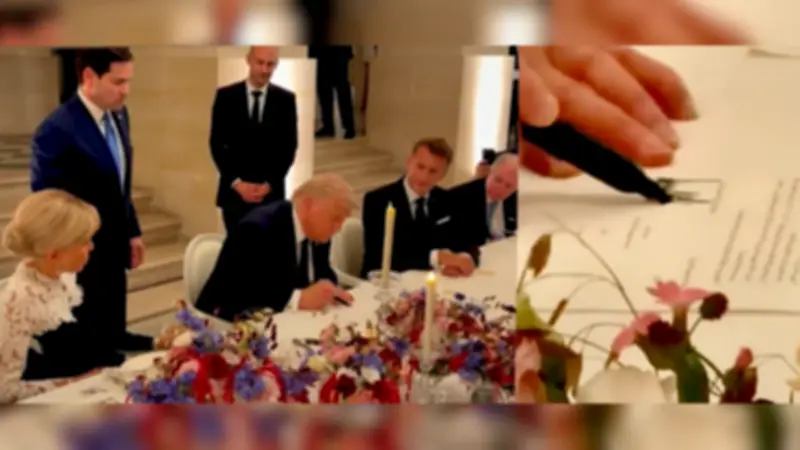
President Donald Trump has signed the memorandum of understanding between the United States and Iran to end the war. Trump signed the document shortly before the dinner hosted by French President Emmanuel Macron at the Palace of Versailles on Wednesday night, June 17.
Signing Ceremony Details
White House Deputy Chief of Staff Dan Scavino posted a video on X shortly after Trump left Versailles. Scavino stated, "Just prior to this evening's dinner at Versailles in France, hosted by President @EmmanuelMacron—President @realDonaldTrump signed the Iran Memorandum of Understanding, once Secretary Rubio received it… A pretty key moment in history we are sharing together… @SecRubio"
Iranian and US Signatures
Iran's president, Masoud Pezeshkian, also signed the agreement on Wednesday from Tehran. The US vice-president, JD Vance, is expected to sign the deal at a more formal ceremony in Geneva on Friday.
Reactions from Negotiators
Iran's chief negotiator, Mohammad Bagher Ghalibaf, commented: "The agreement is a record of US failure. People will see it and judge." Defending the deal, Trump said no US president had ever been as tough on Iran as him, and "there is nothing as smart as the market – and the market loves it."
Economic Implications
Trump argued that "the alternative would be a worldwide depression," stating that if he had not struck a deal, "the strait [of Hormuz] would never have been opened. They don't like floating billion-dollar ships up and down the strait when their rockets are flying overhead, and there are mines all over the place."
Nuclear and Financial Terms
Senior administration officials said the deal would help prevent Iran from obtaining a nuclear weapon, pointing to an agreement to discuss down-blending its 440kg stockpile of highly enriched uranium, which could be further enriched for use in a nuclear weapon. The deal provides important financial incentives to Iran, including the immediate lifting of a US naval blockade on Iranian ports and the issuance of waivers for Iranian crude oil to be shipped abroad, as well as the potential lifting of all international sanctions against Iran, the unfreezing of billions of dollars in Iranian assets, and plans to develop a $300bn (£224bn) reconstruction fund for Iran funded by regional partners in the Gulf.
Iran's Commitments
In return, Iran agrees to restrain its foreign allies, including Hezbollah in Lebanon, and "reaffirms that it shall not procure or develop nuclear weapons." The agreement also allows toll-free passage of ships for 60 days through the Strait of Hormuz. However, on Wednesday, Ghalibaf said Iran would charge ships travelling through the waterway at the end of the period stipulated in the memorandum of understanding. In an interview aired on state television, Ghalibaf said the "Strait of Hormuz will not return to prewar conditions," adding: "Iran has the right to sovereignty over the Strait of Hormuz and of course we will receive a fee for services."
Watch the video below.




