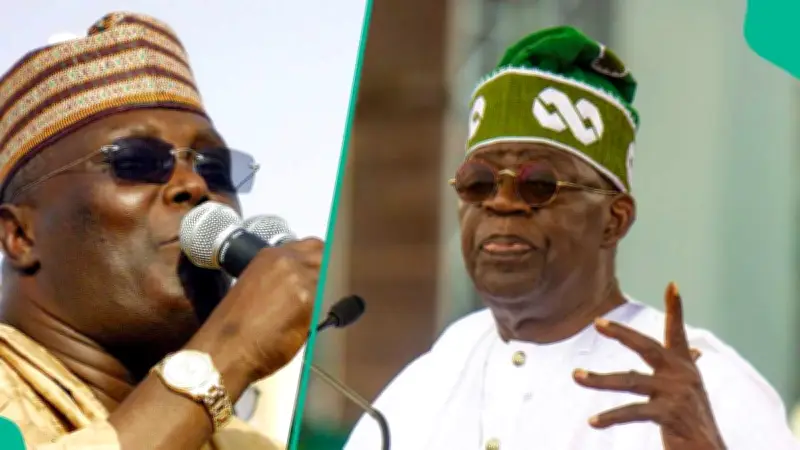
Former Vice President Atiku Abubakar has described Nigeria's N70,000 monthly minimum wage as grossly insufficient, arguing that workers can no longer sustain their households on that figure given the sharp rise in the cost of living since the removal of the petrol subsidy.
Legit.ng reports that Phrank Shaibu, Director of Strategic Communications of the African Democratic Congress (ADC) Presidential Campaign Council, issued the statement on Atiku's behalf on Sunday, September 27.
Minimum Wage Buys Only 50 Litres of Petrol
Atiku pointed out that at N1,400 per litre, the entire monthly minimum wage can purchase only 50 litres of petrol, leaving nothing for food, rent or transportation. He contrasted this with the situation before President Bola Tinubu's administration removed the fuel subsidy, noting that the previous N30,000 wage could buy around 118 litres at the April 2023 national average price of N254.06 per litre.
"The payslip has grown, but the fuel it can buy has more than halved. Tinubu has given workers a larger number and left them with a smaller life. That is hardship dressed up as a wage increase," Atiku said.
Comparison with Other African Nations
The ADC presidential candidate also held up neighbouring and fellow oil-producing nations as a benchmark. Using exchange rates from July 24, 2026, he said Libya's monthly minimum wage was worth about N213,000 in naira terms, Algeria's roughly N245,000, Equatorial Guinea's N302,000 and Gabon's N351,000. He added that Benin Republic's minimum wage also exceeded Nigeria's when converted at the same rates.
Atiku acknowledged that wage structures and living costs vary between countries but maintained that the comparison still exposed how inadequate the current Nigerian floor wage is for workers facing today's prices.
High Petrol Prices Ripple Through Economy
He also stressed that high petrol prices ripple through the wider economy, driving up the cost of food, transport and household goods.
"Petrol does not stay at the pump. Its price follows the farmer to market, enters the baker's oven and appears in the fare a parent pays to take a child to school," he said.
The former vice president challenged President Tinubu to immediately agree to a meaningful wage increase tied to the actual cost of food, transportation, rent and electricity, or else publicly admit he has no such plans.
"If he has no intention of raising workers' pay, he should say so plainly and stop stringing the Nigeria Labour Congress and other labour leaders along," Atiku said.
Atiku's Pledge and Subsidy Plan
Atiku pledged that if elected, he would begin raising the minimum wage from his first day in office in May 2027. He also outlined plans for a targeted production subsidy on petroleum products refined in Nigeria and sold domestically, to be governed by a spending cap, public accounting and independent auditing.
"Nigerians do not eat FAAC figures. A full treasury is no answer to an empty kitchen," he said.
"A living wage must buy a living. It is not a privilege; it is a basic right. Tinubu has made life painfully expensive. I will make life affordable again."
Labour Unions Push for Periodic Hikes
Earlier, Legit.ng reported that Festus Osifo, president of the Trade Union Congress (TUC), said that organised labour is pushing for an annual increase in the national minimum wage paid to workers in Nigeria.
The TUC boss stated that members of the organisation, as well as their colleagues in the NLC, have begun talks on the issue.