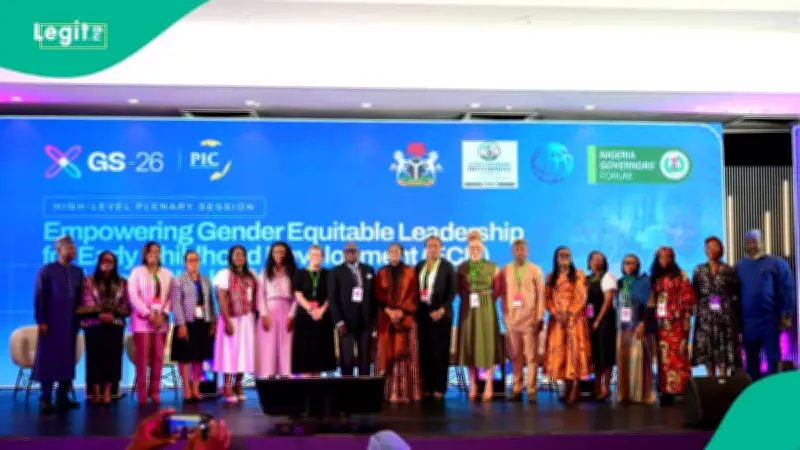
At the 2026 Gender and Inclusion Summit (GS 2026) in Abuja, former Prime Minister and President of the National Assembly of Côte d’Ivoire, Patrick Achi, cautioned African governments against allowing poverty alleviation programmes to become permanent substitutes for economic opportunity. He warned against creating what he called a “poverty-alleviation industry” that manages poverty without ending it.
Achi warns against ‘poverty-alleviation industry’
Achi acknowledged that social protection, targeted cash transfers, development assistance and philanthropy remained important, particularly when economic growth was insufficient or its benefits were narrowly distributed. However, he stressed that such interventions should not become the foundation of African economies.
“We must be careful not to create what I would call a poverty-alleviation industry — a system that becomes very good at managing poverty without building the mechanism that ends it,” Achi said. He added that cash transfers and grants can be essential bridges, but “if the bridge never leads to productive income, we remain vulnerable to the day the grant stops.”

Achi said the most sustainable pathway out of poverty was to make people economically productive, with growth creating wealth, jobs and opportunities at scale. He emphasised that the state must create conditions for investment, enterprise and job creation while ensuring that the benefits of growth reach a broader share of the population.
AbdulRazaq seeks more women in leadership
First Lady of Kwara State and Chairperson of the Nigeria Governors’ Wives Forum, Ambassador Professor Olufolake AbdulRazaq, highlighted the gender dimension of inclusion. She called for more women to occupy decision-making positions, saying gender inequality remained a major obstacle to sustainable development despite interventions in education, healthcare, economic empowerment and political participation.
AbdulRazaq said women’s economic empowerment should go beyond income generation to include access to opportunities, leadership, healthcare, education and platforms where policies affecting their lives are shaped.
Yusuf: Policies must reach the last mile
Chairman of the Nigerian Economic Summit Group (NESG), Mr Olaniyi Yusuf, said the challenge was no longer the absence of policies but ensuring that commitments reached the people for whom they were designed. He said the summit was established to bridge the gap between policy commitments and lived realities, particularly for women, girls, youths, persons with disabilities and underserved communities.
“Nothing happens by chance. Opportunity only becomes meaningful when it reaches the last mile,” Yusuf said. He urged stakeholders to move from discussions to implementation: “We do not gather merely to celebrate. We gather to design. We gather to deliver.”
Sulaiman-Ibrahim: Put women at centre of development
Minister of Women Affairs and Social Development, Hajiya Imaan Sulaiman-Ibrahim, stressed the importance of placing women at the centre of Nigeria’s last-mile development strategy. In her ministerial keynote address, themed “From Agenda to Action: Making Innovations Count for the Last Mile”, she said sustainable inclusion required moving women from beneficiaries of interventions to owners of productive assets.
“So let me state my central message plainly: we will not reach the last mile unless women stand at the centre of how we get there,” she said. The minister listed initiatives under President Bola Tinubu’s Renewed Hope Agenda, including PowerHer774, the Renewed Hope Women Agro-Value Expansion Programme, the Women in Nigeria’s Gas Sector Empowerment Project, Women on Wheels, EmpowerHer774, DigitHer774 and HerSafeHaven.
Sulaiman-Ibrahim said the Nigeria for Women Programme Scale-Up, co-financed by the World Bank and state governments, targets at least five million women across the 36 states and the Federal Capital Territory. Its first phase enrolled more than 560,000 women into over 26,000 savings and enterprise groups, which collectively saved nearly N5 billion. The ongoing scale-up had mobilised N2.7 billion in savings and provided more than N2.2 billion in loans.

She also disclosed that 38 national instruments had been developed, reviewed and validated to strengthen implementation in areas including childcare, social protection, gender equality, menstrual health, disability services and protection of survivors of violence. Sulaiman-Ibrahim urged stakeholders to move innovations beyond the pilot stage through financing, institutional adoption, measurement and scaling, and called for broad participation in the development of the National Gender Policy 2027–2032.
Dirisu: Bring grassroots voices into policy
Executive Director of the Policy Innovation Centre, Dr Osasuyi Dirisu, explained that the “last mile” should not be understood only in geographical terms, as people could also be excluded because of limited access to resources, financing, education, literacy and healthcare. She said PIC had deliberately brought grassroots voices into high-level policy conversations, including beneficiaries of the Nigeria for Women Project and a farmer who shared their experiences.
Dirisu also highlighted efforts to deepen youth participation, including the co-creation of a Youth Charter aimed at giving young Nigerians a stronger voice in policies affecting their future. On implementation, she said PIC could not compel government to adopt recommendations but could create an enabling environment for collaboration and advocacy.
In his welcome remarks, Group Managing Director Udeme Ufot urged government, the private sector, civil society and development partners to strengthen collaboration and ensure that policies and innovations reached those most excluded from economic and social opportunities. He said the success of development interventions should ultimately be measured by their impact on ordinary citizens, especially women, youths and vulnerable communities.