
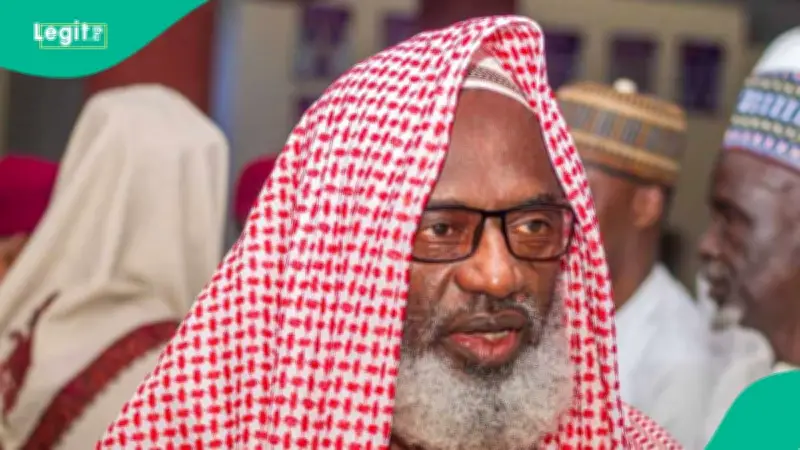
Kaduna-based Islamic scholar Dr Ahmad Gumi has called on political actors across Nigeria to stop using religion as a tool for winning elections, saying the country's diversity demands greater restraint from faith leaders and politicians alike. Gumi stated this while responding to remarks attributed to Sheikh Sani Yahaya Jingir, the National Chairman of Jama'atu Izalatil Bid'a Wa'ikamatsi Sunnah (JIBWIS). The controversial cleric made his position known in a post on his verified Facebook page on Monday, August 10, 2026.
What Sheikh Jingir Said
At a mass wedding ceremony in Kano on Saturday, Jingir reportedly urged Muslims to support President Bola Ahmed Tinubu in the next election, citing the fact that Tinubu chose a running mate who shares his Islamic faith. The comments drew immediate pushback from several Christian leaders, civil society groups, and activists, who described them as divisive.
Gumi did not outrightly condemn Jingir, but said the cleric's political views should be understood within the environment he operates in. "Sheikh Jingir should be excused for his extreme view in politics; he dwells in the eye of the storm of excessive bigotry against Islam."
Gumi Warns Both Sides
The Kaduna cleric did not spare the opposition either. He made clear that the misuse of religion for political advantage was not exclusive to the ruling party or its supporters. "On the other hand, the opposition is not also free from using religion to garner votes." To support his broader point about religious tensions in Nigeria, Gumi referenced a recent controversy in Plateau State. "Just recently, a mere Muslim VC in Plateau State is stirring controversy." His central message was a plea for restraint across the political spectrum. "In a multi-religious entity, religion should not be dragged into the quagmire of dirty politics," he wrote.
Nigeria has had a long history of religious tensions influencing its political landscape. The Muslim-Muslim presidential ticket that brought Tinubu and Vice President Kashim Shettima to power in 2023 sparked fierce debate, with critics arguing it marginalised the country's large Christian population. That controversy has continued to surface ahead of the 2027 general elections.
Kwankwaso and Fani-Kayode React
Recall that NDC vice presidential candidate Kwankwaso spoke out against remarks made by Sheikh Jingir at a Kano government event over the weekend. Jingir's comments, which went viral, included claims that Nigeria is an Islamic state and that Christians carried out a Kano mosque bombing. Kwankwaso linked the controversy to the 2027 elections, saying Nigerians would have a chance to judge the current administration at the ballot box.
Meanwhile, Legit.ng also reported that Nigeria's ambassador-designate to South Africa, Femi Fani-Kayode, pushed back against a viral claim by Sheikh Jingir about the Muslim majority in Nigeria. Fani-Kayode posted his reaction on his verified X account on Sunday, August 9, calling the rhetoric provocative and unhelpful. The former minister also addressed the Muslim/Muslim ticket of President Bola Ahmed Tinubu and Kashim Shettima for the 2027 elections, insisting religion should be kept out of politics.




