
The United Nations Children’s Fund (UNICEF) has issued an urgent warning that insecurity and deteriorating school infrastructure are depriving millions of Nigerian children of a normal childhood and impeding their cognitive development, turning classrooms once considered safe havens into environments dominated by fear.
UNICEF Sounds Alarm on Dual Crisis
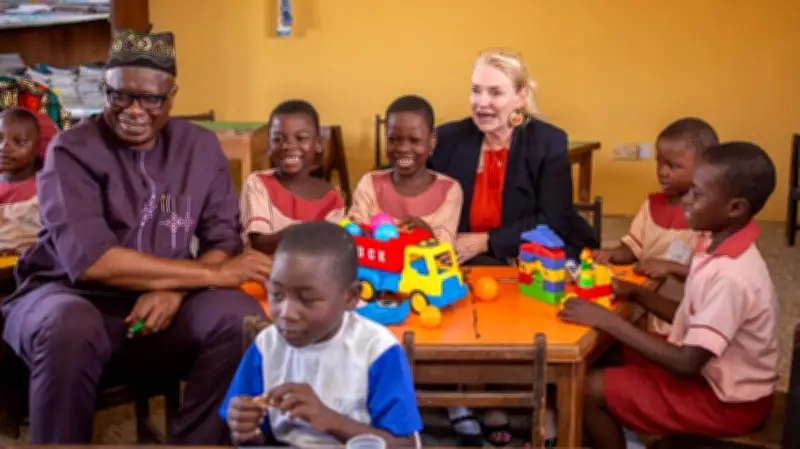
Speaking at the International Day of Play celebration organized by UNICEF in partnership with the Lagos State Universal Basic Education Board (LASUBEB) in Lagos, the Chief of the UNICEF Lagos Field Office, Celine Lafoucriere, stated that the dual crisis of violence and poor learning conditions is creating a generation of children growing up without safety, space, or time to play.
Lafoucriere highlighted a stark contrast between the festive atmosphere at the Lagos event, where pupils engaged in games, storytelling, and creative activities, and the reality facing children in conflict-affected and under-resourced areas of the country. While some learners celebrated the right to play, she noted that millions of others remain trapped in environments characterized by abductions, overcrowded classrooms, bare floors, and a lack of basic play materials—conditions she described as a direct assault on childhood.
“The school compound, which should be a safe haven for learning and growth, has become a place of fear,” she told the gathering of education officials, teachers, parents, and journalists. “In recent months, children have been taken into captivity from their schools in Borno, Niger, and Kebbi States, and just last month, in nearby Oyo State. Many have still not returned home. That is the grim reality of childhood in Nigeria today.”
Psychological Barrier to Education
According to UNICEF, the pervasive threat of violence has created a psychological barrier to education. Lafoucriere explained that parents are now too terrified to send their children to school, and children themselves are often too afraid to attend. The fear of kidnapping, armed attacks, and banditry has disrupted attendance, increased dropout rates, and eroded the sense of safety essential for effective learning.
Beyond the threat of violence, Lafoucriere highlighted systemic structural failures that prevent children from playing and developing holistically. She noted that even in areas unaffected by direct violence, many children are still denied their developmental rights due to poor learning environments. She identified key barriers, including overcrowded classrooms where pupils sit on bare floors or share desks, lack of physical space within school compounds for running or physical games, absence of dedicated time for recreational activities in school timetables, and a shortage of basic play materials such as toys, balls, storybooks, and learning aids.
Play as a Fundamental Component
Defending the critical role of recreation in child development, the UNICEF chief rejected the notion that play is a luxury or a secondary reward reserved for after schoolwork. Instead, she argued that play is a fundamental component of cognitive growth and emotional well-being.
“When a child plays, their brain grows,” Lafoucriere explained. “No worksheet can do what play does. Play is not a reward for finishing work. Play is the work. And no child should be denied that—not by overcrowded classrooms, and not by anyone with a gun.”
She appealed to the government and parents to recognize the direct link between physical safety and intellectual growth, emphasizing that an unsafe child cannot learn effectively, and a child barred from playing cannot reach their full potential.
LASUBEB Chairman Emphasizes Play
In his remarks at the event, the Chairman of LASUBEB, Dr. Hakeem Shittu, stressed the importance of play to a child’s total development. Shittu noted that Lagos State integrates play into children’s development strategies, including those with special needs.
“That is why we ensure our schools are stocked with different toys and storybooks to effectively support our pupils. We also encourage parents to allow and engage their children to play at home under proper guidance,” Shittu said.
He commended UNICEF for partnering with the state government to support child development, adding that these efforts are yielding tremendous results in improving learning outcomes and pupil well-being.
Education Specialist Calls for Collaboration
Yetunde Oluwatosin, an Education Specialist with UNICEF Nigeria, highlighted that proper early childhood development is the surest way for children to become holistic learners. She added that this effort requires all stakeholders, noting that “it takes a village to raise a total child.”
Oluwatosin emphasized the need for continuity between school and home, questioning how parents can better understand and participate in their children’s school activities. She said it is critical to have a safe environment for children to play and learn both in school and at home.
To ensure quality early childhood education, she stressed that teachers must be adequately trained to deliver play-based learning, and that the play aspect is vital in early childhood development. She added that the effort must be multi-sectoral, involving education, health, social welfare, and community leaders.




