
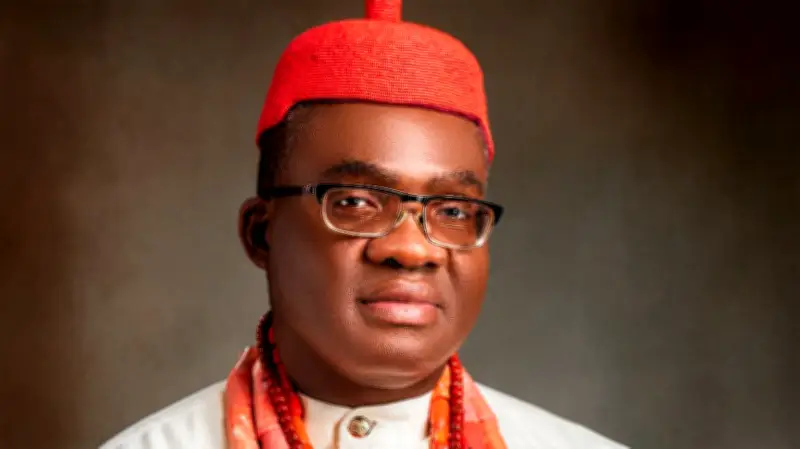
Dr. Ifechukwude Aninshi Okonjo II, the Obi of Ogwashi-Uku in Delta State, is a monarch whose reign has become synonymous with principled leadership, courageous reform, and a deep commitment to community development. Anyone meeting him for the first time is likely to be struck by his warm, engaging, yet dignified personality. Highly cerebral and intellectually curious, he relishes thoughtful discussions on local and global issues. His profound love for his land and people is matched by his readiness to confront anyone working against the best interests of Ogwashi-Uku. For him, the opportunity to serve is a privilege that must be approached with utmost seriousness and care.
Harnessing Tradition for Progress
In an era when traditional institutions are increasingly judged by their relevance to modern life, Obi Ifechukwude Okonjo II has emerged as a compelling example of how ancient authority can be harnessed for progressive ends. Since ascending the throne in 2019 as the 31st Obi of Ogwashi-Uku, he has combined the dignity of a centuries-old monarchy with a contemporary vision anchored in equity, transparency, youth empowerment, and sustainable development.
A Legacy of Service
The Ogwashi-Uku monarchy, one of the most respected traditional institutions in Anioma and Delta State, traces its modern royal lineage back more than a century and a half. For generations, the Obi has served not merely as a ceremonial ruler but as the custodian of communal heritage, culture, and land held in trust for the people. Obi Ifechukwude inherited this responsibility from his distinguished father, the late Professor Chukwuka Okonjo, who reigned as Obi from 2007 to 2019. A renowned academic and administrator, Professor Okonjo laid a strong foundation of intellectual discipline and public service.
The present Obi comes from one of Nigeria’s most accomplished families. His sister, Dr. Ngozi Okonjo-Iweala, is globally renowned as Director-General of the World Trade Organization and former Minister of Finance of Nigeria. Their family pedigree reflects a longstanding tradition of excellence, service, and fearless advocacy. Obi Ifechukwude is himself a scholar of distinction, educated in Nigeria and abroad, with a PhD in Economics. He built a successful professional career before ascending the throne, and his intellectual depth is evident in the analytical and methodical manner with which he approaches governance.
Development Agenda and Land Recovery
Under his leadership, tradition has become a platform for progress. The monarch has consistently emphasized that the purpose of kingship is to improve the quality of life of his people. Community leaders credit his reign with expanding scholarships, supporting healthcare initiatives, improving infrastructure, and promoting youth-focused programmes. The Palace’s vision is rooted in practical outcomes: greater opportunities for young people, stronger institutions, and the preservation of communal resources for public benefit rather than private enrichment.
His determined defence of Ogwashi-Uku communal lands is about safeguarding the economic future of the kingdom. In a recent interview, the Obi declared that “the land belongs to everyone” and explained that recovered lands are being reserved for agriculture, industry, education, and public services. This commitment has been repeatedly vindicated in court. In August 2025, the Delta State High Court reaffirmed the Obi as overlord and lawful custodian of Ogwashi-Uku lands and restrained unauthorized sales and developments. The Palace has also documented the recovery of 1,349 hectares originally set aside by the late Professor Chukwuka Okonjo for the proposed Anioma University of Science and Technology. Additional lands behind the Delta State Polytechnic have likewise been restored to the kingdom following successful litigation.
Transforming Assets into Social Progress
These victories are transforming communal assets into instruments of social progress. Portions of the recovered land are designated for schools, hospitals, industrial estates, and agricultural ventures intended to create jobs and expand opportunities for the next generation. Nearly 2,000 Ogwashi-Uku indigenes have already received free land allocations, reflecting the Obi’s conviction that development must be inclusive and broadly shared.
Courageous and Humane Leadership
What distinguishes Obi Ifechukwude’s leadership is the courage with which he has pursued reforms. Recovering land from entrenched speculators and vested interests has attracted fierce opposition and orchestrated smear campaigns. Yet he has remained steadfast, choosing the courts over confrontation and due process over retaliation. As he has repeatedly maintained, justice must be pursued through law, not propaganda or intimidation.
At the same time, his style of leadership is notably humane and inclusive. He speaks of land as a trust for all, not a privilege for a few. He has sought to balance tradition with innovation, preserving the customs of Ogwashi-Uku while embracing development strategies that address the aspirations of modern youth. His message to critics has consistently emphasized dialogue, lawful engagement, and community unity.
Redefining Enlightened Kingship
The result is a monarchy that is both ancient and forward-looking. Obi Ifechukwude Aninshi Okonjo II has demonstrated that a traditional ruler can be intellectually grounded, socially progressive, and unwavering in defence of the common good. By protecting ancestral lands, expanding access to communal resources, and channeling heritage into development, he is redefining what enlightened kingship means in contemporary Nigeria. In Ogwashi-Uku today, the throne is not merely a symbol of history. Under Obi Ifechukwude Okonjo II, it has become a powerful instrument for justice, inclusion, and hope for generations yet unborn.




