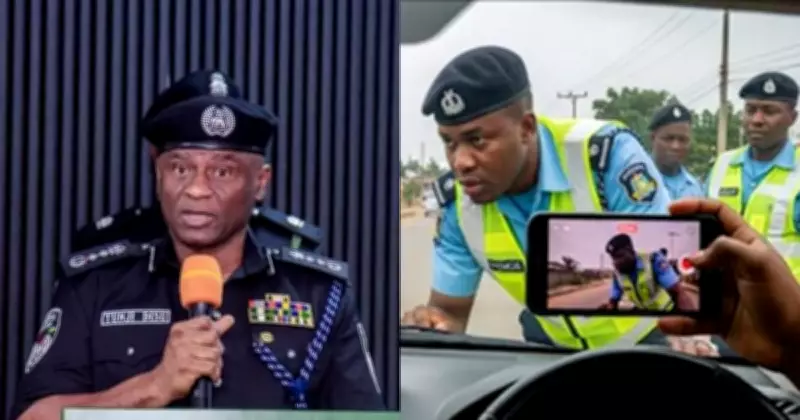
Landmark Ruling: Nigerians Can Legally Record Police Officers During Duty
The Federal High Court sitting in Warri, Delta State, has issued a groundbreaking judgment that solidifies the constitutional rights of Nigerian citizens to document police activities in public spaces. In a significant legal victory for civil liberties, the court has explicitly affirmed that recording, photographing, or filming police officers while they perform their official duties is a protected right under Nigerian law.
Court Declares Anonymous Policing Unconstitutional
Justice H. A. Nganjiwa, presiding over the case with suit number FHC/WR/CS/87/2025, delivered the comprehensive ruling that also declared the practice of anonymous policing unlawful. The judgment specifically prohibits police officers from operating without visible identification, such as name tags and force numbers, while on duty. This aspect of the ruling addresses long-standing concerns about accountability and transparency within law enforcement agencies.
Case Originates from Personal Encounter at Checkpoint
The legal action stemmed from a troubling incident involving Maxwell Nosakhare Uwaifo, a legal practitioner with Lex Phronesis Solicitors in Ekpan, Warri. According to court documents, Uwaifo was driving from Benin to Warri on May 10, 2025, when he encountered what appeared to be a police checkpoint near the Sapele roundabout.
In his sworn affidavit submitted to the Federal High Court Registry in Warri on July 31, 2025, Uwaifo described being stopped by a group of men who displayed aggressive behavior without proper justification. When he attempted to record the interaction using his mobile phone, one officer threatened him with arrest if he didn't cease recording immediately.
The officers involved presented multiple identification issues:
- No visible name tags or identification numbers on uniforms
- Failure to properly introduce themselves or explain their actions
- Use of an unmarked black Toyota Sienna vehicle without police insignia
- No license plate displayed on the vehicle
Uwaifo expressed genuine fear for his safety during the encounter, noting that the officers' aggressive demeanor and visible firearms made it impossible for him to request proper identification or continue documenting the situation. He cited similar incidents in Warri's Effurun Roundabout area in June 2025, where police officers conducting stop-and-search operations also lacked proper identification.
Legal Foundation and Arguments Presented
The lawsuit was grounded in multiple legal frameworks, including Sections 34, 35, 41, and 46 of the 1999 Constitution of Nigeria (as amended), relevant articles of the African Charter on Human and Peoples' Rights, the Fundamental Rights Enforcement Procedure Rules 2009, and specific provisions of the Nigeria Police Act 2020.
Uwaifo's legal team presented five key questions for judicial determination:
- Whether police officers' refusal to wear identification violates constitutional and statutory provisions
- Whether preventing citizens from filming police during official duties infringes on freedom of expression
- Whether the applicant deserves public interest redress and damages
- Whether the applicant has standing to bring the action in public interest
- Whether respondents have constitutional duty to ensure proper personnel identification
The applicant's primary argument centered on Section 66(1) of the Nigeria Police Act 2020, which mandates that officers must prominently display name tags and identification numbers while on duty. Uwaifo contended that this requirement serves as a fundamental mechanism for ensuring transparency, accountability, and proper conduct within the police force.
Regarding recording rights, Uwaifo argued that Section 39(1) of the Constitution guarantees freedom of expression, which inherently includes the right to document public officials performing their duties. He emphasized that no existing Nigerian legislation criminalizes recording public officials, and any restriction would need to meet stringent constitutional tests that don't currently apply.
Judicial Precedents and Respondent's Position
The applicant cited multiple judicial authorities supporting his position, including Court of Appeal decisions in Arthur Nwankwo v. The State (1985) and I.G.P. v. Ubah (2014), along with Supreme Court rulings in Fawehinmi v. Abacha (2000) and Centre for Oil Pollution Watch v. NNPC (2019). These precedents established that public officials have no reasonable expectation of privacy while performing duties and that transparency serves as a cornerstone of democratic governance.
Notably, the Attorney-General of the Federation, represented by Maimuna Lami Shiru, Director of Civil Litigation and Public Law at the Federal Ministry of Justice, filed a written address but did not submit a counter-affidavit. This procedural decision meant that Uwaifo's affidavit evidence remained unchallenged and was deemed admitted by the court.
Broader Implications for Police Accountability
This landmark judgment establishes crucial legal precedents that will significantly impact police-citizen interactions across Nigeria. By affirming the right to record police activities, the court has empowered citizens to exercise greater oversight over law enforcement operations. The ruling against anonymous policing addresses systemic issues of identification and accountability that have long plagued police operations.
The decision reinforces the principle that police officers performing public functions must operate transparently and be identifiable to the citizens they serve. This ruling represents a substantial step toward enhanced police accountability and the protection of fundamental rights in Nigeria's democratic framework.