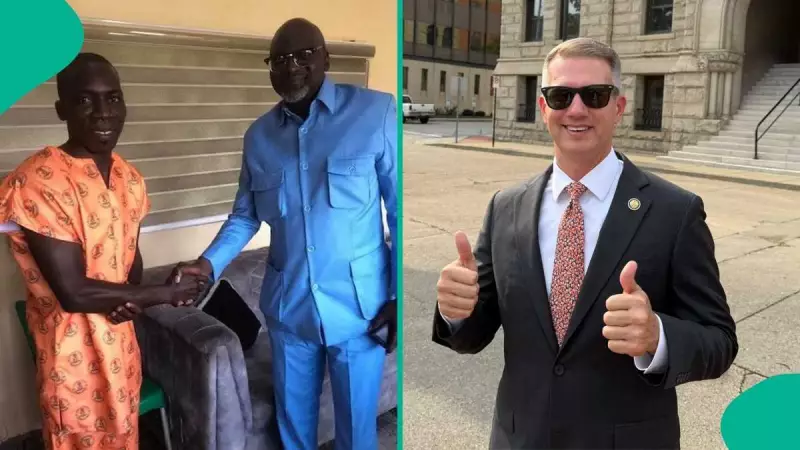
In a significant development highlighting international advocacy, a United States Congressman has publicly commended the Nigerian government for pardoning a farmer who spent over ten years on death row. The case of Sunday Jackson, who was sentenced for killing a herdsman in self-defence, has drawn cross-border attention and culminated in his release by Adamawa State Governor Ahmadu Umaru Fintiri.
Decade-Long Incarceration Ends with Governor's Pardon
The story of Sunday Jackson is one of prolonged legal struggle. Jackson, a farmer in Adamawa state, was sentenced to death after an incident where he killed a herdsman. The court found that the herdsman had attacked Jackson's home, leading Jackson to act in what he claimed was self-defence. Despite this context, the sentence was passed, and Jackson remained imprisoned for more than a decade, his life hanging in the balance on death row.
The turning point came when Governor Ahmadu Umaru Fintiri exercised his prerogative of mercy, granting Jackson a pardon. This executive decision followed sustained pressure and advocacy, notably from figures on the international stage. The pardon effectively nullified the death sentence and secured Jackson's freedom after his lengthy incarceration.
International Advocacy and Diplomatic Pressure
The release was not solely a domestic affair. United States Congressman Rep. Riley M. Moore played a pivotal role in advocating for Jackson's freedom. The lawmaker engaged in a multi-pronged campaign, raising the issue during official congressional hearings, speaking to the media, and holding private meetings with senior Nigerian officials. These efforts took place both in Washington, D.C., and during a congressional delegation's visit to Nigeria.
Following the news of the pardon, Congressman Moore took to his social media on Wednesday, December 24, 2025, to issue a statement. He described Jackson's release as a positive step in the bilateral relationship between the United States and Nigeria. Furthermore, he commended President Bola Tinubu for demonstrating a willingness to cooperate with the United States in addressing broader concerns, including the alleged persecution of Christians in certain parts of Nigeria.
Nigerian Public Reaction and Future Concerns
The news has sparked reactions from Nigerians, many of whom expressed gratitude for the international intervention. Online commentators praised Rep. Moore for his stance on justice and for standing against unrest in northern Nigeria. One user, Koshman, offered prayers, thanking the Congressman for his advocacy. Another, Jeremiah Robert, highlighted the case as evidence of the power of sustained diplomatic pressure but urged for the next steps: ensuring Jackson's safety and preventing similar judicial outcomes in the future.
However, some reactions also pointed to underlying anxieties. Commentator Maro called for Jackson to be granted asylum or provided with formidable security, expressing fear that his release might make him a target. Others, like Tor Kwembe, used the moment to advocate for the safe return of Internally Displaced Persons (IDPs) to their ancestral homes with guaranteed protection.
The case of Sunday Jackson, while now resolved with his pardon, continues to fuel critical conversations around self-defence laws, judicial processes, and the protection of vulnerable communities in Nigeria. It stands as a notable instance where international advocacy intersected with local governance to alter a individual's fate.