
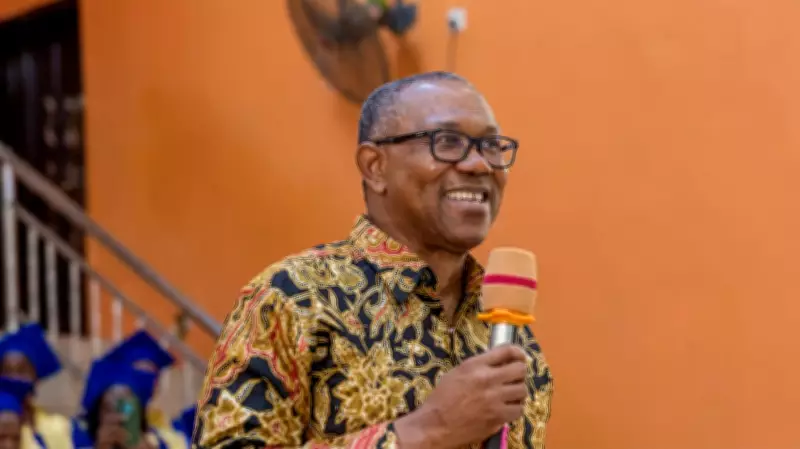
Ever since the outcome of the 2023 presidential election, one question has continued to linger in Nigeria’s political space: is Peter Obi, knowingly or unknowingly, helping President Bola Ahmed Tinubu ahead of the 2027 elections?
At first glance, the question sounds outrageous. Obi remains one of the loudest opposition figures in Nigeria today and still commands an energetic support base through the Obedient movement. Yet, recent political developments and the continued fragmentation of the opposition have created room for suspicion, debate, and political calculation.
In the 2023 presidential election, Tinubu of the APC secured about 8.79 million votes to emerge victorious, while Atiku Abubakar of the PDP polled roughly 6.98 million votes and Peter Obi of the Labour Party gained over 6.1 million votes. Simple electoral arithmetic immediately led many Nigerians to one conclusion: had Obi and Atiku contested on the same platform, the APC might have struggled to retain power. That reality has remained at the center of opposition politics since 2023.
Obi’s rise during the last election was unlike anything Nigeria had seen in recent years. Powered by frustrated youths, urban voters, and first-time participants, the Obidient movement transformed him into more than a politician. He became a symbol of protest against Nigeria’s old political order. His victory in Lagos during the presidential election defeating Tinubu in his political stronghold further elevated his image nationally.
Naturally, many expected the opposition to learn from the mistakes of division ahead of 2027. Talks about a coalition began to dominate political conversations. There were expectations that major opposition figures would unite under a stronger platform capable of challenging the APC nationally. For many analysts, coalition politics appeared to be the only realistic path to defeating an incumbent government with enormous institutional advantages.
However, the opposition soon began experiencing familiar Nigerian political problems: leadership battles, court disputes, personal ambition, and disagreements over who should control any proposed alliance. Instead of growing stronger, the coalition conversations became increasingly unstable. The ADC merger was only short-lived judging by the front runner by miles for many Nigerians. He left for the NPC. Then came fresh political alignments involving Obi and Rabiu Kwankwaso. Rather than fully consolidating under one broad opposition arrangement, different camps appeared to pursue separate political calculations.
To many Nigerians, this looked like history repeating itself. And that is where the controversial question emerges. If opposition figures truly understand that unity gives them the best chance against the APC, why do they continue to operate separately? Why walk away from possible coalition structures that could strengthen their electoral chances? Why divide opposition votes again ahead of a critical election?
To critics, the answer is simple: whether intentionally or indirectly, Obi’s political decisions may ultimately favor Tinubu. Of course, there is absolutely no public evidence that Peter Obi is secretly working for the APC or collaborating with President Tinubu. Such claims remain speculative and politically sensitive. But politics is often judged by outcomes, not declarations. And the outcome of opposition fragmentation usually benefits the ruling party.
Nigeria’s political history supports this argument. Ironically, the APC itself became successful in 2015 because opposition leaders agreed to sacrifice personal ambitions and merge into one political force against the PDP government at the time. Without that coalition, Muhammadu Buhari might never have become president. Today, the reverse appears to be happening within the opposition.
Another issue fueling these suspicions is the enormous advantage incumbents possess in Nigerian politics. Beyond state power and political influence, many Nigerians also believe that election outcomes are increasingly shaped by legal battles after voting concludes. The judiciary’s growing role in electoral disputes has created widespread public skepticism about how elections are ultimately decided. For critics of Obi’s recent political moves, this makes opposition unity even more important. They argue that dividing opposition votes against an incumbent administration with strong institutional influence only reduces the chances of meaningful political change.
Still, Obi’s supporters strongly reject these accusations. They argue that he is simply protecting the identity of the movement that millions of Nigerians built around him in 2023. According to them, merging into traditional political structures too early could damage the credibility that made Obi popular in the first place. They also argue that coalition politics in Nigeria often collapses because politicians are more interested in power-sharing than genuine reform. That argument carries weight too.
But elections in Nigeria are rarely won through popularity alone. They are won through structures, alliances, regional calculations, legal preparedness, and political survival. In a country as politically complicated as Nigeria, emotional support on social media may not be enough to defeat an incumbent government.
So, is Peter Obi working for Tinubu ahead of 2027? Perhaps not directly. But if the opposition remains divided once again, many Nigerians may conclude that the effect of Obi’s political choices intentional or not could end up strengthening the very government his supporters desperately want removed from power.




