
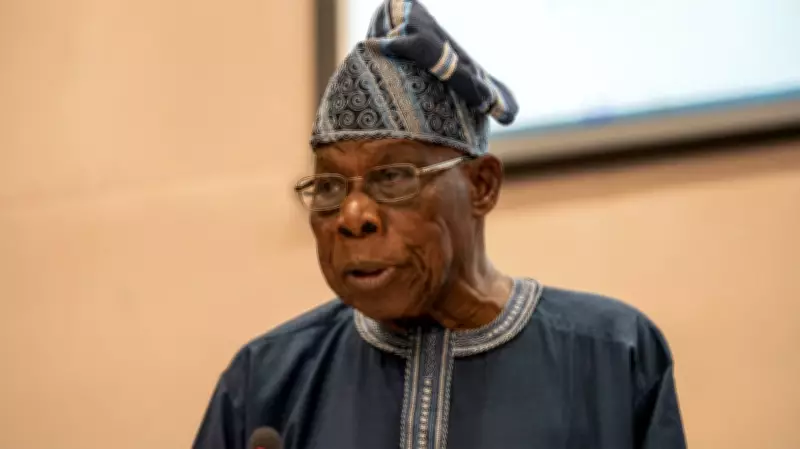
Obasanjo Issues Stark Warning on Nigeria's Future Amid Persistent Crises
Former President Olusegun Obasanjo has voiced profound apprehension regarding the future of Nigeria, lamenting that the nation is not advancing as it should. He cautioned that without immediate and decisive action, the country's struggles will persist across generations, perpetuating a cycle of lamentation and stagnation.
Historical Context and Unresolved Issues
Obasanjo referenced the pivotal Lancaster House meetings of the 1950s, where Nigeria's founding fathers deliberated over the constitution, stability, and unity in the lead-up to independence. He noted that subsequent crises, including census disputes, flawed elections, military coups, and the civil war, should have resolved fundamental questions about Nigeria's future. However, he argued that these issues remain unresolved due to the pervasive selfishness among contemporary Nigerian leaders.
Speaking virtually at the 6th yearly colloquium celebrating Pastor Ituah Ighodalo's 65th birthday, themed 'The Future of Nigeria', Obasanjo emphasized that Nigerians must prioritize the country above all else. He stressed that an individual's identity is intrinsically linked to the nation's existence, and the persistence of self-centeredness, ethnic bias, and religious division has hindered progress.
Critique of Identity Politics and Leadership
Obasanjo expressed dismay that, 65 years after independence, Nigeria is still debating its future. He warned that the nation's trajectory is jeopardized if current trends continue, urging a collective rethink to reposition the country. He criticized the promotion of identity-based politics, such as the 'Emilokan' sentiment, and the tying of leadership positions to religion, arguing that these practices undermine national cohesion and fairness in a diverse society.
"I feel pained when somebody said Emilokan, and some people came to me and said, yes, some people in the north are saying it may be their turn in a country where we have Christians and those who do not even believe in Christianity or Islam. And you say that because you belong to a particular religion, then others may be ignored. That cannot make for the future of a country," Obasanjo stated.
Colonial Legacy and Collective Responsibility
Pastor Ituah Ighodalo, the celebrant, echoed Obasanjo's sentiments, attributing Nigeria's challenges to individuals prioritizing personal interests over the collective good. He traced the crisis back to the colonial era, observing that British colonial masters amalgamated Nigeria not for its benefit, but to serve their own interests by extracting resources and controlling land.
"Nigeria may have been seemingly a mistake, a creation of British colonial masters who came here not for the benefit of Nigeria but for their own benefit. They wanted to extract our resources and take over the land. They did not come here to make Nigeria a great place. They did not come here to foster unity. In fact, they amalgamated us forcefully, not because they thought it was in our best interest but because it was in their own best interest," Ighodalo remarked.
Call for Grassroots Accountability and Education
Opeyemi Adamolekun, Executive Director of Enough is Enough Nigeria (EiE), reinforced the need for enhanced grassroots accountability in government. She urged citizens to focus on local representatives, such as state assembly members and senators, who are closer to understanding and addressing community needs. Adamolekun highlighted the commercialization of politics in Nigeria, where short-term gestures like distributing rice are misconstrued as solutions to deeper issues.
"Politics in Nigeria has become incredibly commercialised. I mean, there are tons of myths going around now that every problem you have will be sorted by rice. When they give a bag of rice, all your problems will be sorted. Therefore, to counter that, we have to invest in education," she asserted.
In summary, Obasanjo's remarks underscore a critical juncture for Nigeria, calling for a shift from self-serving leadership and divisive politics towards unity, accountability, and long-term strategic thinking to secure the nation's future.




