
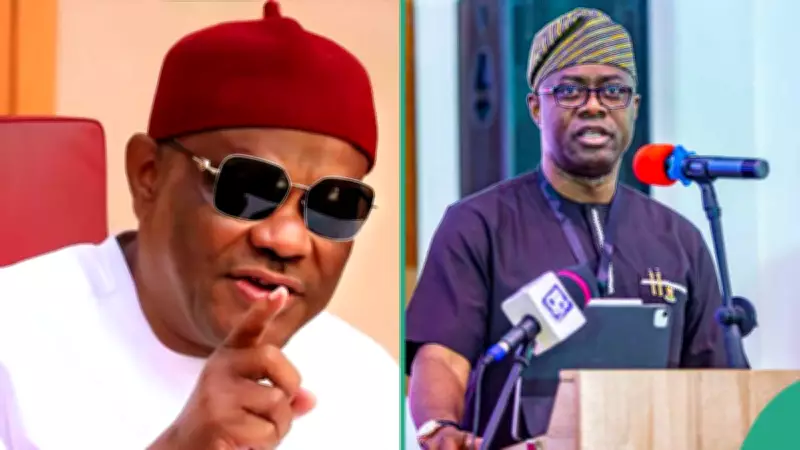
Wike and Makinde Escalate PDP Feud as Internal Crisis Deepens
The ongoing crisis within Nigeria's main opposition party, the Peoples Democratic Party (PDP), has taken a new turn as Federal Capital Territory (FCT) Minister Nyesom Wike launched a fresh verbal attack against Oyo State Governor Seyi Makinde. The political rift between the two former allies has intensified, threatening the party's unity ahead of future elections.
Wike's Direct Criticism at PDP NEC Meeting
Speaking at the national executive committee (NEC) meeting of the PDP faction led by Abdulrahman Mohammed in Abuja on Monday, March 23, 2026, Wike directly addressed Governor Makinde's recent comments. The former Rivers State governor asserted that Makinde had "started a fight he cannot win" and accused the Oyo governor of escalating tensions within the opposition party without possessing sufficient political leverage to succeed.
Wike's remarks came just one day after Governor Makinde made controversial statements linking support for Wike's faction to endorsing President Bola Tinubu's second-term ambition. On Sunday, March 22, Makinde declared that anyone aligning with Wike's PDP faction had effectively supported the re-election bid of President Tinubu and the ruling All Progressives Congress (APC).
Background of the PDP Leadership Crisis
The current conflict stems from deeper divisions within the PDP leadership structure. Recall that the Court of Appeal nullified the PDP national convention held on November 15 and 16, 2025, in Ibadan, the capital of Oyo State. This convention had produced Kabiru Turaki as party leader, a faction that Governor Makinde actively supported.
Party stakeholders have repeatedly called for reconciliation between the Makinde and Wike factions, emphasizing the urgent need for unity to ensure the PDP can effectively field candidates in the upcoming 2027 general elections. The internal strife threatens to weaken the party's position as Nigeria's main opposition force.
Nigerians React to the Political Showdown
The video of Wike's address has sparked widespread reactions across social media platforms, with Nigerians expressing diverse opinions about the political feud:
- Beee praised the minister: "Definitely, contract with Shell and politics are two different things. A leader with quality foresight indeed and those who cannot take it, leave it for those with capacity like the leader @GovWike."
- Okwabani questioned Wike's presidential ambitions: "Of course, he can run his mouth, but let me ask a genuine question: what are Wike's real intentions? Something is triggering him, and if he is cultivating the idea for the presidency in the future, he should kill that idea."
- Cornerstonaid criticized both politicians: "I don't know why certain crops of people think they own Nigeria, and with the temerity to even come out publicly to fight each other because of Sheramwell."
- JustIce highlighted defections to APC: "Keep fooling yourselves. Phillip Aduda, Fintiri, Muftwang, and Ugwuanyi are now in the APC. They are Wike's men. Seventeen members of the RSHA and all Rivers Senators defected to the APC. If they trust Wike's PDP, why did they go to the APC?"
Symbolic Gestures Deepen the Rift
The political conflict has extended beyond verbal exchanges to symbolic actions. Governor Makinde recently withdrew a top honor previously bestowed upon Wike and renamed a popular road in Oyo State that had been named after the minister. These moves have elicited mixed reactions from political observers and the general public.
Makinde and Wike, who collaborated closely ahead of the 2023 general elections, have been engaged in a prolonged power struggle over control of the PDP's leadership structure. Their deteriorating relationship represents a significant challenge for the opposition party as it seeks to rebuild and position itself for future electoral contests.
The ongoing feud between these two prominent PDP figures underscores the deep divisions within Nigeria's main opposition party and raises questions about its ability to present a united front against the ruling APC. As the 2027 elections approach, pressure mounts for reconciliation, but recent developments suggest the rift may be widening rather than healing.




