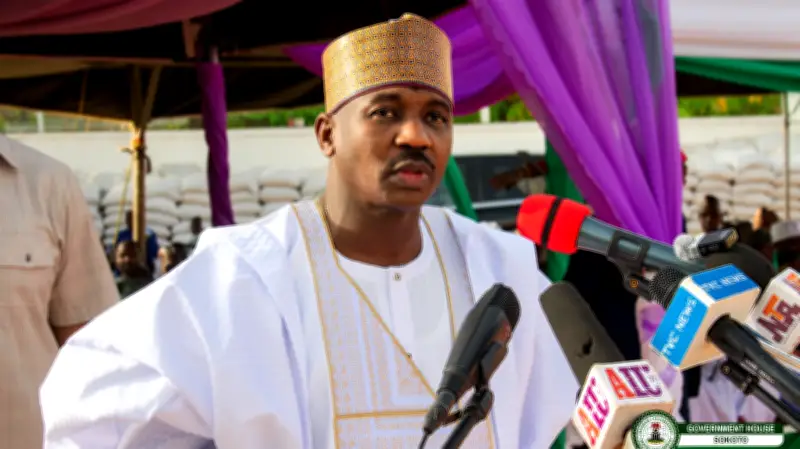
The emergence of Governor Ahmed Aliyu as the All Progressives Congress (APC) candidate for the 2027 governorship election in Sokoto State has set the stage for a highly intense political contest. His political journey is closely tied to former governor and Senator Aliyu Magatakarda Wamakko, the undisputed political godfather of the APC in Sokoto. Since his 2023 victory, Aliyu has governed under Wamakko's protective umbrella, which stabilized his administration and neutralized internal party resistance. His successful acquisition of the second-term ticket surprised few observers, as no visible opposition could challenge the combined authority of the governor and Wamakko.
A Different Battle from 2023
Governor Aliyu's current challenge differs from his 2023 campaign, when he ran as an opposition challenger against the Peoples Democratic Party (PDP) administration of Aminu Waziri Tambuwal. The APC capitalized on public frustration and Wamakko's political structure to reclaim power. Now, Aliyu is an incumbent whose administration faces direct public scrutiny. Elections involving incumbents are often determined by measurable governance outcomes rather than promises.
Supporters argue that Aliyu's administration has made visible progress in infrastructure renewal, urban road rehabilitation, payment of inherited liabilities, rural interventions, and social welfare. The government's media machinery has amplified these achievements, portraying Aliyu as a grassroots-focused governor. In Sokoto metropolis, residents acknowledge improvements in road construction and public sector responsiveness, providing the APC with tangible campaign materials.
Senior Special Assistant to the Governor on Inter-party Matters, Yakubu Maccido, dismissed opposition threats, stating that figures like Aminu Waziri Tambuwal, Yusuf Suleiman, and Faruk Malami Yabo were once followers of Wamakko. He asserted, "They are of no match to either Senator Wamakko or the governor. There is no feeling of heat anywhere as far as the 2027 election is concerned."
Opposition Strengths and Challenges
Political observers note that governance perception extends beyond talk shows. The opposition highlights unresolved socio-economic difficulties and insecurity in rural communities as fertile ground for votes. The PDP, despite losing power in 2023, remains formidable, with loyal structures across local councils and deep-rooted influence among traditional political blocs not aligned with the APC. Historically, Sokoto politics is rarely one-sided, with rivalry between the APC and African Democratic Party (ADC) being fiercely competitive. Electoral outcomes are shaped by elite negotiations, regional loyalties, religious influence, and strategic alliances.
A major threat to Aliyu's re-election is opposition unity. If the ADC reconciles internal grievances and presents a strong candidate, the race could become highly competitive. The opposition's greatest advantage would be transforming the election into a referendum on governance performance rather than political loyalty.
Demographic Shifts
While Wamakko remains influential, an emerging demographic of younger voters increasingly questions traditional political structures. Many youths are issue-driven, focusing on employment, education, transparency, and economic opportunity. This shift introduces electoral uncertainty, as younger voters are less attached to old rivalries and respond more to practical governance outcomes.
Governor Aliyu's political survival depends on redefining himself beyond being Wamakko's successor. He must project independent leadership and establish a governance identity that resonates personally with voters. Critics argue his administration appears overly dependent on inherited structures rather than fresh policy innovation, prioritizing political consolidation over transformational governance.
Incumbency Advantages
Incumbency remains powerful. Aliyu controls state resources, institutional visibility, and extensive political networks. His administration benefits from the APC's organizational strength under Wamakko's influence. The opposition faces internal complications: the PDP struggles with rebuilding cohesion after losing power, and personal ambitions, factional rivalries, and leadership struggles could weaken its united front. If these divisions persist, Aliyu's path to re-election becomes easier.
Traditional and religious influence is crucial in Sokoto politics. As the seat of the Caliphate, Sokoto holds a unique position in Northern Nigeria's socio-political landscape. Political legitimacy often intersects with cultural respectability and elite consensus. Aliyu has maintained strategic relationships with influential stakeholders, projecting respect for traditional institutions and religious leadership to preserve political goodwill.
Political pundits view Aliyu as the favorite, with a formidable political structure. Adamu Mianasara, a public affairs commentator, noted, "His party machinery is organized. His alliance with Senator Wamakko remains intact." The 2027 election will test whether Aliyu can leverage incumbency and party machinery against opposition unity and shifting voter priorities.