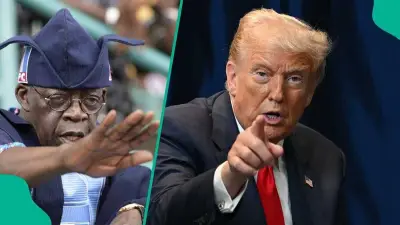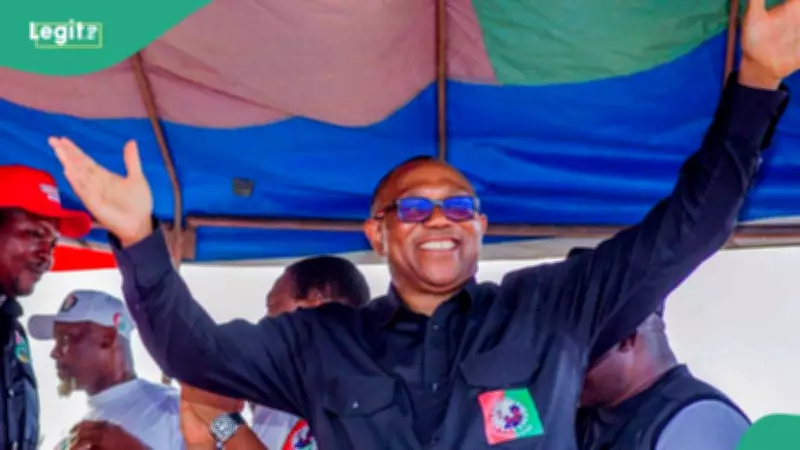
President Bola Tinubu represents establishment power, while top opposition leader Peter Obi embodies emotional political energy in the race for the 2027 elections. Few politicians in recent Nigerian history have inspired the kind of organic enthusiasm Obi generated during the 2023 presidential election cycle.
Obi Fuels Emotional Political Wave
Even after leaving the Labour Party (LP), briefly entering the African Democratic Congress (ADC), and later aligning with the Nigeria Democratic Congress (NDC), the support base of the former Anambra governor remains deeply emotionally charged, digitally active, and stoutly anti-traditional establishment.
Behind Obi stands the Obidient movement, a loose but powerful coalition of youths, urban professionals, reform-minded middle-class voters, diaspora supporters, and anti-establishment Nigerians frustrated with the old political order. In many urban centres, Obi's appeal is driven less by party loyalty than by emotional identification. To supporters, he represents restraint, prudence, and competence in contrast to what they see as elite excess within mainstream politics.
Economic hardship has strengthened that emotional energy. Rising living costs, unemployment pressures, and public frustration with governance have expanded the audience for anti-establishment politics, particularly among younger voters. Sentiment around a Southern presidency also quietly strengthens Obi's position. In parts of the south-east and south-south, many voters view his candidacy not simply as political competition, but as symbolic regional inclusion.
But emotional popularity and electoral machinery are not the same thing. That remains Obi's greatest challenge. Unlike Tinubu, Obi lacks a deep network of governors, entrenched party structures, and longstanding state-level patronage systems capable of sustaining nationwide electoral operations.
Some All Progressives Congress (APC) strategists believe Obi's greatest strength is his ability to energise frustration. But they also calculate that emotional momentum alone may struggle against institutional machinery on election day. The central question surrounding Obi is no longer whether he can inspire voters. It is whether that inspiration can be converted into nationwide electoral protection, polling-unit organisation, and a cross-regional political reach strong enough to withstand a far more established ruling structure.
That is partly why Obi's alliance calculations now matter enormously. Without meaningful Northern reinforcement, his support risks remaining passionate but geographically uneven. Which is where Rabiu Kwankwaso enters the equation.
Obi Joins Forces with Kwankwaso
In early May, Obi and Kwankwaso formally switched parties in a dramatic political realignment ahead of the 2027 elections. Obi, 64, and Kwankwaso, 69, who finished third and fourth respectively in the 2023 presidential election, have both joined the NDC, raising the prospect of a joint ticket to challenge President Tinubu. They were previously in the African Democratic Congress (ADC), along with former Vice-President Atiku Abubakar, who came second in the last election.
While this could be seen as a fragmentation of the opposition, supporters of Obi and Kwankwaso say it will give their alliance greater focus. Both men are former governors and command significant grassroots followings, the Obidient movement and the Kwankwasiya movement, respectively. Obi is hugely popular among young voters across the south, while Kwankwaso wields considerable influence in the north, especially his home state of Kano.
However, their decision risks upsetting allies within the coalition built around the ADC coalition, which had been positioning itself as the main vehicle for opposition unity. Some figures within the ADC bloc have expressed disappointment, raising fresh doubts about whether Nigeria's fragmented opposition can sustain a coordinated challenge against President Tinubu, 74. Elections are scheduled for early January 2027 and will mark the country's eighth since the return to civilian rule in 1999.
Powerful Forces Behind Peter Obi
- Obidient movement
- Coalition of youths
- Urban professionals
- Reform-minded middle-class voters
- Diaspora supporters
- Anti-establishment Nigerians frustrated with the old political order
Earlier, Reverend Solomon Eliyah prophesied that Nigerian presidential hopeful Obi would secure 70% of the total votes in the 2027 presidential election. Rev. Eliyah also predicted that the election results would face legal challenges, stating that he saw the outcome being announced in the court.