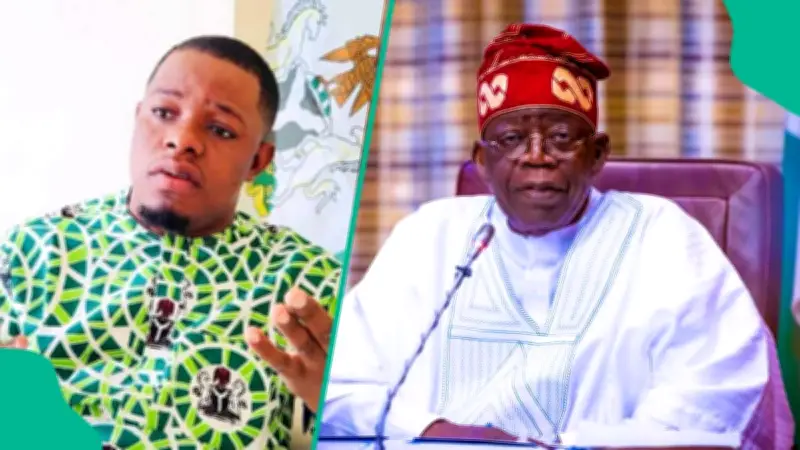
An All Progressives Congress (APC) chieftain, Hon. Obidike Chukwuebuka, has sparked a fresh debate by insisting that academic certificates should not be the primary measure of a leader's ability to govern. He argued that while formal education is important for personal and national development, Nigerians must shift their focus from paper qualifications to competence, vision, integrity, and measurable results.
Obidike, who serves as Chairman and Chief Executive Officer of Clarivo Holdings Limited, made these remarks during an interview made available to Legit.ng. His comments come amid ongoing controversy over President Bola Tinubu's academic credentials, with critics questioning his educational background ahead of the 2027 elections.
A Certificate Does Not Build Roads
Obidike stressed that governance is about tangible outcomes, not academic accolades. "A certificate does not build roads, attract investment, create jobs, stabilise an economy, provide security, or improve the welfare of citizens. Those are achieved through competence, vision, sound judgment, discipline, integrity, and the courage to take difficult but necessary decisions," he said.
He urged Nigerians to evaluate public officials based on their performance and the impact of their policies, rather than engaging in political debates over paper qualifications. This, he argued, would lead to more meaningful political discourse and better governance.
Tinubu's Credentials: Politicised Controversy
Addressing the controversy surrounding President Tinubu's academic credentials, Obidike said the issue had been unnecessarily politicised. He was careful to note that his remarks were not meant to cast doubt on the President's qualifications, adding that Tinubu has consistently maintained he holds the credentials recognised under Nigerian law.
He described Tinubu as one of Nigeria's most intellectually gifted politicians and said critics questioning his educational background could not match his political experience or strategic thinking. "The President's track record speaks for itself," Obidike added.
Historical and Modern Examples of Leaders Without Formal Education
To support his broader argument, Obidike drew on several historical figures. He pointed to Abraham Lincoln, the 16th United States President, who had less than one year of formal schooling but educated himself independently and is widely regarded as one of America's greatest leaders. He also referenced Harry S. Truman, who became US President and led the country through post-war reconstruction without ever obtaining a university degree.
Benjamin Franklin, who left school at age ten due to financial hardship, was cited as someone who became a writer, scientist, inventor, diplomat, and one of America's Founding Fathers through self-education. Thomas Edison, who received only a few months of formal schooling, and Frederick Douglass, born into slavery and initially forbidden from learning to read, were also named as examples of individuals who achieved extraordinary influence through determination alone.
Beyond historical figures, Obidike pointed to modern innovators including Steve Jobs, who left Reed College after one semester before co-founding Apple; Mark Zuckerberg, who dropped out of Harvard University to build Facebook; Winston Churchill, the wartime British Prime Minister; and Ted Turner, founder of CNN. These examples, he argued, demonstrate that formal education is not the sole determinant of success or leadership ability.
Tinubu's Reforms Cited as Evidence of Competence
On governance, Obidike argued that President Tinubu has shown the political will to pursue reforms that previous administrations avoided. He listed the removal of the fuel subsidy, unification of the foreign exchange market, expansion of the student loan programme, and renewed investment in agriculture, road construction, and rail development as evidence of performance-driven leadership under the Renewed Hope Agenda.
He said these efforts, rather than any certificate, should form the basis of how Nigerians assess the current administration. "The reforms are bold and necessary, and they require a leader with vision and courage," Obidike noted.
PDP Chieftain Speaks on Tinubu's Certificate Saga
Recall that a Lagos-based PDP official published an open letter calling on party members to abandon Tinubu's certificate controversy ahead of 2027. The chairman argued that the certificate strategy has failed in court repeatedly since 1999 and is costing the opposition valuable ground. He outlined four steps he wants PDP members to take instead, covering ward organisation, policy messaging, and coalition building.
This comes as INEC published Tinubu's 2027 nomination documents listing only his CSU degree, with sections for primary and secondary school qualifications left blank. Senior lawyers and opposition parties raised questions about the omission, citing constitutional requirements for presidential candidates in Nigeria. INEC said it does not verify the authenticity of credentials, adding that the publication is meant for public scrutiny under the Electoral Act 2026.
Conclusion: Focus on Leadership Qualities
Obidike's comments add to the growing discourse on what truly matters in leadership. As Nigeria approaches the 2027 elections, the debate over certificates versus competence is likely to intensify. However, Obidike's message is clear: Nigerians should judge leaders by their ability to deliver results, not by their academic credentials alone.
His reference to global leaders who succeeded without formal education serves as a reminder that governance is about more than paper qualifications. As the political landscape evolves, the focus should remain on policies, performance, and the welfare of citizens.