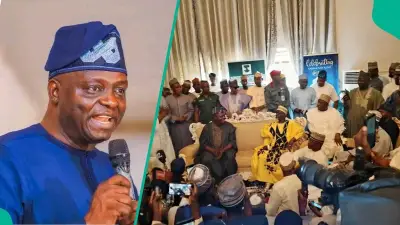
The All Progressives Congress (APC) must confront bitter truths after losing the Osun State governorship election, according to Dr. Dayo Israel, the party's National Youth Leader. Governor Ademola Adeleke of the Accord Party secured re-election with 511,067 votes, defeating APC candidate Bola Oyebamiji, who garnered 444,815 votes—a margin Israel describes as substantial enough to demand honest reflection, not excuses or blame-shifting.
Tinubu's Restraint and Adeleke's Cultural Connection
In a detailed analysis, Israel identifies three defining figures of the election. First, President Bola Ahmed Tinubu, whom he commends for not weaponising state institutions or security forces against the opposition. This restraint, Israel notes, aligns with the President's conduct in other off-cycle elections under his administration, including Anambra and Bayelsa, where opposition parties retained power. "President Tinubu may have lost Osun for the APC, but he won something larger for Nigeria: another opportunity to demonstrate that the vote of the Nigerian people must matter," Israel writes.
Second, Governor Adeleke, whose public dancing and cultural accessibility Israel argues were never weaknesses but a political language that humanised him and created emotional proximity with voters. "His singing, dancing, accessibility and public worship built a bond that many technocratic analyses failed to capture," Israel states, adding that Osun politics is deeply rooted in communities, traditions, faith, and local culture, which cannot be understood solely through elite conversations or Abuja calculations.
Davido's Youth Mobilisation and APC's Structural Gaps
Third, David Adeleke, popularly known as Davido, who Israel says was placed at the centre of youth mobilisation, using his influence, networks, music, and digital reach to connect the campaign to a generation. Alongside emerging actors like Pelumi Olajengbesi, Davido helped give the campaign a youthful, energetic face. Israel poses a hard question: "Who are the Davidos in the APC?" He notes that while the opposition activated its most recognisable young figures, the APC largely relied on governors, senators, and former office holders.
Israel also criticises internal party structures, revealing that the National Youth Wing was not meaningfully engaged despite his personal outreach. "Even when I personally reached out and offered support, I was referred to an individual who was promised to call me. I reached out again but that call never came," he writes. He adds that since the campaign council's inauguration, the National Working Committee did not meet to formally review progress or recalibrate strategy—a strategic weakness in any serious political organisation.
Rallies, Reconciliation, and the Road to 2027
Israel argues that rallies must evolve beyond speeches by political elites, integrating youth, women, and grassroots figures who understand local language and culture. He notes that at the Osun rally, cultural figures like King Wasiu Ayinde Marshal were reportedly confined to pre-programme performances, while local leaders with deep political histories—such as Senator Babajide Omoworare, Senator Iyiola Omisore, Honourable Ayo Omidiran, and Mrs Titi Laoye Tomori—were not adequately elevated. "A rally is not a ceremony. It is a mobilisation tool," he emphasises.
The deeper challenge, Israel says, remains internal division, referencing a "to your tents, O Israel" approach that must end. He points to the party's pragmatism in Akwa Ibom and Plateau, where opposition governors were absorbed, and suggests opening a sincere political conversation with Governor Adeleke, noting that "yesterday's opponent is sometimes tomorrow's ally." He also calls for ending the practice of assembling campaign councils weeks before elections, urging early formation, proper funding, clear deliverables, and accountability.
Looking toward 2027, Israel urges the APC to identify and empower young communicators, creatives, digital voices, campus leaders, and women mobilisers, bringing them to the front. He concludes: "President Tinubu gave us a democratic contest. Governor Adeleke understood his people. Davido understood his generation. The question is whether the APC understands its own lesson. This is not a call for blame. It is a call for renewal. Silence will not win 2027. Osun has spoken. The APC must now listen."