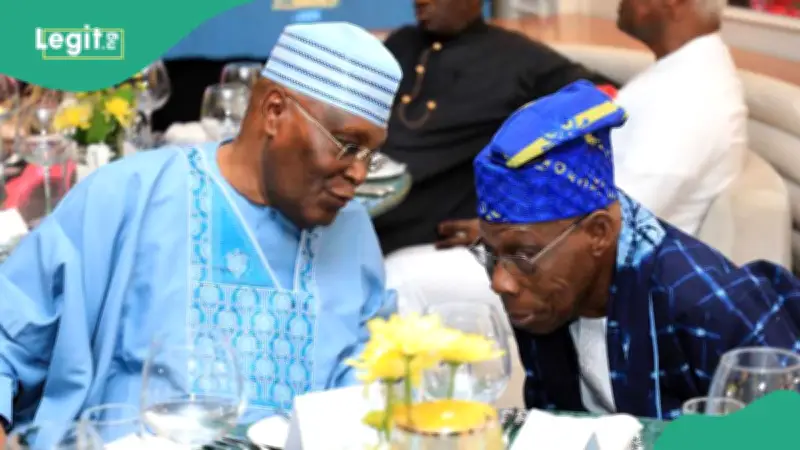
Atiku Abubakar, the presidential candidate of the African Democratic Congress (ADC), has launched a sharp verbal attack on former President Olusegun Obasanjo, dismissing him as a political figure with no genuine electoral influence. Atiku asserted that Obasanjo's 1999 presidential victory was solely due to the support of northern Nigeria, not his own political strength.
Speaking to journalists on Wednesday, August 20, 2026, Atiku responded to reports that Obasanjo had decided not to endorse his presidential ambition for the 2027 general elections. Rather than expressing disappointment, Atiku went on the offensive, questioning Obasanjo's political relevance in the country's electoral landscape, as reported by Tribune.
Atiku Claims Obasanjo Lacks Electoral Value
Atiku directly challenged Obasanjo's political legacy, stating unequivocally that the former president cannot sway voters. "In 1999, he could not even win his own state or the Southwest; it was Arewa that made him President. He possesses no electoral value," Atiku said. The remark underscores the deep rift between the two men, who served together as president and vice president from 1999 to 2007.
Atiku's comments came after reports emerged that Obasanjo had declined to back his former deputy's campaign for the 2027 presidency. The snub did not deter Atiku, who instead used the occasion to highlight what he sees as the limits of Obasanjo's political reach in Nigeria.
Long-Running Rivalry Between Atiku and Obasanjo
The relationship between Atiku and Obasanjo has been fractured for nearly two decades. The two men served in Nigeria's highest offices from 1999 to 2007, with Obasanjo as president and Atiku as vice president. Their partnership deteriorated sharply after they left office, and the rift has persisted.
Atiku has previously stated that his decision to oppose Obasanjo's attempt to secure a third term in office was driven by a commitment to defending Nigeria's Constitution and democratic principles. This opposition is widely seen as a key turning point in their relationship, leading to years of political animosity.
Atiku's Pitch to Young Nigerians
Beyond the clash with Obasanjo, Atiku used the media interaction to remind voters of his record in developing young talent during his tenure as vice president. He noted that several individuals he gave opportunities to during that period have since risen to become governors, ministers, directors, and other senior public officials.
Atiku pledged that a 2027 presidential victory would bring more of the same, with young Nigerians given access to leadership roles and opportunities to serve at the highest levels of government. He emphasized his commitment to youth empowerment as a central pillar of his campaign.
Atiku, who has contested the Nigerian presidency multiple times, was ratified as the ADC's 2027 presidential candidate on May 29, 2026, having resigned from the Peoples Democratic Party earlier that year. His campaign now faces the challenge of building a coalition capable of unseating the ruling party in the upcoming election.