Opposition ‘Crumbles’ as Atiku Takes Nigeria’s Crisis to Global Stage
Former Vice President Atiku Abubakar is moving to draw global attention to Nigeria’s internal crises as the opposition coalition fragments, underscoring deepening divisions that weaken prospects for a unified challenge to President Bola Tinubu in 2027.
Atiku said his forthcoming engagement with policy and institutional stakeholders in the United States will focus on what he described as the worsening state of security, governance and economic stability in Nigeria. In a statement issued yesterday by his media adviser, Mr Paul Ibe, Atiku said the country was facing a severe internal crisis marked by persistent violence in the North-West and North-East, continued bloodshed in the Middle Belt, and rising incidents of kidnapping and criminality nationwide. He said the situation reflected a pattern of systemic failure, with communities overrun and livelihoods disrupted, adding that the ability of any government to secure lives and property forms the basis of its legitimacy.
Atiku also highlighted economic challenges, noting that inflation, currency depreciation and declining purchasing power had placed Nigerians under increasing strain. He attributed the situation to policy inconsistency and a lack of clear economic direction, which he said had weakened confidence in the economy. The former vice president further expressed concern over the state of democratic institutions, warning that declining public trust in governance, accountability and the electoral process could threaten national stability, particularly as the country approaches another election cycle.
Responding to criticism of his planned international engagement, Atiku said discussing Nigeria’s challenges with global partners did not amount to inviting foreign interference. He maintained that Nigeria’s internal situation has broader implications and requires openness and accountability from its leadership. He added that while leadership choices remain the responsibility of Nigerians, international partners have a legitimate interest in the country’s stability and democratic standards. Atiku urged the current administration to prioritise security and economic recovery, calling for a clear and credible strategy to address the challenges facing the country. He also called on citizens to remain engaged and demand accountability, stressing that meaningful change would depend on collective national effort.
Coalition Unravels as Obi Exits ADC Amid Zoning Dispute
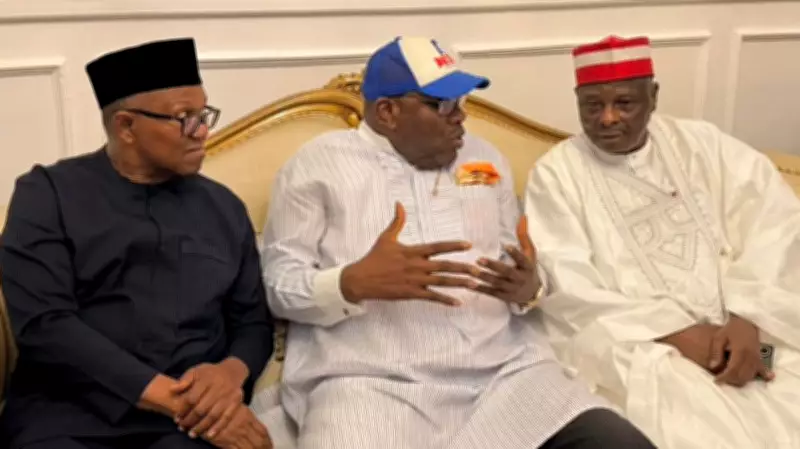
This came as the much-anticipated collapse of the coalition of opposition leaders on the African Democratic Congress (ADC) has begun, following the exit of the Labour Party (LP) presidential contender, Mr Peter Obi, as supporters of his former New Nigeria Peoples Party (NNPP) counterpart, Rabiu Kwankwaso, also pressed for his eventual exit. Officially, the handshake on the coalition platform has turned into a farewell, despite last-minute efforts by the party’s leaders to prevent Obi and Kwankwaso from switching to the newly founded Nigeria Democratic Coalition (NDC) today.
Although the impending collapse of the coalition on the ADC is being framed as a fallout from recent judicial pronouncements on the party’s leadership crisis, checks by The Guardian indicate that the firm presidential ambitions of the first and second runners-up in the 2023 poll are the primary drivers. While the Fourth Republic’s first Vice President, Atiku Abubakar, advocated a united opposition front on a common platform, the Labour Party’s 2023 flagbearer, Obi, aligned with the former Vice President, alongside former Kaduna State governor Nasir el-Rufai and the immediate past Minister of Transportation, Chibuike Rotimi Amaechi.
However, Obi stated from the outset that he should be supported to complete the remaining one term allocated to the South under the North–South power rotation principle. He maintained that the coalition should zone the 2027 presidential ticket to the South if it intends to address governance challenges. As the two dominant blocs within the coalition adopted a wait-and-see approach, tensions escalated last month during the Summit of Opposition Political Parties in Ibadan, which produced the Ibadan Declaration. Among other resolutions, the declaration stated that parties in the coalition would adopt a single presidential candidate for the January 16, 2027 election. Subsequently, the former Vice President declared that the 2027 poll would be his final presidential contest and pledged to support whoever emerges from a transparent and credible direct straw poll.
NDC Chairman Warns Defectors Against Indiscipline, Elite Arrogance
Meanwhile, the National Chairman of the Nigerian Democratic Congress, Cleopas Moses, has warned new entrants to the party against actions that could trigger internal divisions, stating that the organisation will not tolerate indiscipline or elite arrogance. Speaking at a defection ceremony in Abuja, Moses said the party’s expansion would not come at the expense of its internal order, adding that political stature would not override established rules. “Anyone coming into NDC must understand our core values. You don’t come in and assume you are better than those already here,” he said.
He identified entitlement and superiority as factors responsible for instability in other opposition parties. “That mindset is what has caused the calamities we see in the opposition. We will not tolerate it.” Moses said the party would maintain its structure regardless of individual decisions to join or stay away. “If you are not coming, this ark will still float. We are not at the begging end.” He added that members must prioritise loyalty to party structures above personal ambition. “Be humble enough to learn. Where change is needed, make suggestions — not disruptions.” The NDC chairman said disagreement within the party should not undermine cohesion. “We can disagree, but we must not destroy the system. There must always be room for common ground.”
The warning came as the NDC recorded a new wave of defections from the All Progressives Congress, the New Nigeria Peoples Party and the Peoples Redemption Party, indicating growing traction ahead of the 2027 general elections. Among those who joined the party are Babatunde Ali, former deputy national chairman (South) of the Peoples Redemption Party; Mohammed Sani Yahaya, the New Nigeria Peoples Party’s 2023 governorship candidate in Taraba State; and Ehiozuwa Johnson Agbonayinma, a former lawmaker and ex-member of the Code of Conduct Bureau board. The event, led by National Leader Seriake Dickson alongside members of the National Working Committee, featured the decoration of defectors with party caps and presentation of membership cards. Party officials said the development reflects growing confidence in the NDC as a disciplined alternative, as Moses reiterated the party’s position on expansion anchored on internal order and adherence to its principles.
PDP Crisis Deepens as Wabara Faction Moves to Convene NEC, Appoint Caretaker Committee
In a related development, the crisis rocking the Peoples Democratic Party (PDP) took a new turn yesterday as a faction of the Board of Trustees (BoT) led by former Senate President, Adolphus Wabara, announced plans to convene a meeting of the National Executive Committee (NEC) to appoint a caretaker committee to run the affairs of the party. Wabara disclosed this at the 84th meeting of his factional BoT held in Abuja, stating that the group had secured the consent of two-thirds of NEC members to hold the meeting scheduled for Monday. The move, according to him, is part of efforts to stabilise the party following the Supreme Court judgment delivered on April 30, which nullified the 2025 national convention that produced the National Working Committee (NWC) led by Kabiru Tanimu Turaki.
Wabara said the apex court’s verdict had effectively stripped the party of a valid NWC, thereby necessitating the intervention of the BoT to prevent a leadership vacuum. “The Board immediately assumed administrative leadership of the party in line with the provisions of the PDP Constitution (as amended in 2017),” he said, noting that the action averted a total collapse of the party’s structure in the aftermath of the judgment. He explained that the proposed NEC meeting would deliberate on the implications of the court ruling and take “crucial decisions” aimed at rescuing the PDP from its current challenges. The meeting, it was gathered, is expected to facilitate the appointment of a caretaker committee that would oversee the party’s affairs pending the conduct of a fresh national convention.
In attendance at the BoT meeting were former Niger State governor, Babangida Aliyu, who serves as secretary of the faction’s board of trustees; former chairman of the defunct NWC, Kabiru Tanimu Turaki, and other key stakeholders aligned with the group. Wabara used the occasion to justify the BoT’s assumption of administrative control, insisting that the body, as the conscience of the party, had a duty to restore credible leadership. He also alleged that the party’s internal crisis was exacerbated by acts of sabotage by certain members allegedly working in concert with external forces to weaken the PDP ahead of the 2027 general elections. Despite the turmoil, Wabara expressed optimism that the party would overcome its challenges, citing widespread support from members and sympathisers across the country. “We have been receiving a flurry of solidarity messages from Nigerians whose belief in the PDP remains unshaken. This strengthens our resolve to lead the charge to rescue our nation,” he said. He commended members of the dissolved NWC for what he described as their “patriotism, loyalty and resilience,” as well as governors, lawmakers and party faithful for standing firm during the crisis.
Mbamara, Uwazurike Fault Atiku’s Ambition, Say It Weakens Opposition Prospects
An Imo State governorship aspirant in 2023, Captain David Mbamara, and a chieftain of the South-East socio-cultural organisation, Ohanaeze Ndigbo, Chief Goddy Uwazurike, yesterday blamed the failures of opposition parties in Nigeria since 2015 on former Vice President Atiku Abubakar. They alleged that his persistence and refusal to step down his presidential ambition for a more viable candidate have undermined the opposition’s chances of success. Both speakers also urged Nigerians, as well as the United States government and any external actors the former Vice President may be engaging, to resist attempts to discredit the administration of President Bola Tinubu and the ruling All Progressives Congress (APC). They argued that such claims should be weighed against the question of why Nigerians should consider electing another northerner in 2027 after the late President Muhammadu Buhari of Katsina State completed eight years in office.
Stating his position, Uwazurike said: “Atiku can do whatever he likes, but no Southerner will vote for a northerner in 2027. The fact that Obi was allowed to defect from ADC has reduced the coalition to a caricature of itself, much like the current state of the Labour Party.” Uwazurike added that he had anticipated Obi’s exit from the ADC, given Atiku’s refusal to step down. “I agree that the former Vice President has contributed his quota, but he has not been as strategic as President Tinubu, who endured political headwinds as an opposition leader, even when he was vilified within APC circles under Buhari,” he said.
Mbamara, on his part, said the cracks within the opposition remain an advantage for President Tinubu, adding that he does not see the opposition unseating him in 2027. According to him, the challenge lies not with the electorate but with the platform through which Tinubu could be removed. “That platform is not viable yet,” he said. Meanwhile, a South-West group, the Yoruba Ronu Leadership Forum, expressed concern over what it described as the “inconsistent posture” of Mr Peter Obi following his decision to leave the ADC. President of the forum, Akin Malaolu, said: “Obi’s decision to quit ADC at a time when the National Working Committee, led by David Mark, had stabilised the party suggests a deeper motive, raising questions about whether he may be serving other interests. He needs to reflect more on the conditions in the country and the hardship faced by Nigerians under the APC, rather than personal ambition. We are concerned by what now appears to be a contradiction — presenting himself as a presidential hopeful while allegedly destabilising the African Democratic Congress after benefiting from the Labour Party platform in 2023. Our forum supported the Labour Party in 2023, and we regret that decision. To our supporters nationwide, particularly in the South-West, we apologise. We remain committed to the ADC and will work towards its success in future elections. As for the Obidient movement, while we engaged with them previously, we advise that political engagement must go beyond emotional mobilisation. Experience and strategy remain critical in navigating the political landscape. Finally, we bid farewell to Peter Obi and his supporters.”
ADC Crisis Deepens Over Zoning, Primaries as Coalition Strains Worsen
Irked by what they described as a cumbersome and costly direct primary instead of a consensus arrangement, supporters of Obi began consultations aimed at withdrawing from the coalition. They argued that the failure of some entrenched political interests in the ADC to address the public pronouncement on the contentious issue of zoning revealed a hidden agenda. In a move similar to his March 27, 2022, defection from the Peoples Democratic Party (PDP) to the Labour Party (LP), Obi, in the early hours of yesterday, announced his exit from the ADC, citing a “toxic political environment”. Reflecting on his time on the ADC platform, Obi decried “the worsening political climate marked by internal crises, external interference, and growing hostility within party structures”.
Obi’s exit comes on the heels of mixed signals from Kwankwaso, who had earlier issued a statement explaining that, contrary to narratives in the public domain about his immediate political direction following the Supreme Court ruling, he had yet to reach a conclusive decision on his consultations. In a statement titled Clarification on My Political Position, Kwankwaso declared: “In light of the misleading narratives in the public domain, I wish to state categorically that no final decision has been taken regarding my political future or that of my political associates.” He noted that, despite the split decision by the Supreme Court, which affirmed the legitimacy of the David Mark-led National Working Committee (NWC) while remitting the matter to the High Court, “has left the party in a precarious position.”
Pushing back against suggestions that his exit from the ADC would amount to betraying northern interests or undermining Atiku’s chances, the former NNPP presidential candidate stated that the Federal High Court ruling, which invalidated the party’s recent convention, compounded the ADC’s challenges. He further expressed concern that the Attorney General of the Federation “has also strangely applied to a Federal High Court to deregister the ADC”, adding that these issues explain his ongoing consultations. “We left the NNPP due to externally influenced legal problems that made our stay perilous. The ADC has now also been forced into this difficulty. Consequently, like other major stakeholders, we have commenced wide-ranging consultations, including with leaders from the NDC, PRP and others to explore the best options for protecting our democratic interests. We shall announce our decision in the soonest possible time,” the statement noted.
Kwankwaso also addressed the sensitive issue of zoning, a key concern among coalition partners. While stating that his group would continue to engage constructively at all levels, he highlighted his political standing and experience. His words: “On the issue of presidential candidacy, I wish to recall my consistent record as a committed democrat. In the 2014 APC presidential primary, I came second to President Muhammadu Buhari (whom I fully supported to victory), with Atiku Abubakar third, Rochas Okorocha fourth, and the late Sam Nda-Isaiah fifth. Similarly, in 2019, I contested the PDP presidential ticket and immediately supported the winner, His Excellency Atiku Abubakar, serving as the campaign’s coordinator in the North. I have always placed national interest and party unity above personal ambition. Furthermore, the ADC is yet to zone its presidential ticket or take any decision on a candidate. I have therefore neither declared any intention to run for president nor endorsed any aspirant. All speculations to the contrary are premature and unfounded.” He promised to communicate any definitive position on his group’s political direction through official channels at the appropriate time.
In a reflective message shared yesterday, Obi lamented the increasing toxicity of Nigeria’s political environment, where he said intimidation, insecurity and persistent scrutiny have become the norm. “The systems meant to protect citizens now often work against them, while individuals striving for sincere service face mounting pressure both publicly and privately,” he stated, stressing that his exit was not due to any personal grievances with party leaders, including former Senate President David Mark or former Vice President Atiku Abubakar. Without directly referring to the ADC’s position on zoning the presidential ticket to the South, Obi criticised the persistent internal divisions, legal disputes and infiltration that undermine party stability. Recalling similar dynamics that led to his exit from the Labour Party, the former Anambra State governor condemned the normalisation of repudiating integrity and humility, while adherence to due process is treated as weakness. He restated his belief that a new Nigeria that works for all remains possible, while lamenting that “genuine efforts toward nation-building are increasingly undermined by suspicion, exclusion, and political maneuvering focused more on control than service.”
Presidency Criticises Peter Obi Over Possible ADC Exit
The Presidency yesterday criticised the former Labour Party presidential candidate, Peter Obi, over indications that he may be preparing to leave the African Democratic Congress, describing him as a “political nomad” prone to opportunistic shifts. Obi, who joined the ADC in March after contesting the 2023 presidential election under the Labour Party, had hinted in a recent social media post at a possible exit amid speculation over fresh political alignments ahead of the 2027 general elections. Reacting via his verified X handle, @aonanuga1956, the Special Adviser to the President on Information and Strategy, Bayo Onanuga, dismissed Obi’s reasons for the reported move, describing them as incoherent and self-serving. “We told you so. The political nomad is on the move again. Ignore all those puerile reasons he gave in these illogical musings, a self-serving letter to his mob,” Onanuga wrote.
In remarks laced with sarcasm, the presidential aide further described Obi as “a politician made of jelly” and “an opportunistic fellow”, suggesting he lacks the staying power to compete within party structures. “He can’t fight Atiku Abubakar or Rotimi Amaechi for the ticket of ADC. He pursues the easy road that will only lead him to doom, like in 2023,” he added. Onanuga also accused Obi of deflecting responsibility, saying, “He always blames the government without doing a soul-searching of himself. Welcome, Peter, to the 2027 race.” Although Obi has yet to formally announce his next political move, reports have linked him and former Kano State governor, Rabiu Musa Kwankwaso, to a possible new political platform, the Nigeria Democratic Congress (NDC), as consultations intensify ahead of the next election cycle.
Mimiko Defends Tinubu, Blames Opposition Crisis on Internal Failings
The governorship candidate of the Zenith Labour Party (ZLP) in the 2024 election in Ondo State, Abass Mimiko, has dismissed claims that President Bola Tinubu is responsible for the crisis rocking opposition parties in Nigeria. Mimiko said the president should not be blamed for what he described as internal failings within the opposition fold, adding that allegations that Tinubu is stifling opposition are baseless. Speaking with journalists at his Ondo residence during a media chat, the psychiatrist and younger brother of former governor Olusegun Mimiko said governors and political actors defecting to the ruling All Progressives Congress (APC) are acting out of conviction and political calculation rather than coercion.
The ZLP chieftain said Tinubu’s democratic credentials remain unmatched, citing his role during struggles to reclaim electoral mandates allegedly stolen in Ondo, Ekiti, Osun and Edo states as examples where he played a frontline role in supporting legal and political battles that restored opposition victories. He dismissed fears that the country is drifting towards a one-party state, noting that opposition figures such as Atiku Abubakar, Peter Obi and Rabiu Musa Kwankwaso remain active voices in national discourse.
Binani Leads Supporters to NDC as ADC Downplays Defection
Back in Adamawa State, supporters of the 2023 governorship candidate of the All Progressives Congress (APC), Senator Aisha Dahiru Ahmed (Binani), followed her to the NDC, stressing that the overall consideration was public good rather than individual ambition. Senator Binani explained that her purpose in public service has always been people-centred, adding that she responded to her supporters’ demand that the NDC should serve as their alternative platform to the ADC. She lamented the machinations of certain leaders within the coalition platform, stressing that imposition and godfather politics have no place in the new Nigeria that the people demand.
In a statement by the ADC National Publicity Secretary, Mallam Bolaji Abdullahi, the party said it remained unfazed, adding that it plans to field a credible candidate for the 2027 poll. He dismissed insinuations that the ADC would not produce candidates in the 2027 elections, describing them as “unfounded and mischievous scaremongering, with no basis in reality or in any law”, insisting that it will field credible candidates for the elections. While maintaining that it remains the country’s primary opposition platform, with a clear focus on organising, mobilising and preparing to win the 2027 general elections, the ADC urged Nigerians to disregard such assertions. “Our party is fully compliant with all legal requirements and is actively building the structures necessary to contest and win elections at all levels,” Abdullahi stated.