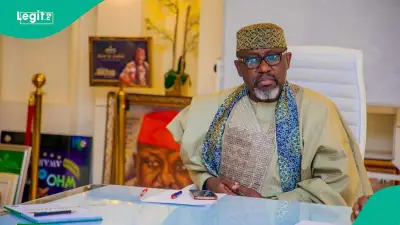
As political realignments quietly gather momentum ahead of the 2027 general election, leader of the Social Democratic Party (SDP), Prince Adewole Adebayo, has disclosed why his party has refused to join the African Democratic Congress (ADC) coalition platform, dismissing the elite-driven alliance as fundamentally flawed. In an interview with select journalists, he noted that the SDP is building what he described as a “people-powered coalition” that aims at not only ousting President Bola Tinubu from power but also enthroning good governance in the country.
Why the SDP is not joining the ADC coalition
Alliances and coalitions are with strategic partners in an election, Adebayo explained. Strategic partners are not necessarily politicians but segments of society. If you have the political class, there are disagreements because the ultimate aim of politics is to enter government and govern. If you talk about accountability and corruption, you will not have credibility if you align yourself with people who don’t believe in that, either by their words, actions, or questionable character. So you will be inconsistent.
Also, he noted that the majority of people who make elections happen have not been participating. In the last presidential election, 93 million voters were registered, but less than 80 per cent showed up. To build a coalition, you need to find out where the 80 per cent that didn’t show up are, what issues bothered them, and why they didn’t vote. The SDP is working with strategic partners to address those issues.
The SDP has talks with other political parties from time to time, but sometimes those talks are not productive because some people who made serious mistakes in government over the past 20 years haven’t learned anything new. They are looking for an opportunity to make another mistake for another 20 years, and the SDP will not enable that. Some in the coalition want to play roles they are not suited for, based purely on ambition.
SDP’s activities and membership drive
When asked about the party’s activities, Adebayo said they are focused on increasing membership. Across the country, thousands of people have joined the SDP. In Kano, for instance, thousands joined, but the media underreported it. However, the party sees this as a mixed blessing; on election day, the difference will be visible.
Adebayo urged Nigerians not to rely solely on a coalition to save them. Instead, they should talk to their neighbours, listen to debates, join a political party that speaks the truth, and participate in elections. He encouraged people not to lose hope.
The SDP is also engaging religious, civic, and professional organizations that profit from serving a bad election system, urging them to improve it. In the last few months, data shows that in many remote parts of the country, the party gains close to 100,000 new members each week, up from 100,000 a month. The party is following up to ensure quality participation, not just numbers.
On defections from the SDP
Regarding recent defections, Adebayo downplayed their significance. If 5,000 people leave, the party may not notice because it brings in 50,000 to 100,000 every week. Defections often occur when a particular aspirant is not favoured by zoning and decides to pursue his ambition elsewhere. The party respects that, but it is not about individual ambition. For every defector who advertises his departure, thousands are joining.
What matters is that Nigerians understand why the SDP is in the race. The party is about the substance of Chapter Two of the Constitution, emphasizing that governance is a contest of principles, not personality. If that message spreads, others will join, even those currently in other coalitions.
INEC and credible elections
Adebayo expressed doubt about INEC’s ability to conduct a credible election in 2027. The INEC chairman was appointed by the president, and the Council of State and National Assembly approved the appointment without question. He noted that opportunities for free and fair elections, such as the Uwais Panel report, were squandered. The chairman of the ADC, who was Senate President at the time, threw away the report.
Now, the people left to ensure free, fair, and credible elections are the politicians themselves, the media, voters, and law enforcement. For INEC, that opportunity has passed.
On the perception of shrinking democratic space
Adebayo stated that President Tinubu is not a democrat and has stopped pretending to be one. He recalled an interaction at the State House where Tinubu told political parties, “Listen, I suffered, go and suffer your own.” Adebayo interpreted this as a message that opposition parties must be ruthless to unseat him.
He outlined three things the opposition must do: run political parties lawfully, oppose in principle to save the country and ensure good governance, and create a sharp contrast with Tinubu’s government. Nigerians must see a clear alternative that is like day and night, black and white.