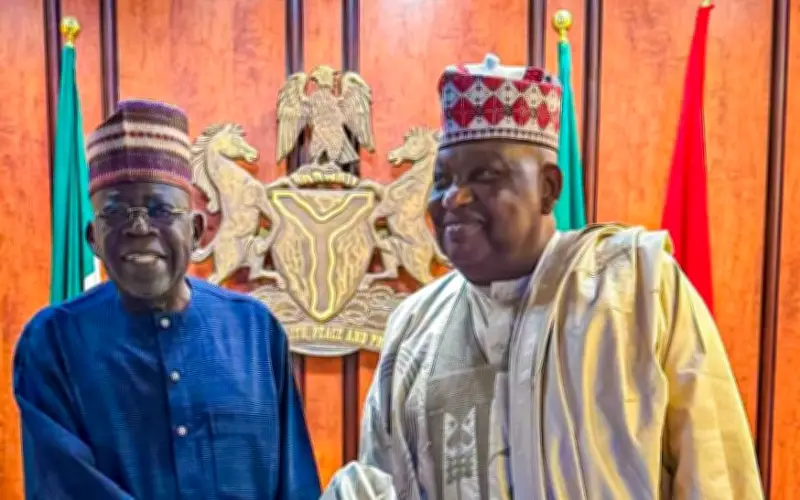
Senator Rufa'i Hanga, the sole opposition senator from Kano State representing the Kano Central District under the Nigeria Democratic Congress (NDC), has intensified political consultations with top figures of the ruling All Progressives Congress (APC). A late Sunday meeting with President Bola Tinubu at the State House in Abuja has sparked widespread speculation that the lawmaker is preparing to defect from the NDC to the APC.
High-Profile Consultations
Hanga, accompanied by former senator Kabiru Gaya, was escorted to the Presidential Villa by Deputy Senate President Barau Jibrin. Jibrin later described the encounter as “fruitful.” Prior to the presidential audience, Hanga had also held separate meetings with the National Chairman of the APC, Nentawe Yilwatda, and Kano State Governor Abba Yusuf. These successive engagements with key political figures have led observers to conclude that a formal party crossover is imminent.
Political analysts note that such a move would break Hanga’s long-standing ties with his political ally and leader of the Kwankwasiyya Movement, Rabiu Kwankwaso. The relationship between Hanga and Kwankwaso has reportedly soured after Hanga failed to secure a return ticket to the Senate and was also overlooked for the NDC deputy governorship nomination. These developments are seen as classic precursors to a party switch.
Strategic Advantage for APC
With the APC actively consolidating its base in Kano State, welcoming a sitting senator from the state’s most populous and politically influential district—Kano Central—represents a major strategic advantage for the ruling party ahead of the 2027 general elections. Kano Central encompasses 15 local government areas, including Kano Municipal, Tarauni, Dala, Nassarawa, and Fagge. Winning this district requires strong grassroots networks that are independent of state-wide party waves.
Observers believe that Hanga’s defection would bolster APC’s presence in the region, leveraging his extensive constituency outreach and welfare interventions. Hanga is known for providing burial materials to constituents and maintaining direct contact with local communities. While some question his personal popularity, his supporters argue that he enjoys substantial backing from elders, traditional structures, and grassroots loyalists.
Public Fallout with Kwankwaso
The friction between Hanga and Kwankwaso became public during a radio interview in Kano. Hanga accused Kwankwaso of betrayal for allegedly denying him a return ticket to the Senate or the position of NDC deputy governorship candidate. Kwankwaso reportedly cited Hanga’s age and a leg condition as reasons for bypassing him. However, Hanga dismissed these justifications, asserting that he is healthier than Kwankwaso.
“How can Kwankwaso cite my age and health condition to deny me the chance? As of today, I am healthier than Kwankwaso. His frequent references to my leg condition are nothing but a sham… Regarding age, he is two years older than I am,” Hanga stated. He maintained that his leg condition has never impeded his legislative duties in the 10th Senate, accusing the NDC leadership of deliberate political marginalisation.
This public exchange signalled a complete breakdown of trust, making Hanga’s departure from Kwankwaso’s political camp appear inevitable. By joining the APC, Hanga could leverage federal backing, remain politically relevant, and potentially secure a key appointment or a strategic role within the APC structure in Kano State.
Who is Rufa'i Hanga?
Rufa'i Hanga is a professional accountant and a seasoned figure in northern Nigerian politics. He served as the founding National Chairman of the Congress for Progressive Change (CPC), the party created by former President Muhammadu Buhari before its merger into the APC in 2013. Hanga is known for unconventional, direct constituency outreach and widespread welfare interventions that have helped him maintain ties across Kano Central’s 15 local government areas. His political future now hangs in the balance as he navigates the transition from the opposition NDC to the ruling APC.