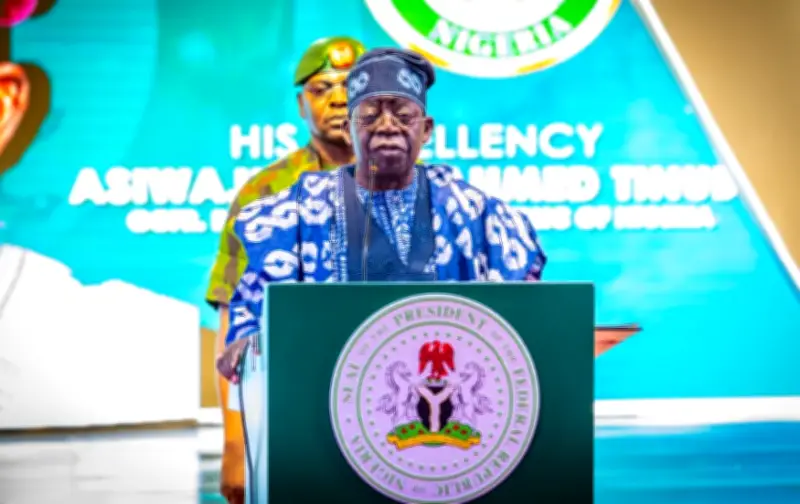
President Bola Tinubu has defended his administration’s economic and power sector reforms, asserting that access to reliable electricity is a “democratic dividend” that every Nigerian deserves. In his Democracy Day address on Friday, Tinubu acknowledged persistent challenges in the electricity sector but stated that ongoing reforms are designed to reverse years of underinvestment, infrastructure deficits, and financial instability.
Electricity Sector Challenges
Tinubu explained that his administration inherited a power sector plagued by chronic generation shortfalls, unreliable gas supply, weak transmission infrastructure, huge distribution losses, and a metering deficit exceeding four million customers. He noted that the sector was also burdened by significant legacy debts, resulting in electricity generation, transmission, distribution, and revenue collection all falling below sustainable levels.
“By 2023, when we came on board, the electricity sector was characterised by chronic generation shortfalls, an unreliable gas supply, and transmission infrastructure so fragile that it could not evacuate available power,” Tinubu said. “The result was a sector that generated less than the 13,500 megawatts installed capacity, transmitted less than it generated, distributed less than it transmitted and collected revenue far below what it needed to sustain itself.”
Despite enormous investments in generation infrastructure over the years, low plant availability, gas supply constraints, maintenance challenges, transmission hitches, and ageing grid infrastructure continue to limit effective electricity delivery across Nigeria. The national grid suffers intermittent collapses, forcing many households to seek alternative power sources such as expensive solar systems and generating sets. Recent spikes in fuel costs, following the US-Israel war against Iran, have further driven up energy costs, making alternatives almost unaffordable for Nigerians already grappling with a major cost-of-living crisis.
Reforms and Initiatives
To address these challenges, Tinubu said he signed the Electricity Act, which devolves greater authority to states to generate, transmit, and distribute electricity within their jurisdictions. He added that the Presidential Power Sector Task Force has been mandated to tackle the metering deficit and has received approval to raise a N4 trillion bond to clear verified legacy debts across the electricity value chain. The president also highlighted efforts by the Rural Electrification Agency, supported by the World Bank and the African Development Bank, to expand electricity access through off-grid and mini-grid projects in underserved communities, universities, markets, and hospitals.
Economic Reforms
Beyond the power sector, Tinubu used the Democracy Day broadcast to defend broader economic reforms introduced since he assumed office in May 2023. He said the measures, though difficult, were necessary to restore fiscal stability, improve public finances, and attract investment. “The reforms we are undertaking were not chosen for ease, but for necessity,” he said. According to the president, federation revenues have increased significantly since the reforms began, providing state and local governments with more resources for infrastructure, education, healthcare, and security. He noted that fiscal transparency has improved, revenue leakages have been reduced, and investor confidence has returned, leading to increased investments in agriculture, manufacturing, technology, mining, transportation, energy, and the creative sector. Tinubu also pointed to growing domestic refining capacity, which he said is helping to strengthen Nigeria’s energy security and reduce dependence on imported petroleum products.
Acknowledging Hardship
Despite highlighting progress in economic management, Tinubu acknowledged that many Nigerians continue to face economic hardship. He said his administration remains focused on reducing inflation, increasing food production, creating jobs, and improving living standards. Tinubu cited ongoing infrastructure projects across the country aimed at linking producers to markets and stimulating economic activity. He noted that the National Agricultural Development Fund is implementing a programme to deploy 10,000 tractors over five years, while more than 1,000 small and medium-sized enterprises have been certified for export. According to him, non-oil exports grew by 21 per cent in the last year. “We are moving from uncertainty to stability. The next phase is about accelerating growth and ensuring the benefits are felt in every home, every community, and every region,” he said. “We believe that democracy must be felt in the pocket.”