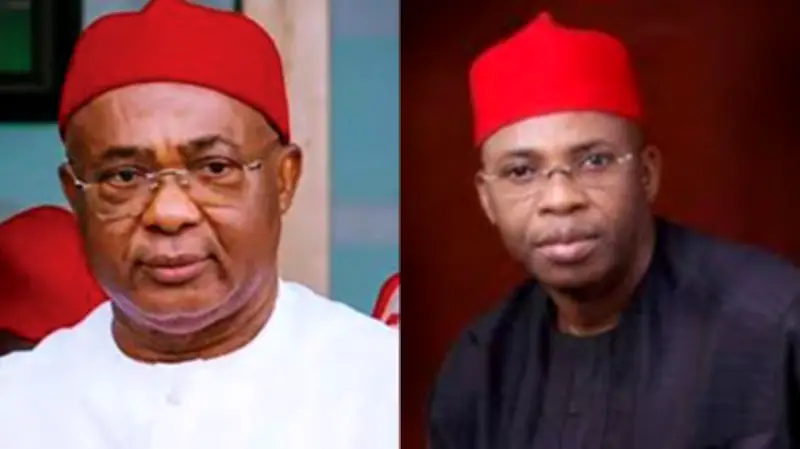
At first glance, some may see Governor Hope Uzodimma and Dr. Ikedi Ohakim as belonging to different political eras. A closer look reveals something else. Both men share a common philosophy. They believe that government must build. They believe that infrastructure matters. They believe that institutions matter. They believe that development requires vision, courage and persistence.
Governor Uzodimma deserves credit for stabilising Imo State during a difficult period and restoring confidence in governance. Across the state, roads have been reconstructed, public infrastructure has expanded and major development projects have taken shape. But every governor who builds eventually faces a critical question: Who preserves the legacy?
History teaches us that progress can be reversed as quickly as it is achieved. Projects can be abandoned. Policies can be dismantled. Institutions can be weakened. Years of effort can disappear. This is why continuity matters. Not continuity of personalities. Continuity of vision.
This is where Dr. Ikedi Ohakim becomes particularly relevant. Unlike many politicians whose instinct is to destroy whatever came before them, Ohakim has consistently demonstrated respect for continuity. Since leaving office, he has supported successive administrations and acknowledged progress where he has seen it. He understands something many politicians do not. Development is cumulative.
No governor starts from zero. No governor succeeds alone. Each administration inherits something and leaves something. The true test of leadership is whether that chain remains unbroken. If Governor Uzodimma desires a successor who understands the importance of preserving achievements while advancing them further, then experience becomes an asset.
Ohakim understands governance. He understands institutions. He understands long-term planning. Most importantly, he understands that the future of Imo cannot be built by endlessly restarting the state. It must be built by consolidating gains and expanding opportunities.
That is why the story of Hope Uzodimma's achievements and the relevance of Ohakim are not competing narratives. They are complementary narratives. One speaks to recovery. The other speaks to continuity. Together, they point toward a simple truth: Imo's future will be safest in the hands of someone who understands both where the state has come from and where it needs to go.