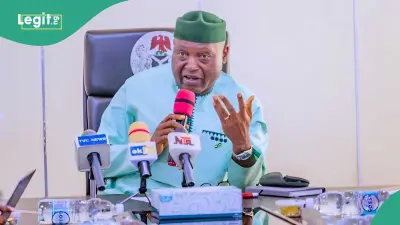
Zamfara State Governor Dauda Lawal has revealed that he refused to pay a N300 million ransom demand when his brothers were abducted in 2019, stating he would rather see them killed than fund criminal activity. The governor made the disclosure on Thursday, July 9, at the ARISE News and THISDAY Townhall Conference in Abuja, where he also made a strong case for the establishment of state police across Nigeria.
Governor's Stand on Ransom Payments
Speaking at the event, Lawal recounted the harrowing experience: "My own brothers were kidnapped in 2019, and these criminals were demanding at the time about 300 million. And I said, look, I'm not going to pay a dime. If you like, go and kill them." The kidnappers held his brothers for three months before releasing them without collecting any payment.
The governor argued that ransom payments directly fuel the cycle of abductions, giving criminal networks both the financial means and the motivation to continue. "By the time we continue to pay ransom to these people, we are encouraging them to be kidnapping people more and more," he said. He added that removing the financial incentive would force criminals to reconsider their actions. Lawal made clear that his position remains firm and non-negotiable: "I will not negotiate, and I will not pay ransom to any criminal, no matter what happens."
Call for State Police and Accountability
Beyond the ransom issue, Lawal used his address to highlight what he described as a fundamental contradiction in Nigeria's security architecture: governors are designated chief security officers of their states but hold no operational authority over the police or other security agencies. "In as much as I was called or I'm being called the chief security officer of the states, however, I don't have the command and control structure to determine what happens or give instructions to some of these security officers," he said.
He questioned how anyone could hold governors accountable for insecurity under such conditions. "Why is it difficult for people to understand that my primary responsibility is the protection of lives and property, and I don't have that control? How do you hold me accountable?" he asked. Lawal said devolving policing powers to states would enable citizens to directly hold elected leaders responsible for security outcomes and allow states to properly fund and train personnel. He also noted that the Nigeria Police Force suffers from chronic underfunding, inadequate training, and poor welfare, all of which he said weaken operational effectiveness.
Zamfara's Security Investments
The governor said Zamfara State already funds more than 30 per cent of security operations within its borders. Over the past three years, his administration has procured more than 500 vehicles for security agencies and recently supplied 35 Armoured Personnel Carriers and Mine-Resistant Ambush Protected vehicles for active deployment. Lawal added that the state had also acquired both surveillance and attack drones to assist security forces in targeting criminal hideouts.
His remarks align with an ongoing national debate over state police reform, with advocates arguing that localising policing powers could sharpen accountability and improve responses to security threats at the grassroots level.
Recent Kidnapping Incident
In a related development, three university students were recently kidnapped in the state. SP Ramhan Nansel, the command's public relations officer, said that a distress call was put through to the police at about 9:21 pm on Tuesday, July 7. The assailants first knocked on the door of the students' residence before they forced their way inside. He further explained that their hostel is located in an area that is secluded around the temporary campus of the university, behind a power line and close to a bush path that led to Awe town.