
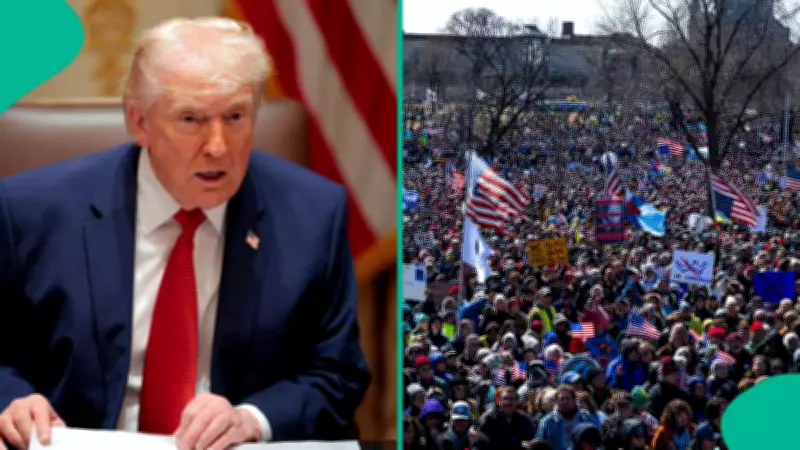
Millions March Across America in 'No Kings' Protests Issuing Five Core Demands
Millions of demonstrators have flooded streets across the United States under the unifying banner of "No Kings," creating one of the largest protest movements in recent American history. From the urban centers of New York and Washington, D.C., to rural communities in Kentucky and the West Coast, citizens have mobilized to demand fundamental changes to government policies and priorities.
Nationwide Mobilization with Historic Turnout
More than 3,000 organized events have taken place nationwide, with participation numbers expected to surpass the 5-7 million mark seen in previous major protests. The movement has captured national attention through creative displays, powerful chants, and coordinated marches that have brought together diverse communities with shared grievances against what they perceive as authoritarian overreach and systemic failures.
At the flagship rally in Minnesota, an estimated 50,000 people gathered at the State Capitol in St. Paul, where prominent figures including Senator Bernie Sanders, actress Jane Fonda, and musician Bruce Springsteen energized the massive crowd. Springsteen's address particularly resonated with protesters when he declared, "Your strength and your commitment told us that this is still America, and this reactionary nightmare and these invasions of American cities will not stand."
The Five Core Demands of the Movement
Organizers emphasize that the protests represent more than a single issue, instead addressing a comprehensive range of concerns that have galvanized citizens across political and geographic divides. Here are the five primary demands driving this nationwide mobilization:
- Demand for Democracy: "No Kings"
The very name of the coalition serves as its foundational demand. Organizers describe "No Kings" as a rejection of authoritarian rule and a call to return power to ordinary citizens. Hunter Dunn of the 50501 movement explained the philosophy behind the name: "It's a declaration of intent that we are going to return power back to the people." This demand represents a fundamental challenge to perceived concentrations of power and decision-making authority.
- End to War in Iran
Protesters have strongly condemned U.S. military actions in Iran, with memorials erected in Boston to honor children killed in missile strikes. Demonstrators view the conflict as unjust and demand an immediate cessation of military aggression abroad, arguing that resources should be redirected toward domestic needs and peaceful diplomacy.
- Stop Immigration Raids and Crackdowns
Immigration enforcement has emerged as a major flashpoint, with protesters denouncing raids and fatal shootings by federal agents. The chant "No ICE in our streets" has become a rallying cry at numerous demonstrations. In Austin, activists left an ice sculpture inscribed with "ICE MELTS IN TEXAS" to symbolize their demand for more humane immigration policies and an end to what they describe as aggressive enforcement tactics.
- Protect Workers, Not Billionaires
Economic justice forms a central pillar of the movement. Ezra Levin, co-founder of Indivisible, has called for a nationwide economic protest on May 1, urging people to skip work, school, and shopping to demonstrate economic power. His message encapsulates this demand: "We're going to show up and say we're putting workers over billionaires and kings." This reflects broader concerns about economic inequality and corporate influence in politics.
- Safeguard Voting Rights and Demand Congressional Accountability
Proposed changes to voting laws have sparked significant anger among protesters, who argue these changes threaten democratic participation. The movement demands that voting rights be protected and expanded rather than restricted. Simultaneously, protesters have directed frustration at lawmakers with chants of "do your job," while signs mock Congress as timid or unwilling to stand up to the Administration. This dual demand calls for both electoral reform and stronger legislative oversight and accountability.
A Movement of Comprehensive Reform
The "No Kings" protests represent more than opposition to individual policies—they constitute a sweeping rejection of what participants perceive as authoritarian tendencies, unjust wars, and systemic inequality. Protesters are demanding nothing less than a fundamental reorientation of American democracy, justice systems, and economic priorities.
As the movement continues to gain momentum, its voices echo across cities and towns nationwide, creating a powerful testament to citizen engagement and the enduring American tradition of peaceful protest. The diversity of demands highlights how multiple issues have converged to create a unified movement determined to protect rights, workers, and the environment while challenging concentrations of government and corporate power.
The protests have also inspired international attention, with smaller anti-war demonstrations taking place in Tel Aviv, Israel, where demonstrators criticized Israel's attacks on Iran. As the Middle East conflict enters its third week, tensions continue to intensify across the region, adding global dimensions to the domestic concerns driving American protesters.




