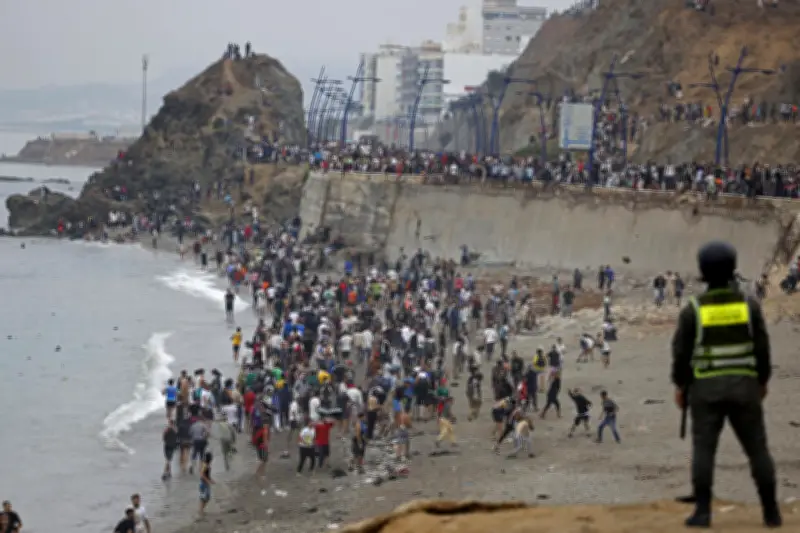
The confirmed death toll from last week's unprecedented migrant crossing into Spain's North African enclave of Ceuta has risen to at least 72, the Spanish government's delegate in the territory told reporters on Sunday.
Miguel Angel Perez Triano said "the latest figure that we have is 72," raising the previous count of 67 fatalities during the mass influx. Most of the estimated 60,000 people who entered the enclave last week, many swimming around a border fence from neighboring Morocco, have since returned voluntarily to Morocco within 48 hours.
Largest Migrant Rush in Ceuta's History
Ceuta witnessed a sudden surge of tens of thousands of migrants, many of whom bypassed the border post by swimming around it. The influx, described as the largest such rush in the enclave's history, overwhelmed local infrastructure and required swift reinforcement of security forces.
Spanish police and troops patrolled the streets of Ceuta on Sunday as the enclave began to return to normal after the chaos. Only small groups of migrants remained visible, with many having already left. An AFP reporter observed Spanish soldiers detaining a group of nine tired-looking migrants sitting on a pavement outside a housing project near Ceuta port, guarded by troops with an armoured car.
Small inflatable boats from a rescue unit scoured waters around a new 500-metre floating boom that now reinforces the border barrier extending into the Mediterranean Sea. The Civil Guard was also seen taking migrants off a bus to escort them back to the border post for return to Morocco.
International Fallout for Madrid
The largest migrant rush ever recorded in Ceuta has sparked an international crisis for Spain, drawing criticism from European partners over Madrid's immigration policies. The sudden influx over a few days strained relations between Spain and Morocco, which have long cooperated on migration control. European capitals expressed alarm, urging Spain to better secure the external border of the European Union.
Spain has blamed criminal gangs for spreading rumors that a recent Spanish Supreme Court ruling on immigration would make it easier for migrants to stay. Authorities say the misinformation triggered a surge leading to tens of thousands attempting to cross the land border or swim around the sea barrier.
Return of Migrants and Security Measures
In response, Spanish authorities reinforced security with additional police and military deployments, as well as the installation of the floating boom designed to deter swimmers. The rapid return of most migrants, facilitated by Spanish and Moroccan efforts, eased immediate pressure on Ceuta's reception facilities, which had been overwhelmed at the peak of the crisis.
The voluntary return of roughly 60,000 people within 48 hours underscored the logistical challenge faced by local authorities. Spanish officials credited the calm handling of the situation, but the government delegate acknowledged the tragic loss of life and warned that the death toll might rise as search operations continued along the coast and in the waters near the border.
The tragedy has reignited debate within Spain and the European Union over asylum policies and border enforcement, with opposition parties demanding tougher measures and human rights groups urging that repatriations comply with international law. As Ceuta gradually returns to a semblance of normality, the focus now shifts to preventing a recurrence and addressing the underlying causes that drive migrants to risk such dangerous crossings.