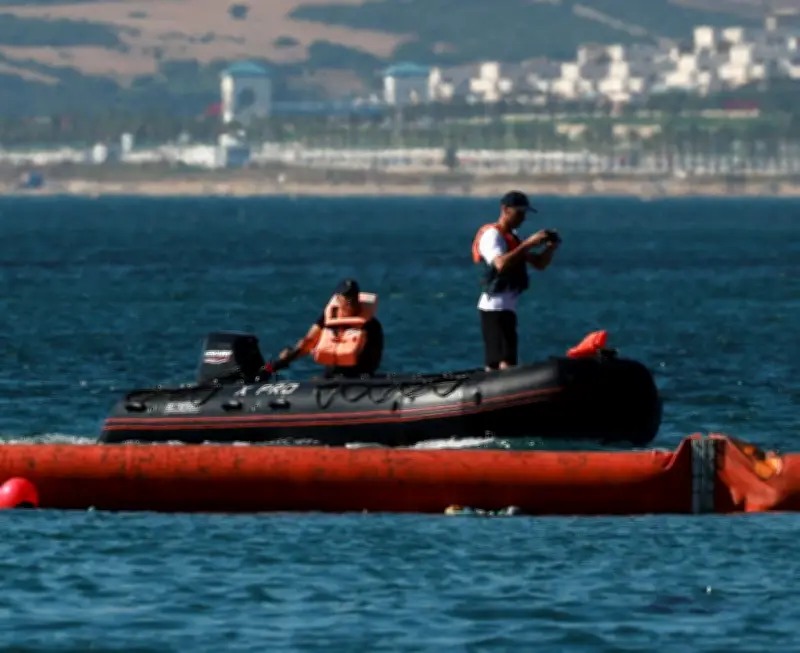
Spanish authorities have arrested two suspected people smugglers after separate attempts to move migrants from the North African enclave of Ceuta to mainland Spain using jet skis and a speedboat. The arrests come at the height of a migration crisis that has seen an estimated 60,000 people enter Ceuta from Morocco in a single week.
The Spanish Civil Guard confirmed that one suspect was detained after allegedly trying to transport migrants on a jet ski, while another was intercepted at the helm of a speedboat carrying 11 Moroccan nationals. The speedboat was stopped before it could reach Spanish territory and was towed back to port in Ceuta. According to local residents, the speedboat's operator was a minor, believed to be under 18 years of age.
Authorities have not revealed the identities or nationalities of the two suspects, and it remains unclear whether they are being held in custody or have been released on bail.
Smuggling Across the Strait: A Costly and Perilous Voyage
Ceuta is a Spanish autonomous city located on the northern coast of Africa, separated from the Spanish mainland by the Strait of Gibraltar. The crossing is short; by jet ski, the sea journey takes roughly 30 to 45 minutes. That speed has made jet skis and speedboats attractive tools for smuggling networks, which charge migrants extortionate fees. Officials have previously reported that smugglers demand up to £3,500 per person for the journey.
Spanish law enforcement has dismantled trafficking operations involving jet skis before, yet the latest arrests demonstrate that these networks remain active and ready to take advantage of chaotic conditions. The use of jet skis is notoriously difficult to police. These agile craft are barely distinguishable from the pleasure boats that regularly cross the strait, and they can be beached on quiet stretches of coastline in minutes. As a result, the Civil Guard has had to rely on intelligence and tip-offs to intercept smugglers, as demonstrated by the latest arrests.
Ceuta Overwhelmed by Unprecedented Arrivals
The city of Ceuta, with a usual population of roughly 84,000 residents, has been brought to a standstill by the extraordinary influx of migrants. People arrived in waves, many crossing on foot or by swimming around breakwaters, and thousands occupied public squares and streets. Residents reported seeing migrants bathing in public fountains and sleeping in the open, while local services were unable to cope.
A local business owner described the scene to Spanish broadcaster RTVE in stark terms: “They had no capacity to control the chaos and migrants are now bathing in public fountains and sleeping in the streets. It’s like an apocalypse. Waves of people everywhere.”
Deadly Toll and the Vulnerability of Children
At least 72 people lost their lives during the mass crossing, according to authorities. Many drowned in the sea, while others were killed in a stampede near a beach border crossing. The toll underscores the extreme dangers faced by migrants, including thousands of children who are believed to have entered Ceuta. Many were reportedly motivated by social media posts claiming they would get Spanish citizenship if they reached the enclave.
In the chaos, some migrants were seen clinging to trucks crossing the border, trying to avoid being sent back to Morocco. Spanish officials say that more than 49,000 migrants have since been returned to Morocco, but the situation on the ground remains volatile. The arrest of the two suspected smugglers is a reminder that people traffickers are still operating in the area, relentlessly seeking to profit from the desperation of others.
The crisis has raised urgent questions about border management in the European Union's southern flank. While the immediate wave of migrants has begun to recede, the conditions that produced the surge have not disappeared. The two suspected smugglers in custody are a stark indication that human trafficking continues to thrive alongside the broader migration challenge.