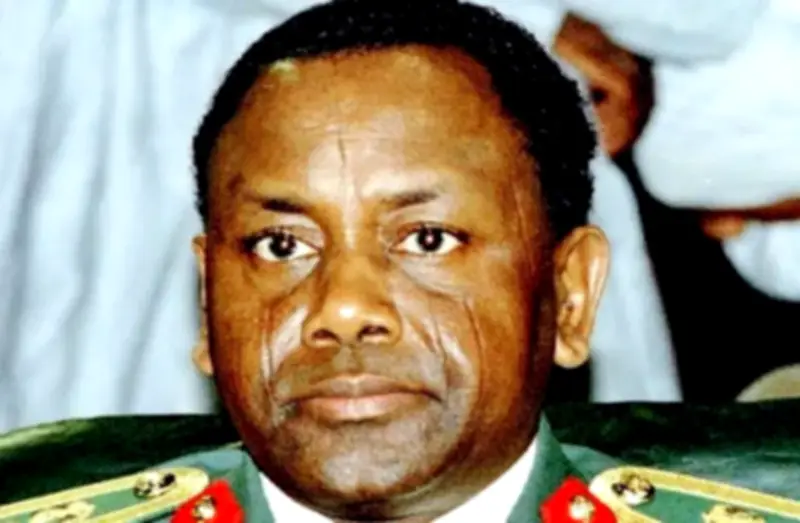
Retired security operative Dennis Amachree has disclosed that the mistress of former military Head of State General Sani Abacha confessed that the dictator died on top of her during intercourse, not by poisoning or foul play. Amachree, a former Assistant Director of Operations and Intelligence at the Lagos State State Security Service (SSS) Command, provided the account in his newly released 348-page book titled 'DSS @40: My journey behind the shield.'
The Confession
According to Amachree, the woman, an Igbo pharmacist, was with Abacha when he passed away around 4:05 am on June 8, 1998, at the Aso Villa in Abuja. After the incident, she immediately fled to Lagos. Amachree's team located and brought her to his office for interrogation. 'The first thing she said to me was: “I did not kill him, he died on top of me,”' Amachree recounted. After her detailed account, he called the Director in Abuja and had her flown back.
Ending Conspiracy Theories
Amachree stressed that the pharmacist's account 'remains the true position, and puts an end to the conspiracy theories and half-truths that have gone viral.' He emphasized that 'any other narrative is an act of deceit and a disservice to our countrymen and women.' Abacha, who ruled Nigeria from November 1993 until his death at age 54, died barely a month before the death of Chief Moshood Abiola, winner of the June 12, 1993 presidential election, who was in Abacha's custody.
Abacha's Rule
Amachree noted that Abacha's five-and-a-half-year rule was marked by extreme authoritarianism and brutal repression, with widespread human rights abuses including arbitrary arrests, torture, and extrajudicial killings. He added that the number of political detainees during Abacha's tenure reportedly exceeded the total from the entire British colonial period. Days before his death, Abacha received emissaries from Palestine Liberation Organization leader Yasser Arafat and Pope John Paul II, who visited Nigeria to plead for the release of detainees.
Dismissing Other Narratives
Amachree dismissed several other accounts of Abacha's death. He rejected journalist David Orr's speculation of poisoning by disaffected soldiers, citing autopsy results that ruled out poisoning. He dismissed former US National Security Advisor Susan Rice's claim that Abacha died in the company of prostitutes possibly due to Viagra use, calling it lacking concrete evidence. He also rejected Major Hamzat Al-Mustapha's account that Abacha's health collapsed after a handshake with a security guard, noting inconsistencies. The accounts of General Jeremiah Useni, Brig-General Oviemo Ovadje, and Femi Fani-Kayode were similarly dismissed for lacking evidence or contradicting timelines.
The Final Hours
In his book, Amachree provides a detailed timeline: At approximately 2:40 am on June 8, shortly after General Useni left, Abacha's girlfriend arrived at the Aso Rock Guest House from the Nicon Nogs Hilton Hotel with her younger sister, a pharmacist. Abacha became interested in the younger sister, and the girlfriend returned to the hotel, leaving the pharmacist alone with him. At about 4:05 am, as they were getting intimate, the pharmacist realized Abacha had stopped moving. She checked his pulse and found none. Panicked, she dressed and left, telling the soldier on guard that 'Oga' had asked for a car to take her back to her hotel. She returned to the Hilton, told her sister, and was driven to Abuja Airport to catch the 7:00 am Okada Airline flight to Lagos. When Major Al-Mustapha was informed of Abacha's instability at 5:00 am, he asked who had been with the General and was told about the pharmacist. The SSS was informed, but she was already on her way to Lagos.
Broader Implications
Amachree warned that the confusion surrounding Abacha's death reflects a larger problem in Nigeria: a leadership culture steeped in falsehood and lack of accountability. He said, 'The deliberate suppression of facts and the promotion of misinformation by those who should be held to a higher standard have kept the country in a retrogressive circle.' He concluded that power is transient and that no amount of security can shield a leader from their ultimate fate. He urged that while truth may be suppressed temporarily, human curiosity and investigative inquiry will ultimately bring it to light.