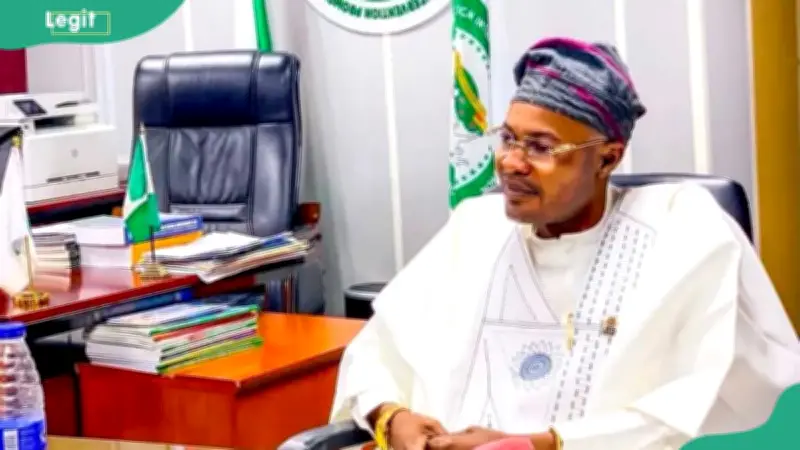
Prince Adeniyi Adeyemi Matthew, 38, is at the centre of one of Nigeria's most extraordinary controversies of 2026: he allegedly operated a completely fictitious government agency, the Presidential Foreign Investment Promotion Council (PFIPC), for over a year, complete with federal office space, Central Bank accounts, diplomatic meetings, and hundreds of purported staff. He faces eight counts of forgery and impersonation, has pleaded not guilty, and insists his appointment was legitimate.
Who is Adeniyi Adeyemi Matthew?
Adeniyi Adeyemi Matthew hails from Ogbomoso, Oyo State. He attended Anglican Grammar School in Igbara-Oke and later studied at Ladoke Akintola University of Technology (LAUTECH) until 2011. He claims a Master's degree from the University of Western Ontario in Canada, though no one has independently verified his educational credentials. He calls himself "Prince," while acquaintances from LAUTECH reportedly called him "Emperor," though no documented royal lineage exists for either title.
This was not his first brush with controversy. In 2016, he presented himself as an ambassador and President-General of the World Youth Organisation, an alleged UN affiliate supposedly elected in New Delhi—a claim the United Nations appeared never to have heard of when asked. He charged people $600 per person to register for a World Economic Youth Summit 2017 and claimed the real World Youth Organisation's CEO personally organised and attended his inauguration in Nigeria. In 2023, he was appointed Senior Special Assistant on Protocol to Governor Adeleke of Osun State, handling visa and travel documents, but was fired within four to five months.
The PFIPC scheme: How the fake agency operated
For over a year, Adeyemi ran what the Nigerian Presidency now describes as an entirely fictitious government agency. He presented himself as Director-General of the PFIPC, also styled as the Presidential Economic Advisory Council. According to the Presidency, he secured office space at the Federal Secretariat Complex Phase III in Abuja and operated there for well over a year, holding meetings with foreign diplomats and Nigerian officials while presenting himself as a legitimate federal appointee. He even requested a note verbale from the Ministry of Foreign Affairs to the US embassy to facilitate visas for some of his staff.
One of the most striking elements of the case is the apparent inclusion of the PFIPC in Nigeria's national budget. Documentation processed by the Budget Office of the Federation and the National Assembly included a ₦1.302 billion allocation for the council in the 2026 Appropriation Act before the President signed it into law. Adeyemi argued that the 2026 Appropriation Act referenced both the PFIPC and the Presidential Economic Advisory Council, questioning the government's position that these organisations never officially existed.
The ₦400 million claim and the Presidency's denial
In an interview on Channels Television's Politics Today, Adeyemi made a stunning disclosure about how he claims to have secured his role: "I borrowed this money. In fact, those that I borrowed this N400 million from have reported to the EFCC. I borrowed this money to pay for this appointment." He alleged he paid ₦400 million through a proxy to Femi Gbajabiamila, Chief of Staff to President Bola Tinubu, to secure his appointment. The controversy also involved allegations that Gbajabiamila demanded an additional ₦200 million. Both the Chief of Staff and the Presidency have denied all such claims.
Adeyemi claimed he received the money in United States dollars through his late associate, Dolapo Tanimola. Asked the denomination, he replied, "Dollars." Asked who received it, he answered, "Dolapo." Tanimola was reportedly killed in a fire at a hotel in Abuja. Presidential spokesman Bayo Onanuga alleged that Adeyemi forged appointment letters and official documents, falsely presented himself as a presidential appointee, and fraudulently sought diplomatic paperwork from the Ministry of Foreign Affairs. On 5 November 2025, the Chief of Staff responded to the Office of the Secretary to the Government of the Federation, stating that "Prince Adeniyi Matthew, Director-General of the Presidential Foreign Investment Promotion Council, is unknown to any office."
Defence, court updates, and institutional gaps
Adeyemi's legal defence team rejected allegations that he was the sole architect of the controversy, arguing that multiple federal institutions officially recognised and interacted with the council long before the current investigations. As reported by Sahara Reporters, his legal team stated: "If the SGF, the Accountant-General, the Central Bank of Nigeria, the Head of Service, the Budget Office, the EFCC, the National Assembly, and the heads of Nigeria's primary security architecture all verified, processed, funded, and officially interacted with this agency over an extended period — how can a single citizen be held uniquely responsible?" In an open letter to President Tinubu, Adeyemi said he was ready to submit documentary evidence and cooperate fully with investigators if an independent panel was established.
The case has moved rapidly since mid-2026. Justice Mohammed Umar struck out the initial eight-count criminal charge at the Federal High Court in Abuja after the Director of Public Prosecution of the Federation (DPPF), Rotimi Oyedepo (SAN), applied for it. The Federal Government then refiled charges at the FCT High Court. Adeyemi was arrested in Osun State following a bench warrant, and he was remanded at the Kuje Correctional Centre in Abuja. Following directives from President Bola Tinubu, the ICPC concluded its probe, finding that Adeyemi had no legitimate government mandate and that the appointment paperwork and foundational gazettes were entirely fabricated. The ICPC also uncovered two additional fake agencies linked to the fictitious PFIPC and recommended prosecuting its alleged promoter. The ICPC's no-fly application hearing was adjourned to 10 November 2026, after no legal representative appeared when the matter was called.
In 2025, officials from the Nigerian Investment Promotion Council wrote to the Presidency to complain about Adeyemi's activities, noting that his agency appeared to function at "cross-purposes" with it—a complaint that reportedly triggered the unravelling of the scheme. The Senate declined to immediately investigate the inclusion of the alleged PFIPC in the 2026 Appropriation Act, opting instead to await the outcome of the anti-graft agency's probe. The case has exposed gaps in the checks governing Nigeria's public institutions, raising questions about systemic oversight failures that go beyond one individual. Adeyemi has pleaded not guilty, and the allegations remain subject to the judicial process, with the case still under investigation and in court.