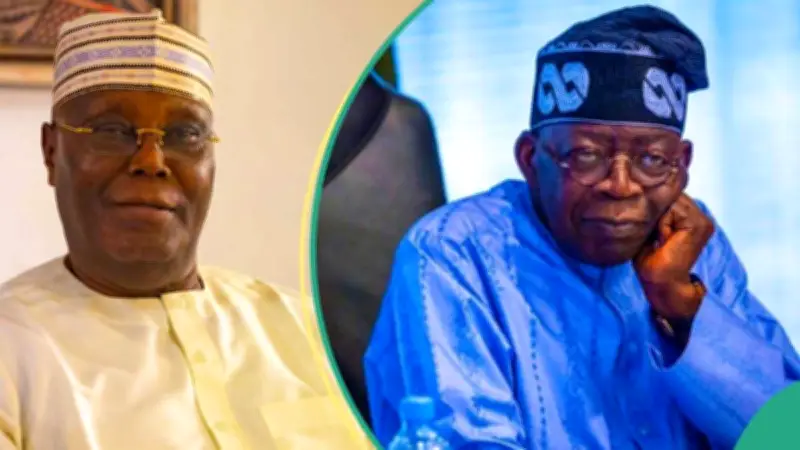
A Washington-based lobbying firm hired by former Nigerian Vice President Atiku Abubakar has begun circulating more than 60 pages of U.S. Department of Justice documents detailing drug trafficking allegations against President Bola Tinubu to officials in the Trump administration and members of Congress.
Von Batten-Montague-York disclosed the distribution in a post on X, stating that many within the U.S. government were previously unaware of the DOJ's allegations against Tinubu. The firm said it intends to bring the full collection of court filings, a supporting affidavit, and related federal court decisions to President Donald Trump's attention.
Atiku's $1.2 Million Lobbying Contract
Atiku, now the presidential candidate of the African Democratic Congress, engaged Von Batten-Montague-York in March 2025 under a 12-month, $1.2 million contract. The agreement covers reputational work in the United States, facilitating meetings with American officials and legislators, and countering what the contract describes as the Nigerian government's lobbying narratives in Washington.
Following discussions with members of the Trump administration, Congress, and senior congressional staff, the firm began providing more than 60 pages of DOJ documents concerning allegations of Tinubu's involvement in a heroin trafficking investigation spanning the late 1980s and early 1990s, the firm wrote on July 20.
Details of the 1993 Civil Forfeiture Case
The firm made public a background document detailing the 1993 case formally known as United States v. Funds in Account No. 263226700 et al., No. 93 C 4483, filed in the U.S. District Court for the Northern District of Illinois. The individuals named in the government's allegations were Bola Ahmed Tinubu, Adegboyega Mueez Akande, and Abiodun Agbele.
According to the document, federal investigators between 1988 and 1991 examined a Nigeria-based heroin trafficking organization that imported white heroin into the United States and distributed it through Chicago. The government alleged that proceeds from the operation were deposited into U.S. bank accounts owned and controlled by Tinubu.
Akande was described as a longtime acquaintance of Tinubu whom the DOJ alleged led the trafficking organization, and who the government said provided funds used to open one of the accounts. Agbele, whom Tinubu said he met through Akande, was alleged to have sold heroin for the organization before being arrested during a transaction with an undercover officer, after which he cooperated with federal investigators. The case concluded through a negotiated civil forfeiture settlement in which a portion of the funds was forfeited to the United States.
FOIA Lawsuit and Ongoing Litigation
The background document also traced a 2023 Freedom of Information Act lawsuit filed by journalist Aaron Greenspan seeking related records from several federal agencies. A U.S. District Court for the District of Columbia ruled in 2025 that the FBI and the Drug Enforcement Administration could not issue a blanket refusal to confirm or deny the existence of responsive records, ordering them to process the request. That litigation remains ongoing.
Von Batten-Montague-York said the documents were being shared with House and Senate committees for informational and oversight purposes, citing Nigeria's ties with the U.S. and reports that Tinubu is seeking a meeting with Trump at the UN General Assembly.
Nigeria's 2023 Election Court Ruling
The 1993 forfeiture case was a central argument before Nigeria's Presidential Election Petition Court in 2023, where both Atiku Abubakar, then of the Peoples Democratic Party, and Labour Party candidate Peter Obi argued Tinubu should have been disqualified over the $460,000 civil forfeiture. The court dismissed the argument, finding that the petitioners had not established a criminal conviction and that the forfeiture proceedings were civil in nature. The court also held that the evidence did not prove Tinubu submitted false information to the Independent National Electoral Commission by not disclosing the forfeiture.
Earlier, Legit.ng reported that Atiku rejected President Tinubu's decision to order an ICPC investigation into the PFIPC controversy, arguing that assigning the probe to a government agency could not guarantee impartiality because the allegations involved public institutions and officials.