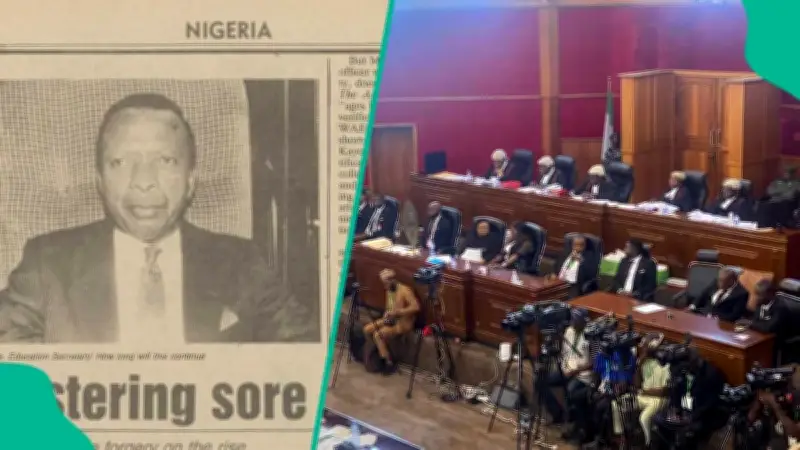
Babatunde Larinde, a former chairman of Lagos Mainland Local Government, is believed to be the first Nigerian politician to face trial for certificate forgery in the country's history. This case emerged amid ongoing scrutiny of certificate forgery allegations that have affected President Bola Tinubu's administration.
Historical Context of Certificate Forgery in Nigeria
According to a report by The African Guardian, archived by archive.ng, certificate forgery became widespread in Nigeria in 1993. Employers, universities, and government agencies struggled to distinguish genuine qualifications from fake ones. The report highlighted that the West African Examinations Council (WAEC) detected 258 forged certificates in 1990, 157 in 1991, and 286 in 1992, warning that many more went undetected.
The Case Against Babatunde Larinde
Larinde was docked at the Lagos High Court on January 13 on a four-count charge of forgery and altering a Master of Arts (MA) and Doctor of Philosophy (PhD) certificates from the University of Siegen, Germany, between 1986 and 1991. He was accused of using the forged certificates to seek clearance from the National Electoral Commission (NEC) to contest the 1991 bye-election for the chairmanship of the council. The report states: "It was a climax of sorts for the recurring problem of certificate forgery. Lagos Mainland Local Government chairman, Dr Babatunde Larinde, was dragged before the Lagos High Court on January 13, on a four-count charge of forgery and altering a Master of Arts (MA) and Doctor of Philosophy (PhD) certificates of the University of Siegen, Germany, between 1986 and 1991."
Weak Verification Systems and Legal Gaps
Officials attributed the prevalence of certificate forgery to weak verification systems and gaps in the law. They noted that certificate forgers were difficult to prosecute because existing legislation focused on examination malpractice rather than forged certificates. The report also cited nine students expelled from the Rivers State School of Health Technology for certificate forgery and an investigation into fake credentials at the University of Calabar.
Comparison with Recent Forgery Allegations
The report on Larinde was shared shortly after Uche Nnaji, the former Minister of Innovation, Science and Technology under President Tinubu, faced investigation over claims that he falsified academic credentials and National Youth Service Corps (NYSC) discharge documents submitted during his 2023 ministerial screening. Nnaji later stepped down from his ministerial position after the allegations became public. Legit.ng reported that Nnaji is being tried before the Federal High Court in Abuja over the forgery allegation, with the suit filed by the Independent Corrupt Practices and Other Related Offences Commission (ICPC).
Ongoing Impact and Legal Proceedings
Larinde's case remains a significant reference point in Nigeria's fight against certificate forgery. The report emphasizes that Larinde still has the chance to defend himself in court. The recurrence of such allegations, from local government officials to federal ministers, underscores the persistent challenge of credential fraud in Nigeria.