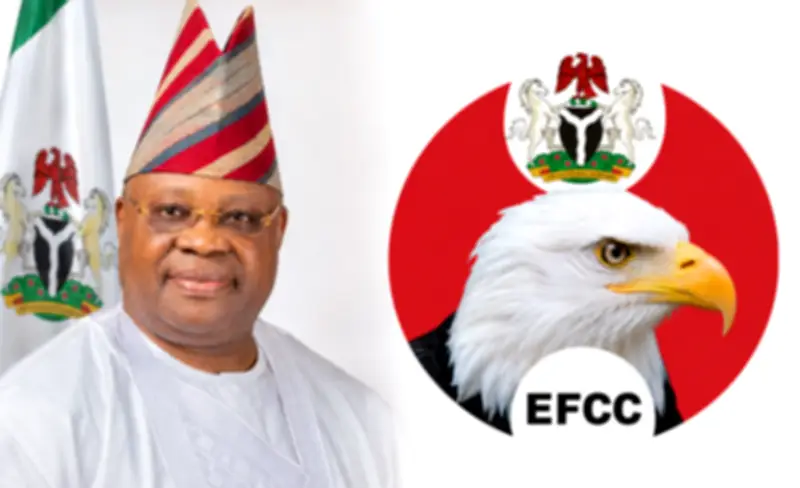
The Economic and Financial Crimes Commission (EFCC) has reportedly placed a "Post No Debit" restriction on an Osun State Government account domiciled with First Bank, just ten days before the state's governorship election scheduled for August 15. The account, allegedly used for the payment of workers' salaries, was frozen by the anti-graft agency, according to a Vanguard report.
Governor Adeleke's Allegations and Immediate Aftermath
This development comes hours after Governor Ademola Adeleke alleged that the EFCC was planning to freeze the state's accounts and those of top government officials. In a statement issued on Wednesday by the Commissioner for Information and Public Enlightenment, Kolapo Alimi, the governor described the reported move as an attempt to cripple government activities ahead of the August 15 governorship election.
Adeleke maintained that there was no legal basis for freezing the accounts of the state government, arguing that the EFCC lacked the statutory powers to take such action. He emphasized that the timing of the freeze, so close to the election, raises suspicions of political interference.
Confirmation from State Source
"I can confirm that the state government account has been frozen by the EFCC. It is no longer an allegation. The governor will address the press shortly to update the public on the situation," a source in the state government was quoted as saying. The source, who spoke on condition of anonymity, added that the freeze has already disrupted the payment of salaries and other essential government expenditures.
The EFCC is yet to comment on this development, leaving many questions unanswered about the legal basis for the action and its potential impact on the state's finances.
Impact on Workers and Government Operations
The freezing of the account has raised concerns among civil servants in Osun State, who fear that their salaries for the month may be delayed. The state government has been struggling to meet its financial obligations, and this latest development could exacerbate the situation. Workers' unions have called on the EFCC to clarify the reasons for the freeze and to ensure that the rights of workers are not violated.
Political analysts have also weighed in, noting that the EFCC's action could have significant implications for the upcoming election. The opposition party has accused the federal government of using the EFCC to destabilize the state, while the ruling party has denied any involvement.
Legal and Constitutional Questions
The development has sparked a debate about the powers of the EFCC to freeze state government accounts. Legal experts argue that while the EFCC has the authority to investigate financial crimes, it must follow due process and obtain a court order before freezing any account. In this case, it is unclear whether such an order was obtained.
Governor Adeleke has vowed to challenge the freeze in court, stating that the EFCC's action is unconstitutional and an infringement on the state's rights. He has also called on the judiciary to intervene and protect the state's interests.
Public Reaction and Next Steps
The news has generated mixed reactions from the public, with some supporting the EFCC's action as a necessary step to fight corruption, while others view it as a politically motivated move to undermine the state government. Social media has been abuzz with discussions, with many calling for transparency and accountability from both the EFCC and the state government.
As the situation unfolds, all eyes are on the EFCC to provide clarification and on the state government to ensure that the welfare of its citizens is not adversely affected. The governorship election, now just ten days away, is set to proceed amid these tensions, with voters watching closely to see how the crisis is resolved.