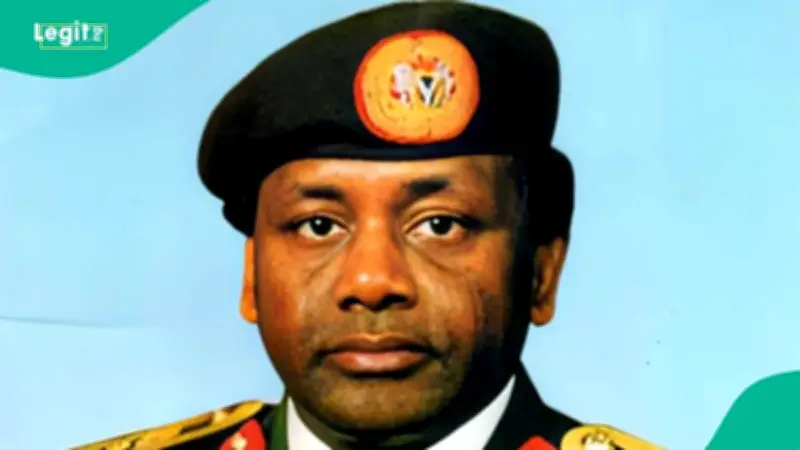
A retired Assistant Director of Nigeria's Department of State Services (DSS) has asserted that the number of political detainees under General Sani Abacha's five-and-a-half-year military rule surpassed the total recorded during the entire British colonial era. Dennis Amachree made the claim in his newly released memoir, DSS @40: My Journey Behind the Shield, excerpts of which were published on Tuesday, July 21, 2026.
Abacha's Repression Detailed in Memoir
Amachree, who served as an intelligence officer during one of Nigeria's most controversial military governments, described Abacha's regime as a period of extreme authoritarianism and brutal repression. He wrote that the government was widely condemned for widespread human rights abuses, including arbitrary arrests, torture, and extrajudicial killings.
According to Amachree, the volume of political detainees under Abacha was staggering, surpassing the number recorded across the entirety of British colonial rule in Nigeria. He noted that Pope John Paul II was the last visitor Abacha received before his death in June 1998, arriving to appeal for the release of political prisoners. A few days earlier, the late general had also received emissaries from Palestinian leader Yasser Arafat.
Challenging Death Theories
Beyond the record of repression, Amachree devoted significant attention to contesting the many competing accounts of how Abacha died. He criticised narratives put forward by figures including former Chief Security Officer Major Hamza Al-Mustapha, former FCT Minister General Jeremiah Useni, retired military doctor Brigadier-General Oviemo Ovadje, former Aviation Minister Femi Fani-Kayode, Irish Times journalist David Orr, and former US National Security Adviser Susan Rice.
On Al-Mustapha's version specifically, Amachree argued it contained notable inconsistencies. 'He claimed Abacha's health collapsed after a handshake with a security guard of a visiting dignitary. This version, while exonerating the 'poisoned apple' theory, differs significantly from other timelines and accounts,' Amachree wrote.
He also rejected claims tying the CIA, imported Indian prostitutes, and a poisoned apple to Abacha's death, calling such stories sensational and damaging to the historical record. Amachree said he identified a crucial gap in Al-Mustapha's account, pointing to 'the one-and-a-half-hour window after Gen. Useni's departure that provides the key to the mystery.'
Motivation for the Memoir
Amachree stated his motivation for writing was straightforward: 'As a security professional who was in the thick of it, I feel compelled to set the record straight and provide the true narrative for posterity.'
Previous reports from the same memoir included claims that Abacha believed he was invincible and had planned a transition to civilian presidency. The memoir also stirred political controversy when former Labour Party presidential candidate Peter Obi accused some former pro-democracy activists of abandoning the ideals they once defended, noting that their conduct in power now compares unfavourably with that of late military ruler Sani Abacha.