Fraudsters are exploiting motorists' urgency to pay traffic fines by sending fake FRSC text messages with malicious links. Victims have reported losing ₦1.8 million, ₦400,000, and $2,500 after clicking these links and entering their card details on fraudulent websites. The Federal Road Safety Corps (FRSC) has officially warned Nigerians about these deceptive messages and impersonating websites.
Victims Lose Millions to Fake FRSC Traffic Fine Links
Nollywood actor and filmmaker Adekanla Aderinola Desalu, known as Deza The Great, said he lost $2,500 after clicking a link in an SMS claiming he had exceeded the speed limit. He told his followers that he believed the message was a genuine FRSC notification and followed the link to pay the supposed ₦2,500 fine. After entering his card details, he discovered $2,500 had been deducted from his account.
Comedian MC Monica also alleged he lost ₦1.8 million after interacting with a similar link. He said he clicked the link and paid what he believed was a small fine of ₦5,000, only to wake up the next morning to find millions of naira gone from his account. Monica questioned how the money left his Wema Bank account when the only OTP he generated was for the ₦5,000 payment.

How the Fake FRSC Websites Operate
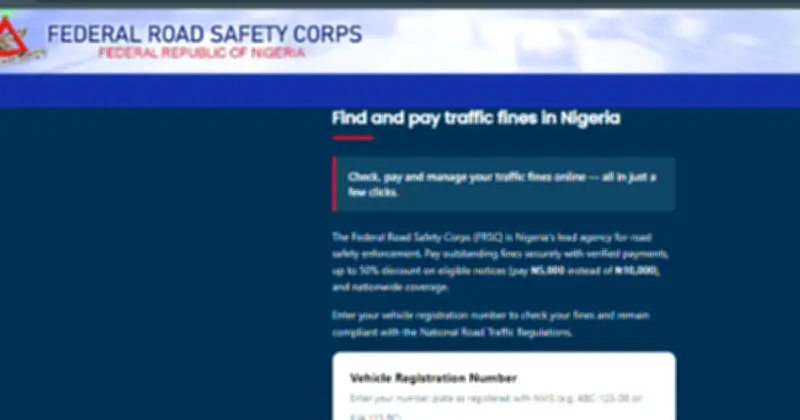
The Foundation for Investigative Journalism (FIJ) investigated the scam and found multiple websites impersonating FRSC. Among the fake domains identified were frsc-gov.sbs.ng and frsc.gov.eu.cc.ng. These sites copied FRSC's branding and layout, making them look like official traffic offence portals. FIJ tested the websites by entering made-up vehicle plate numbers, including numbers that did not follow the normal format for Nigerian number plates. The websites still generated traffic offences and fines. In one test, a fake number plate produced a supposed ₦10,000 offence, followed by an offer of a 50 per cent discount if payment was made immediately.
The fake websites then directed users to a third-party payment page called Payfast Now, where FIJ found requests for card details, including the card number and CVV. One version also requested the cardholder's PIN. FIJ also found that one of the fake domains had been registered only on September 16, the same day the scam began receiving wider attention.
The OTP Illusion: How a ₦5,000 Fine Turns into a ₦1.8 Million Heist
The technique behind such large losses is known as Adversary-in-the-Middle (AiTM), also called a Real-Time Phishing Relay. In this scam, fraudsters create a fake website that acts as a middleman between the victim and a real payment service. When a victim enters their card details on a fake FRSC payment link, the scammers capture the information and use it to initiate a separate, much larger transaction through a legitimate payment platform.
This larger transaction may trigger the victim's bank to send an OTP to their phone. Because the victim has just tried to make a payment, they may assume the OTP is for the small fine. If they enter the OTP into the fake website, the scammers capture it and use it to complete the separate transaction. From the bank's perspective, the transaction appears properly authorised, so it is processed even though the victim believed they were only confirming a small payment.
FRSC’s Official Warning and How to Stay Safe
FRSC has confirmed that the messages are fraudulent. In a statement issued on September 16, 2026, Corps Public Education Officer Osondu Ohaeri said the Corps was aware of unsolicited messages claiming that recipients had new road traffic offences requiring immediate action. FRSC specifically disowned frscgov.top/ng, saying it has no affiliation with the Corps. The agency warned Nigerians not to click suspicious links, make payments through them, or provide banking information, passwords, card details, driver's licence information, or vehicle registration details in response to the messages.
Corps Marshal Shehu Mohammed has directed that motorists be sensitised about the scam and urged Nigerians to follow a simple warning: “STOP. VERIFY. REPORT.” FRSC advised motorists to verify alleged traffic offences directly through its official channels, including the national toll-free number 122 and its official website frsc.gov.ng.

The first step in avoiding this scam is knowing how to spot a fake portal. The biggest difference is the domain name. FRSC's official website uses frsc.gov.ng. A website does not become an official government website simply because it contains “FRSC”, “gov” or “ng” somewhere in its address. The fake websites identified by FIJ used different domain structures, including frsc-gov.sbs and frscgov.eu.cc.ng. Other warning signs include generating supposed offences for random vehicle numbers, offering discounts for immediate payment, and redirecting users to an unfamiliar payment platform. FRSC's published payment procedure provides for payment through recognised channels, including Remita, and its e-ticketing documentation lists online payment, bank payment, and POS terminals at FRSC offices as payment options.
If you receive a suspicious traffic fine SMS, do not click the link. Instead, manually type frsc.gov.ng into your browser or call the FRSC national toll-free number at 122 to verify your status. If you have already entered your card details into one of these websites, contact your bank immediately, block the affected card or account where appropriate, monitor your transactions, and preserve the SMS, website address, and transaction records as evidence.