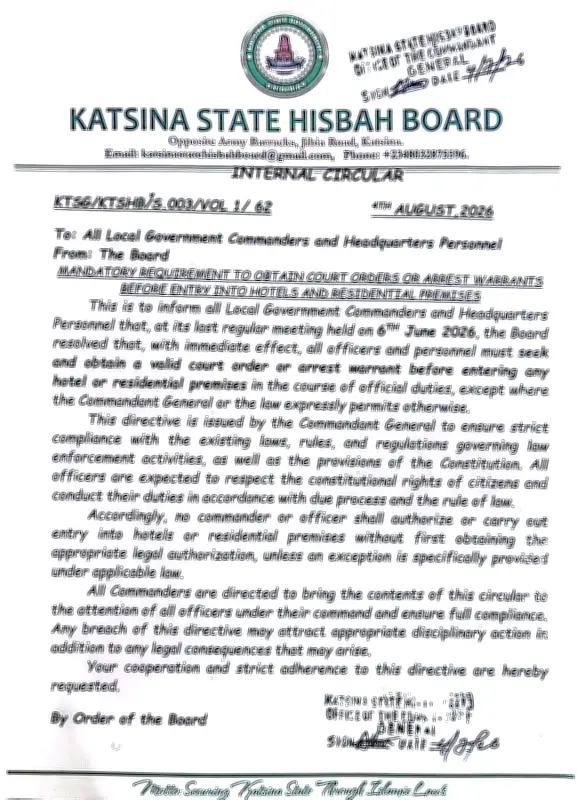
The Katsina State Hisbah Board has issued a directive barring its personnel from entering hotels or residential premises without first obtaining valid court orders or arrest warrants. The internal circular, dated August 4, 2026, was addressed to all local government commanders and headquarters personnel, marking a significant shift in operational protocol.
Directive Follows Board Resolution
According to the circular, the decision stems from a resolution reached at the board's regular meeting held on June 6, 2026, and takes immediate effect. All officers and personnel must now secure proper legal authorization before conducting searches or entering hotels and private residences, "except where the commandant general or existing laws expressly permit otherwise".
The directive emphasizes strict compliance with existing laws, rules, and regulations governing law enforcement activities, as well as the provisions of the Nigerian Constitution. It explicitly warns that no commander or officer should authorize or carry out entry into hotels or residential premises without obtaining the appropriate legal authorization, unless an exception is specifically provided for under applicable laws.
Ensuring Constitutional Rights and Due Process
The board has instructed all local government commanders to immediately communicate the contents of the circular to officers under their command and ensure full compliance. The circular stresses that officers are expected to respect the constitutional rights of citizens and conduct their duties in accordance with due process and the rule of law.
Any violation of this directive will attract appropriate disciplinary action in addition to any legal consequences that may arise. This move aligns with broader efforts to ensure that law enforcement agencies operate within legal boundaries, protecting citizens from arbitrary intrusions.
Impact on Hisbah Operations
This policy change is expected to affect how Hisbah personnel conduct their enforcement activities, particularly in relation to moral policing and public morality campaigns. Previously, there have been reports of Hisbah officers conducting raids without warrants, leading to public criticism and legal challenges.
The new requirement for court orders is seen as a positive step toward accountability and transparency, ensuring that Hisbah operations do not infringe on individual rights. Legal experts have welcomed the move, noting that it brings Hisbah in line with standard law enforcement practices and constitutional mandates.
Compliance and Enforcement
Local government commanders are tasked with ensuring that all officers under their jurisdiction are aware of and adhere to the new directive. The board has made it clear that failure to comply will result in disciplinary measures, underscoring the seriousness of the policy.
This development comes amid ongoing discussions about the role of religious police in Nigeria and the balance between moral enforcement and civil liberties. By requiring court orders, the Katsina Hisbah Board aims to strike a balance, demonstrating a commitment to legal procedures and respect for citizens' rights.