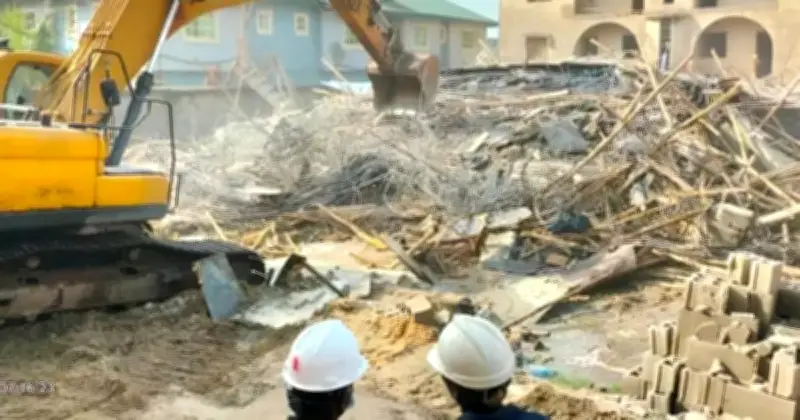
The Lagos State Building Control Agency has carried out a partial demolition of buildings behind Barracks Bus Stop in Surulere, months after the developers allegedly refused to act on repeated warnings from the agency. According to LASBCA, the affected structures had no valid planning approvals and were built in violation of the state's Urban and Regional Planning and Development Law, two of the most common triggers for enforcement action in Lagos.
Why the buildings were demolished
The buildings also encroached on designated setback spaces. Setback spaces are areas that must remain clear by law to allow for safety, accessibility and orderly development around a structure. Exceeding those limits, with or without a valid permit, is enough grounds for demolition under Lagos building regulations.
What made this case particularly stark was the timeline. LASBCA said it had served the developers with statutory contravention and enforcement notices well before any demolition took place, giving them time and opportunity to stop construction and regularise their buildings. The developers did neither. The agency only moved in after those directives were repeatedly ignored.
How LASBCA enforcement works
The partial demolition, targeting only the offending sections rather than entire structures, reflects how LASBCA typically handles first-stage enforcement. Full demolition usually follows if developers still fail to comply after partial action.
For property owners across Lagos, the Surulere case is a reminder of how enforcement works in practice. The agency does not typically act without prior notice. The process usually begins with a monitoring visit, followed by an inspection report, then a formal contravention notice, and finally an enforcement notice before any physical action is taken. Demolition, in most cases, is the last step, not the first.
What puts property owners at risk
What puts owners at risk is either building without obtaining planning approval from the outset, or deviating from the approved plans during construction, like building higher, wider or closer to boundaries than what was sanctioned. Both are violations that LASBCA is empowered to act on, and both were present in the Surulere case.
The agency has urged developers and contractors to secure all necessary permits before breaking ground and to ensure construction stays strictly within approved specifications throughout the process. It also called on residents to report illegal developments and distressed buildings in their communities, indicating that enforcement sweeps are not limited to areas already on the agency's radar.
Broader context of building control in Lagos
Lagos has intensified building control enforcement in recent years following a series of building collapses across the state that claimed lives and drew public criticism of weak regulatory oversight. The Surulere demolition sits within that broader push to bring construction activity across the state into compliance before structures become hazards rather than after.