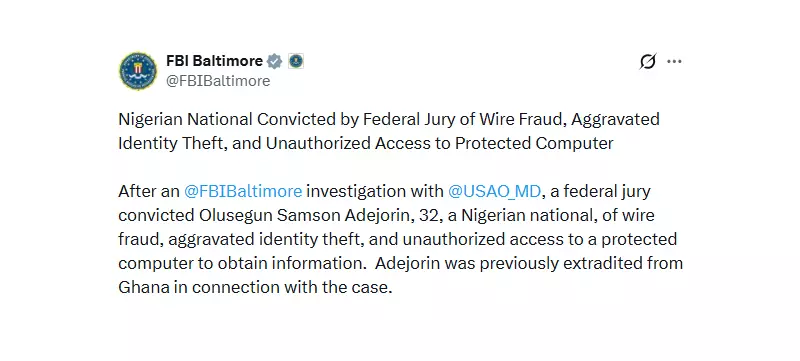
A federal jury in the United States has found a 32-year-old Nigerian man guilty on multiple charges related to a sophisticated cyber fraud scheme that defrauded two charitable organizations of more than $7.5 million.
The Verdict and Charges
Olusegun Samson Adejorin was convicted on Thursday, December 18, 2025, following a six-day trial in Greenbelt, Maryland. The jury found him guilty of five counts of wire fraud, one count of unauthorized access to a protected computer to obtain information, and one count of aggravated identity theft.
The guilty verdict was announced by U.S. Attorney for the District of Maryland, Kelly O. Hayes, alongside Special Agent in Charge Jimmy Paul of the FBI's Baltimore Field Office. Adejorin had been previously extradited from Ghana to face these charges.
Details of the Fraudulent Scheme
According to evidence presented during the trial, Adejorin executed his plan between June and August 2020. The scheme targeted two specific victims:
- Victim 1: A Maryland-based charitable organization that provides investment services to other non-profits.
- Victim 2: A charitable organization located in New York.
Adejorin's method involved a multi-layered attack. He first gained unauthorized access to the email accounts of employees at both organizations. To make his fraudulent withdrawal requests appear legitimate, he registered spoofed domain names that mimicked the real ones used by Victim 2.
Posing as legitimate employees of Victim 2, he then contacted Victim 1 to request large withdrawals from Victim 2's investment accounts. To further authenticate these requests, he used the compromised email accounts of Victim 1's staff to send confirmation emails. This complex impersonation scheme ultimately caused over $7.5 million of Victim 2's funds to be transferred to bank accounts controlled by Adejorin, rather than to the charity's legitimate accounts.
Potential Sentence and Next Steps
Adejorin now faces severe penalties for his crimes. For each of the five wire fraud counts, he could receive a maximum sentence of 20 years in federal prison. The charge of unauthorized access to a protected computer carries a maximum penalty of five years.
Most significantly, the conviction for aggravated identity theft carries a mandatory prison term of two years, which must be served consecutively to any other sentence imposed. U.S. District Judge Theodore D. Chuang has scheduled sentencing for Friday, April 10, 2026.
It is important to note that actual sentences for federal crimes are often less than the maximum penalties. The final sentence will be determined by Judge Chuang after considering the U.S. Sentencing Guidelines and other statutory factors.
In closing statements, U.S. Attorney Hayes commended the FBI for its investigative work and thanked Assistant U.S. Attorneys Joshua Rosenthal and Darren S. Gardner, who prosecuted the case.