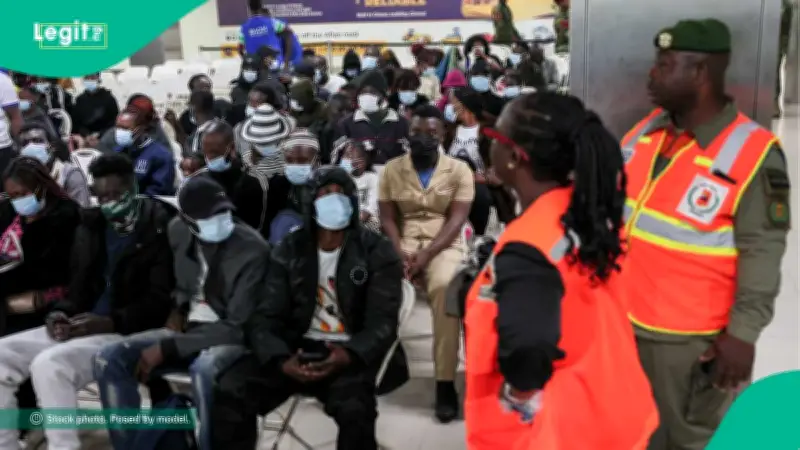
Richard Itoro, a 47-year-old Nigerian businessman, has recounted the harrowing moment he boarded a voluntary repatriation flight from Johannesburg in June, leaving behind his South African wife and twin children. The decision came after months of anti-migrant protests that swept through South Africa, making him fear for his safety despite holding valid immigration documents.
Itoro had spent over 15 years building a life in South Africa, establishing a car dealership, purchasing a home, and starting a family. However, the escalating hostility forced him to choose between staying under constant threat or starting over in Nigeria. "If I go home and start all over again, it's better than being here, being harassed, being scared for my life," he told the BBC.
Separation from Family
Itoro's departure was marred by a painful separation. The Nigerian high commission refused to allow his wife and children to board the repatriation flight with him. He described the moment as surreal, likening it to a scene from a film where someone escapes a besieged city on the last helicopter. "I wish I could have just begged the people from the embassy and said: 'This is my wife, I can't leave her behind and my kids,' but I couldn't," he said.
His wife faced direct threats from neighbours who warned, "You're married to a Nigerian. Those of you who are married to Nigerians we are supposed to arrest you people." The couple now relies on daily phone calls to maintain their bond, with Itoro expressing both heartbreak and hope: "I'm broken. There is hope, because my wife is going to join me very soon… but it was heartbreaking, and that's how I felt: like I lost everything."
Diplomatic Tensions Rise
Itoro's case is not isolated. Nigeria's Minister of State for Foreign Affairs, Sola Enikanolaiye, confirmed during a bilateral meeting with South Africa's Foreign Minister Ronald Lamola that "We have records of Nigerians who have legitimate papers to remain in South Africa, yet they have been attacked." The Nigerian government has raised formal objections over the treatment of its citizens, many of whom hold valid residency permits.
The crisis extends beyond Nigeria. Emmanuel Asamoah, a 37-year-old Ghanaian hairstylist, faced a similar ordeal in Soweto. After moving there in 2023, he was confronted by a group that pushed him and ordered him to leave. The incident was filmed and widely shared online. "They came to me and started pushing me… they said that I should go home, that we are spoiling their country, because of us, they don't eat, we are taking their girlfriends," Asamoah told the BBC, adding that he had a valid entry stamp in his passport.
Ghana's Response
Asamoah returned to Ghana in May and has since started a cement business with local support. Ghana's Foreign Minister, Samuel Okudzeto Ablakwa, criticized the treatment, arguing that South Africa, which benefited from African solidarity during the anti-apartheid struggle, "should be the epitome of Pan-Africanism."
South African officials have defended the crackdown. Culture Minister Gayton McKenzie stated that protests targeted undocumented migrants, while Foreign Minister Lamola said President Cyril Ramaphosa remains firm on enforcing immigration laws.
ECOWAS Involvement
The situation has escalated to the regional level. Vice-President Kashim Shettima addressed the 69th ECOWAS summit in Sierra Leone, urging West African leaders to confront xenophobic attacks in South Africa. He reminded South Africa that Nigerian students had deductions from their scholarship allowances to finance liberation movements in Southern Africa. The remarks came amid fresh diplomatic tensions following attacks that killed at least 4 Nigerians, prompting Nigeria to evacuate 1,490 citizens from South Africa.