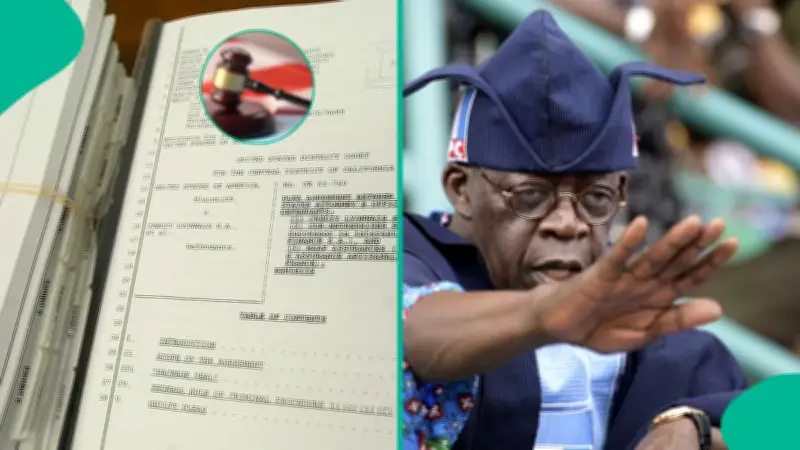
The legal battle over President Bola Tinubu's alleged drug trafficking records in the United States has entered a new phase, with the FBI seeking to submit a sealed declaration and a judge granting only a partial extension to the Department of Justice. Here are seven key things to know about the case, which has now stretched beyond three years.
Origins of the Case: FOIA Requests and the Glomar Response
Between 2022 and 2023, Aaron Greenspan, an American transparency activist and founder of PlainSite, filed 12 Freedom of Information Act (FOIA) requests with six US federal agencies. He sought documents related to investigations into a Chicago heroin ring that operated in the early 1990s. The individuals named in his requests included Tinubu, Lee Andrew Edwards, Mueez Abegboyega Akande, and Abiodun Agbele.
Five of the agencies responded with what is known as a Glomar response, an official refusal to confirm or deny whether the requested records exist. Unsatisfied, Greenspan escalated the matter to the Department of Justice's Office of Information Policy, which backed the agencies' position. He then filed a lawsuit on June 12, 2023.
Court Rulings: Judge Orders Lifting of Improper Responses
In April 2025, Judge Beryl Howell ruled that the FBI and DEA had issued improper Glomar responses and ordered them lifted. She found that the two agencies failed to show that Tinubu had a recognisable privacy interest in keeping secret the fact that he had been a subject of criminal investigation. The case also involves a 1993 civil forfeiture proceeding in which roughly $460,000 was linked to Tinubu. Greenspan's requests specifically include the FBI's full file on Tinubu and FBI Form 302 interview records from 1992 to 1993.
The defendants in the case include the FBI, the Drug Enforcement Administration, the Internal Revenue Service, the Executive Office for United States Attorneys, the Department of State, and later the CIA.
Tinubu's Legal Fight and the FBI's Sealed Declaration Request
Tinubu, through lawyers Christopher W. Carmichael, Victor P. Henderson, and Oluwole O. Afolabi, filed court documents arguing that releasing the records would violate his right to privacy. His 16-page filing argued that even where some information has appeared in public records, an individual retains a privacy interest in details that remain undisclosed, citing US Supreme Court precedent. He has denied any wrongdoing.
On August 20, 2026, the FBI filed an application asking the court to allow it to submit a sealed, ex parte declaration explaining in private why it withheld certain records. The agency said publicly disclosing its full reasoning would reveal law enforcement techniques and could "reasonably be expected to endanger the life or physical safety of any individual."
Judge Grants DOJ Only Four Extra Days
When Jeanine Pirro, a Donald Trump-appointed attorney, requested a 10-day extension to comply with a court order, Judge Howell granted only four additional days, setting August 21, 2026 as the deadline. Tinubu's legal team also joined a request for the same extension, which the judge declined. Howell noted that the case had already been pending for more than three years.
Washington-based lobbying firm Von Batten-Montague-York, recently engaged by former Vice-President Atiku Abubakar, published court documents relating to the case on X and called for the records to be made public immediately.
An ex parte in camera declaration is a written statement presented only to a judge, without being shared publicly. The FBI's motion to submit such a declaration means the agency's full reasoning for withholding records will not be available to the public, potentially shaping the final outcome of this long-running case.