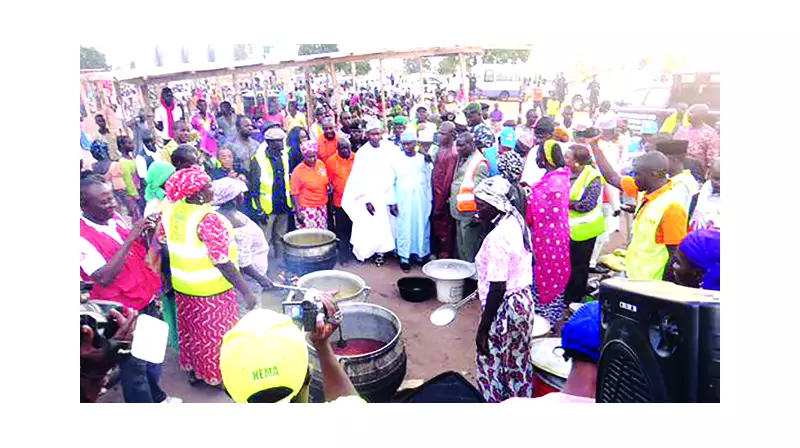
The National Human Rights Commission (NHRC) has unveiled a sobering assessment of Nigeria's internal displacement crisis, identifying Yobe and Benue states as bearing the heaviest burden. The data, presented via the Commission's dashboard in mid-2025, paints a grim picture of widespread humanitarian challenges driven by conflict and insecurity.
States in Distress: A Snapshot of Displacement
Presenting the findings, the Executive Secretary of the NHRC, Dr Tony Ojukwu, SAN, disclosed that Yobe State recorded the highest number of Internally Displaced Persons (IDPs) at 2,047. Benue State followed closely with 1,850 displaced persons, a situation largely attributed to persistent herder attacks and insurgent raids that have devastated infrastructure and livelihoods.
Dr. Ojukwu, who was represented by the Director of the Economic, Social and Cultural Rights Department, Mr. Harry Obe, stated that the total number of IDPs captured in the monitoring stood at 9,290 individuals spread across 11 states. These states include Adamawa, Akwa Ibom, Borno, Cross River, Taraba, Kano, Katsina, Sokoto, and Zamfara, in addition to Yobe and Benue.
The report highlighted a particularly alarming statistic: children constitute a staggering 82 per cent of the displaced population reached. Furthermore, the data revealed 472 returnees, 81 per cent of whom are children struggling to reintegrate into communities that remain insecure.
Escalating Violations and Protection Gaps
The NHRC dashboard documented over 1,800 human rights violations, with specific concerns sharply outlined. These include 530 cases of denied access to food and shelter in Benue, Taraba, and Kano states, and 278 incidents where freedom of movement was restricted due to insecurity, primarily in Yobe.
Gender-based violence remains a critical issue, with 195 incidents recorded. The future of a generation is also under threat, as 324 barriers to education were identified in states like Kano and Taraba. Dr. Ojukwu also noted a disturbing 58 per cent surge in violations against children, exacerbated by violence, climate shocks, and food insecurity.
Beyond internal displacement, the report noted 215 asylum seekers facing registration difficulties in Taraba and Cross River States, alongside 583 refugees primarily located in those areas.
Response, Challenges, and a Call to Action
Despite the daunting figures, the NHRC reported significant intervention efforts. Its field teams resolved 372 cases and referred 1,157 others to relevant agencies. They also conducted 104 detention visits, reaching 326 detainees, and held 331 community outreach sessions on GBV prevention and rights reporting for 6,551 people.
Dr. Ojukwu commended the resilience of its monitors who operate under severe constraints, including transport shortages, high data costs, and security risks. He also acknowledged the support of the United Nations High Commissioner for Refugees (UNHCR), whose backed project has reached over 15,000 additional individuals since the start of the year.
However, the Commission's Executive Secretary issued a strong call to action. He urged the federal and state governments to domesticate the Kampala Convention, integrate NHRC data into national humanitarian planning, and bolster security for returnees. He emphasized the need for strengthened inter-agency coordination to scale up child protection services and close documentation gaps for asylum seekers.
Reaffirming the Commission's commitment, Dr. Ojukwu pledged to refine data quality, referral pathways, and community-based monitoring. The ultimate goal, he vowed, is to transform the displacement experience "from despair to dignity" for Nigeria's estimated 6.7 million displaced persons.
Dr. Benedict Agu, the Head of Human Rights Monitoring who presented the dashboard's graphic information, lamented the hydra-headed challenges faced by IDPs, including poor nutrition, inadequate healthcare, and other socio-economic hardships. He confirmed that the awareness programs and interviews conducted by his team were aimed at thoroughly interrogating all issues for better human rights and humanitarian protection.
This October dashboard presentation marks the fourth edition since the initiative's inception.