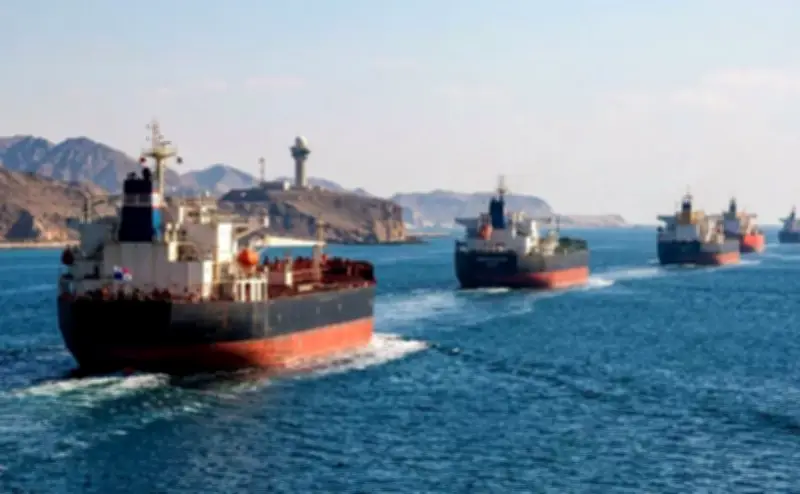
Iran has announced that it is in the "final stage" of drafting an agreement with Oman concerning the Strait of Hormuz, a development that follows US President Donald Trump's statement that a deal could be announced this week. The proposed maritime route would primarily lie within Iranian territorial waters, with parts extending into Omani waters, according to officials.
Iran Confirms Progress on Maritime Agreement
Foreign Ministry spokesperson Esmaeil Baqaei told journalists that "the geographical coordinates of the proposed maritime route have been agreed upon by both sides," adding that the bilateral process was "professional" and "forward-moving." This marks a significant step in addressing one of the world's most critical shipping lanes, through which about 20% of global oil consumption passes daily.
The announcement comes after President Trump revealed last weekend that Tehran had asked Washington to hold off any attack on Iran due to the pending agreement on the strait. In a post on Truth Social, Trump wrote: "This would include the Immediate, Complete, and Total OPENING OF THE HORMUZ STRAIT, and an end to Iran's nuclear threat."
US Naval Blockade and Ceasefire Negotiations
The United States reimposed a naval blockade on Iranian ports on July 14 after hostilities between the two countries resumed. The blockade has since become one of the main sticking points in ceasefire negotiations, with Tehran insisting it must be lifted as part of any broader agreement. The strait remains closed as a result of the military strikes launched by the US and Israel, Baqaei maintained in his remarks.
Analysts note that the reopening of the Strait of Hormuz is crucial for global energy markets, as any disruption can lead to significant fluctuations in oil prices. The strait is a chokepoint for liquefied natural gas (LNG) from Qatar and crude oil from Saudi Arabia, Iraq, and the UAE.
Implications for Regional Stability and Global Energy
If finalized, the agreement between Iran and Oman could pave the way for de-escalation in the region, potentially easing tensions with the United States. However, details on the implementation and verification mechanisms remain unclear. The deal's success hinges on both sides adhering to the agreed coordinates and ensuring safe passage for commercial vessels.
Observers suggest that Oman's role as a mediator is pivotal, given its diplomatic ties with both Iran and Western nations. The sultanate has historically facilitated dialogue in regional disputes, including previous US-Iran negotiations.
Meanwhile, the broader ceasefire talks continue, with the blockade issue at the forefront. Tehran has consistently linked the lifting of the blockade to any comprehensive agreement, while Washington has insisted on Iran's full compliance with nuclear non-proliferation commitments.
Next Steps and International Reaction
As the world watches, the coming days will be critical. President Trump hinted that an announcement could come this week, raising hopes for a breakthrough. International shipping companies and insurance firms are likely to adjust their risk assessments based on the outcome.
In the meantime, Iran's Foreign Ministry stresses that the process is moving in the right direction, but caution remains. The situation underscores the fragile balance in the region, where any miscalculation could have far-reaching consequences for global security and the world economy.