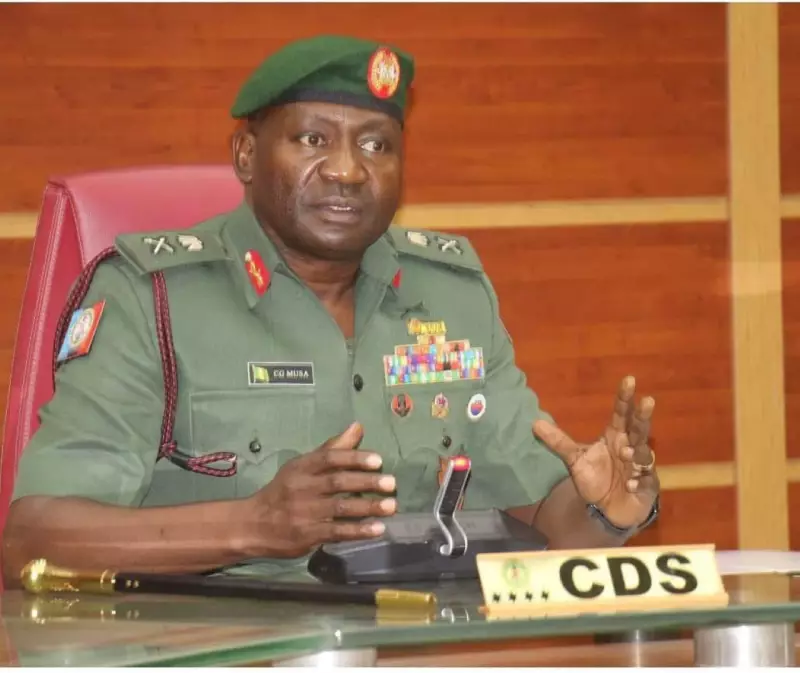
President Bola Tinubu has formally requested the Senate to confirm the appointment of General Christopher Gwabin Musa as Nigeria's new Minister of Defence. This nomination comes directly after the resignation of the former minister, Alhaji Mohammed Badaru Abubakar, on Monday.
A Seasoned Commander for a Critical Role
In a letter addressed to the Senate President, Godswill Akpabio, President Tinubu described General Musa as a seasoned and battle-tested commander. The President expressed confidence that Musa's leadership will significantly reinforce the nation's defence capabilities. This appointment is seen as a strategic move at a time when Nigeria is confronting severe security challenges across multiple regions.
General Christopher Musa, who will be 58 years old on December 25, is a highly decorated officer with an extensive career. He most recently served as the Chief of Defence Staff (CDS) from 2023 until October 2025. His military honours include the prestigious Colin Powell Award for Soldiering, which he received in 2012.
From Sokoto to the Highest Ranks
Born in Sokoto State in 1967, General Musa completed his early education there before proceeding to the College of Advanced Studies in Zaria. His formal military journey began in 1986 when he joined the Nigerian Defence Academy (NDA). He graduated in 1991 with a Bachelor of Science degree and was commissioned as a Second Lieutenant that same year.
His career is marked by a series of crucial operational and staff appointments, including:
- Commanding Officer of the 73 Battalion.
- Theatre Commander of the critical Operation Hadin Kai in 2021.
- Commander of Sector 3 under both Operation Lafiya Dole and the Multinational Joint Task Force (MNJTF) in the Lake Chad Basin.
His elevation to Chief of Defence Staff in 2023 by President Tinubu was the pinnacle of a career dedicated to frontline service.
Closed-Door Consultations Amid Rising Violence
The nomination was preceded by a closed-door meeting between President Tinubu and General Musa at the State House in Abuja on Monday. This engagement is viewed as part of the President's broader consultations with key security figures, both serving and retired, as he evaluates new strategies to counter terrorism and kidnapping.
This discreet meeting occurred against a backdrop of alarming security incidents that have heightened national anxiety:
- The abduction of schoolgirls in Kebbi State.
- An attack on worshippers in Eruku, Kwara State.
- The kidnapping of Catholic schoolchildren in Minna, Niger State.
Security analysts note that these events highlight the evolving and overlapping nature of threats, which now range from banditry and kidnapping-for-ransom to terror-linked assaults on communities.
Public Expectation for Decisive Action
The Tinubu administration has recently pushed for tighter coordination among the armed forces, police, and intelligence agencies to dismantle criminal networks. With public confidence shaken by the relentless wave of violence, there is immense pressure on the government to swiftly unveil and implement stronger measures to protect vulnerable populations and stem the tide of abductions.
The nomination of General Musa, a respected operational leader, is widely interpreted as a direct response to this crisis. All eyes are now on the Senate for a swift confirmation process, as the nation awaits a more robust and effective security framework.