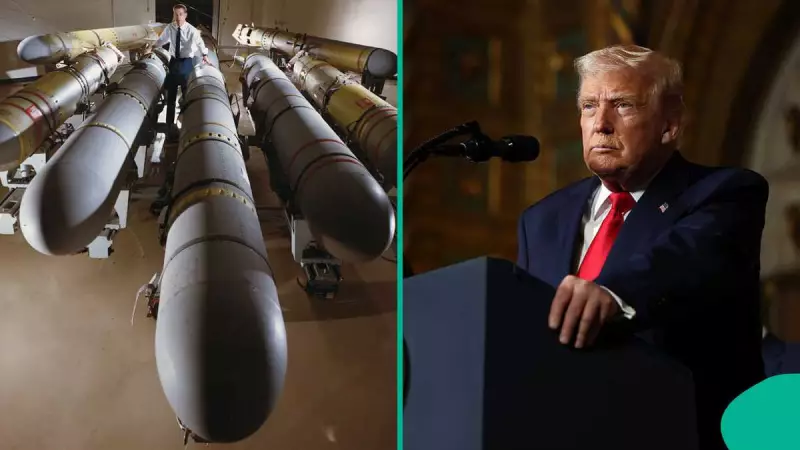
Recent reports confirming the use of Tomahawk cruise missiles in United States air strikes within Nigeria's Sokoto State have shifted significant attention to this advanced weapon system. The deployment underscores a notable moment in Nigeria's security landscape, highlighting the application of long-range, precision American military technology on Nigerian soil.
Anatomy of a Tomahawk: Precision and Power
The Tomahawk is an American-made, long-range, subsonic cruise missile designed for strategic strikes. It is renowned for its ability to fly at very low altitudes, often between 30 to 90 metres, which helps it evade enemy radar detection. This capability makes it ideal for hitting high-value, fixed targets like command centres and air defence sites in environments deemed too risky for manned aircraft.
In terms of specifications, the missile is formidable. It measures 5.6 metres (18.4 feet) in length and can travel at speeds up to 885 km/h (550 mph). Its operational range extends to approximately 2,400 km (1,500 miles), allowing it to be launched from distant naval platforms. Perhaps most critically, its reported accuracy is within about 5 metres (16 feet) of its intended target.
Launch Platforms and Guidance Systems
The versatility of the Tomahawk is evident in its launch methods. It can be fired vertically from surface ships or launched horizontally from the torpedo tubes of attack submarines. Upon launch, a solid-fuel booster propels it before a small, fuel-efficient turbofan engine takes over, producing minimal heat signature and further aiding its stealth.
Once over land, the missile's guidance system takes command. It uses a combination of inertial navigation and a sophisticated Terrain Contour Matching (TERCOM) radar. This system compares the ground below with a digital map stored in its computer, enabling it to navigate precisely by following the contours of the landscape, much like a pilot following a terrain map.
A Proven Combat History and Modern Upgrades
The Tomahawk is not a new weapon; it has a storied combat history dating back to its first use in Operation Desert Storm in January 1991. During that conflict, it was used to destroy hardened targets in Iraq, including presidential palaces and power plants. Since then, it has been a weapon of choice in numerous operations, including in Bosnia, Libya, Sudan, Yemen, Syria, and Afghanistan.
Modern variants like the Block IV and Block V have significantly enhanced its capabilities. The Block IV, introduced in 2004, added the ability to be reprogrammed in flight via satellite, loiter over a target area, and strike any of 15 pre-programmed alternate targets. It can also send back images for battle damage assessment. The latest Block V variants feature improved navigation, communications, and specialised warheads for striking moving maritime targets.
Military analysts note that the Tomahawk's precision, long reach, and ability to operate in denied airspace make it a flexible and responsive tool for commanders. Its deployment in Sokoto is a testament to its enduring role as a strategic asset for high-risk strikes. Reports following the December 25 strikes indicate that the action has prompted suspected terrorist elements in northern Nigeria to begin relocating, demonstrating the immediate operational impact of such capabilities.